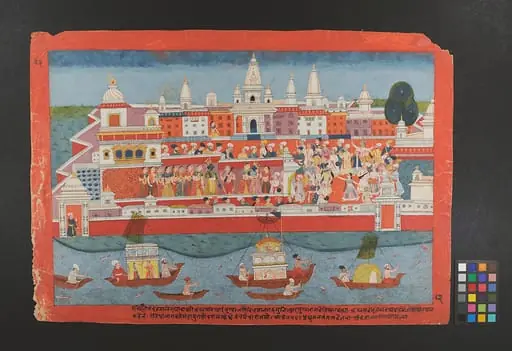
Artwork
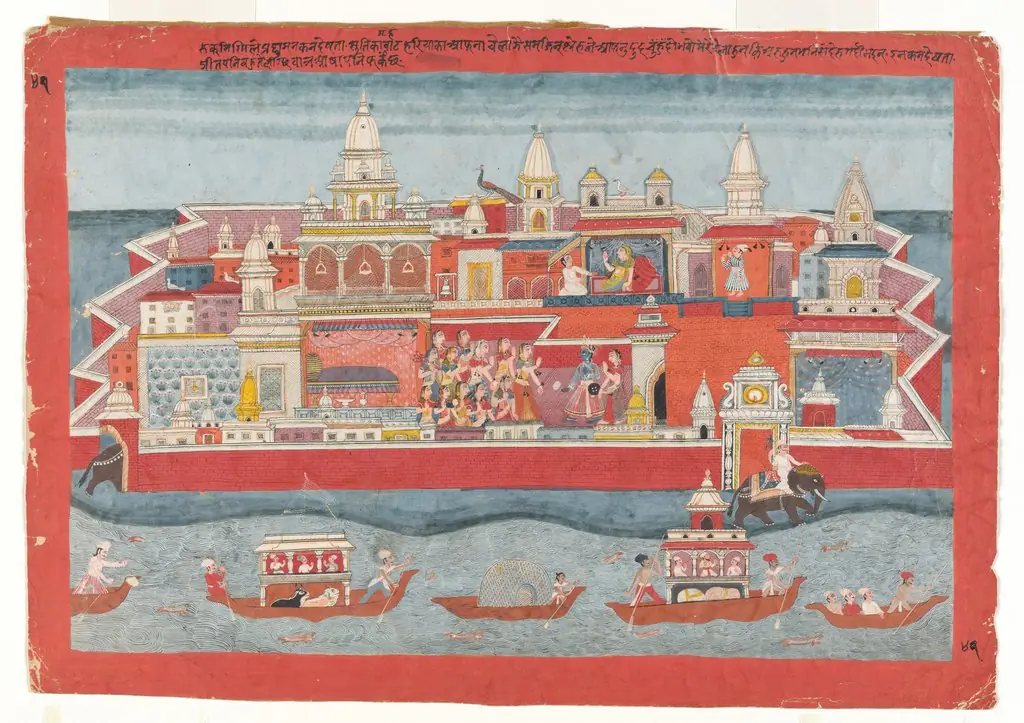
Rukmini Seeks Krishna's Permission to Visit her Brother Rukma, page from a manuscript of the Bhagavata Purana
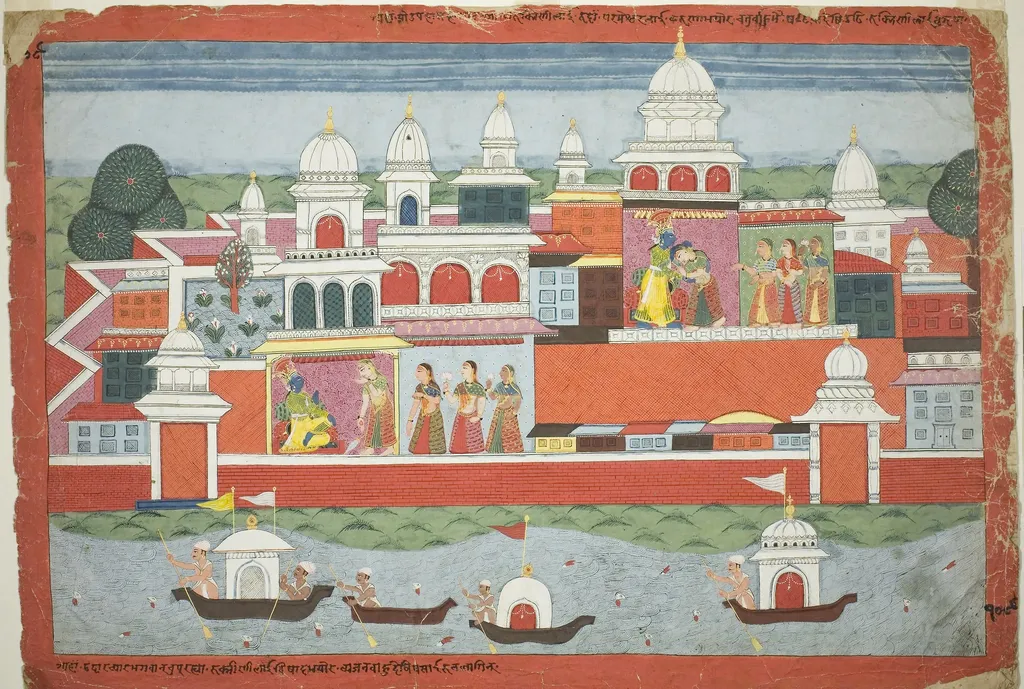
Rukmini Seeks Krishna's Permission to Visit her Brother Rukma, page from a manuscript of the Bhagavata Purana is an unspecified painting by the Mughal Painting artist Unknown. It dates from 1775 and is held in the collection of the Art Institute of Chicago. This painted folio originates from a manuscript of the Bhagavata Purana, a sacred Hindu text.
About this work
Overview
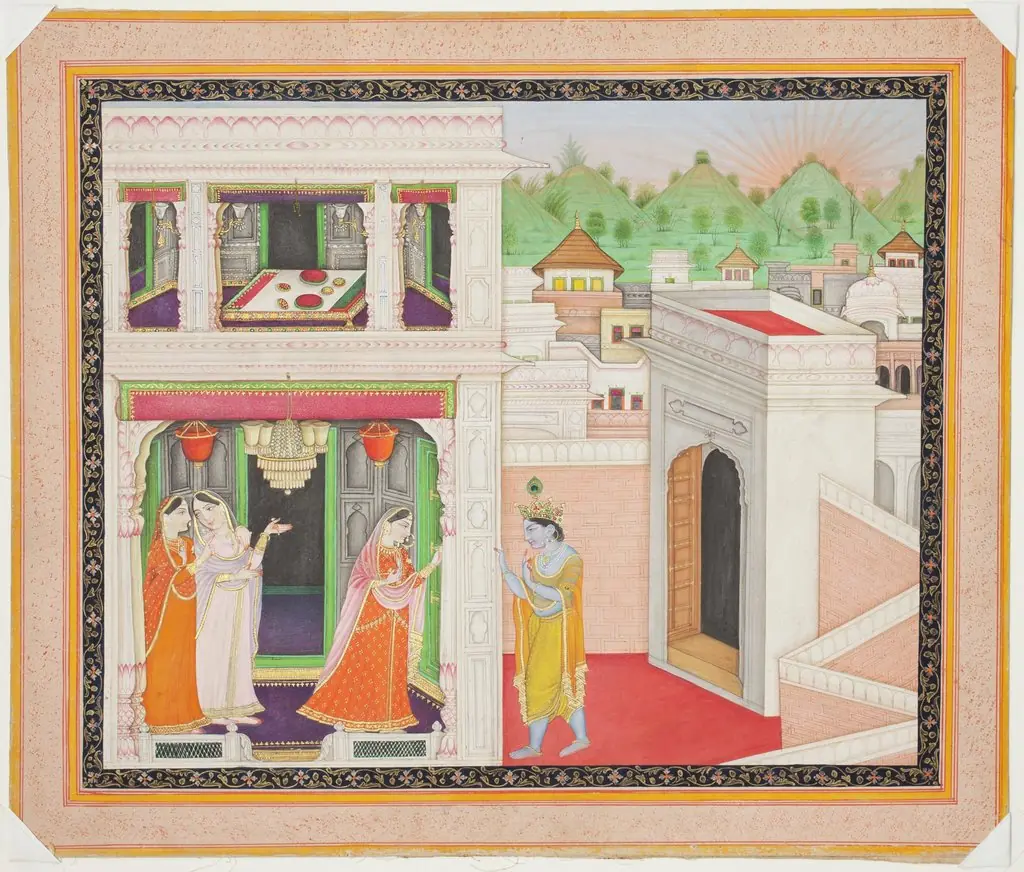
Created in the Rajasthani style, it illustrates a moment from Krishna’s life: Rukmini, his wife, seeks permission to visit her brother Rukma.
This painted folio originates from a manuscript of the Bhagavata Purana, a sacred Hindu text. Created in the Rajasthani style, it illustrates a moment from Krishna’s life: Rukmini, his wife, seeks permission to visit her brother Rukma. The scene unfolds within a vividly colored palace complex, rendered with flat, saturated hues and minimal modeling, typical of regional Indian manuscript painting traditions.
Subject & Meaning
Rukmini, depicted in yellow on a balcony, is shown in quiet anticipation as she requests leave to see her brother. Her posture and placement suggest deference and emotional restraint, contrasting with the animated figures around her. The scene reflects themes of familial duty and devotion, underscoring Rukmini’s role as both a royal princess and a devoted consort of Krishna, whose presence is implied but not visually shown.
Technique & Style
The painting employs a flat, decorative approach with bold, unmodulated colors—reds, whites, and yellows dominate. Architecture is stylized, with white domes and red walls forming a rhythmic backdrop. Figures are arranged in horizontal bands, lacking perspective or shadow, emphasizing narrative clarity over spatial realism. Calligraphic inscriptions at top and bottom frame the image, linking visual and textual elements of the manuscript.
History & Provenance
This folio likely dates to the late 16th or early 17th century, produced in a royal atelier in Rajasthan, possibly Mewar or Bundi. Such manuscripts were commissioned by Hindu rulers to honor Krishna’s legends. The work was part of a larger codex, now dispersed, with individual pages held in private and institutional collections across Europe and India.
Context
Illustrated Bhagavata Purana manuscripts flourished under Rajput patronage as devotional objects. Scenes from Krishna’s life were popular for their emotional and moral resonance. This image reflects a broader tradition where royal patrons aligned themselves with divine narratives, using art to affirm spiritual authority and cultural identity within a courtly setting.
Legacy
The folio exemplifies the enduring visual language of Indian miniature painting, where narrative precision and symbolic color outweigh naturalism. Its preservation in museum collections highlights its role in transmitting religious stories across centuries. Scholars continue to study such works to understand regional artistic practices and the interplay of text and image in pre-modern South Asian devotion.
Artist & collection

 Domestic Scene
 Giacomo and Cardinal Marco, investing Andrea, Abbot of San Zeno, with his Benefice
 The Nymph of Fontainebleau
 Portrait of a Woman
 Madonna and Child with Saints in the Enclosed Garden
 Venus and Minerva
 Family Group of Four on Sofa
 Wall painting from Room H of the Villa of P. Fannius Synistor at Boscoreale