Artwork
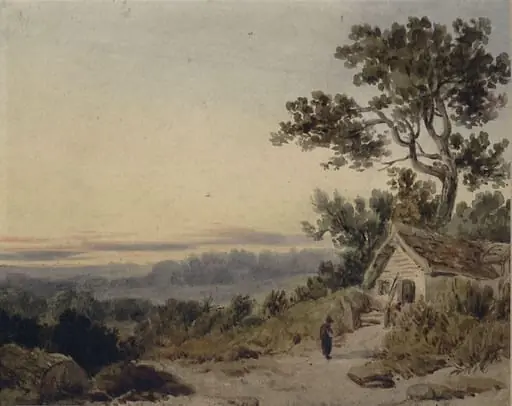
Mill at Mapledurham (?) on the Thames
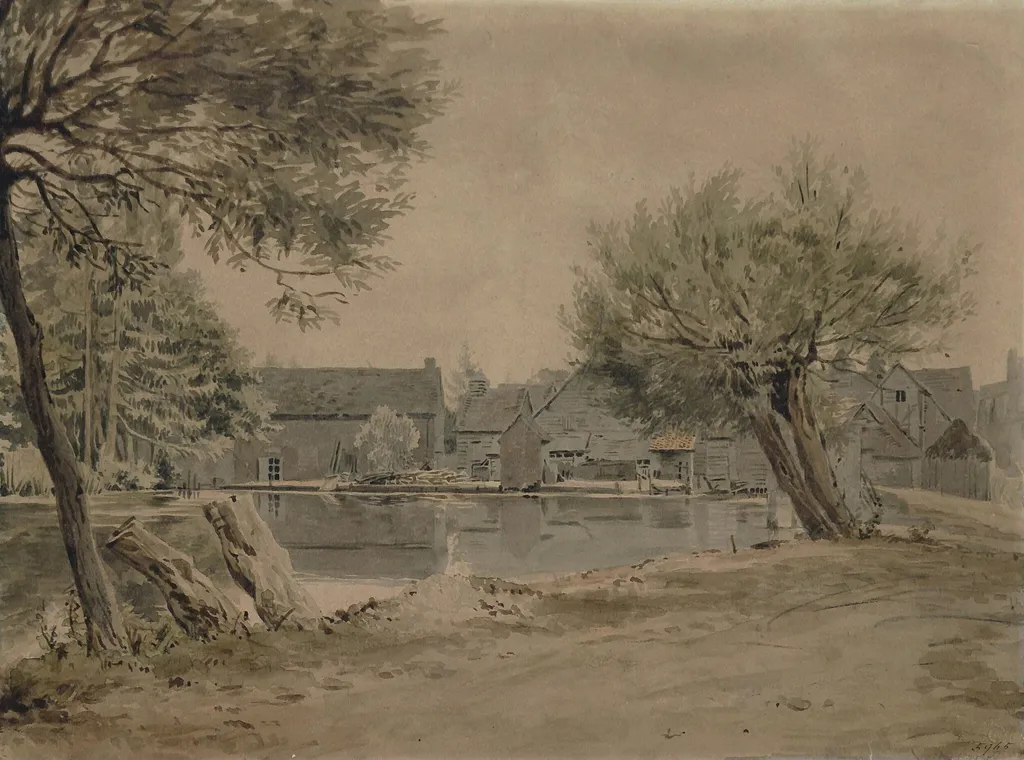
Mill at Mapledurham (?) on the Thames is a watercolor work on paper by the Romanticist artist Hunt. It dates from 1810 and is held in the collection of the Victoria and Albert Museum.
About this work
Overview
This watercolor, dated around 1810, depicts a modest riverside mill near Mapledurham on the Thames, attributed to William Hunt. Executed in delicate washes, the work captures a tranquil, unassuming stretch of the river. It resides in the Victoria and Albert Museum’s collection, where it is valued for its quiet observation of rural England during the early 19th century.
Subject & Meaning
The scene centers on a weathered wooden mill and a narrow bridge, both nestled along the riverbank. Surrounding trees arch over the water, their reflections softening the boundary between land and river. There is no human activity visible; the focus lies in stillness and decay, suggesting a meditation on time, labor, and the quiet persistence of rural structures against nature’s rhythm.
Technique & Style
Hunt employed loose, fluid brushwork and translucent watercolor layers to suggest atmosphere rather than define form. Colors are subdued—soft grays, pale greens, and muted browns—evoking a hazy, overcast day. Light is implied through subtle tonal shifts, not sharp contrasts, reinforcing the scene’s calm, introspective mood.
History & Provenance
The painting entered the Victoria and Albert Museum’s collection as part of its broader effort to document British watercolor traditions. Its attribution to Hunt is based on stylistic comparison with his known works, though the exact provenance before museum acquisition remains undocumented. The uncertain location label—Mapledurham (?)—reflects ongoing scholarly discussion about its precise site.
Context
Created during the rise of Romanticism, the work aligns with a broader interest in unidealized natural landscapes. Unlike grand Romantic vistas, Hunt’s scene embraces ordinariness, reflecting a growing appreciation for modest, everyday environments. This quiet realism contrasts with the dramatic sublime favored by contemporaries, offering instead a contemplative view of rural life.
Legacy
Though not widely exhibited, the painting contributes to the understanding of early 19th-century British watercolor practice. It exemplifies how artists used the medium’s intimacy to record unremarkable places with sensitivity. Its preservation underscores the museum’s role in safeguarding works that document the aesthetic shift toward quiet observation over heroic narrative.
Own this work as a print
Artist & collection
Artist
English watercolor painter working in the early 1800s, Hunt captured riverside life along the Thames in delicate sheets of color.

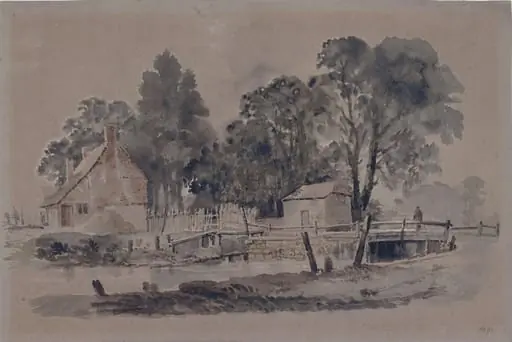 Stream with bridge and cottages
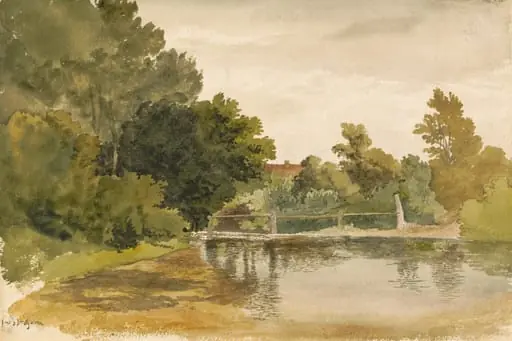 Reflections in a Wooded Pool
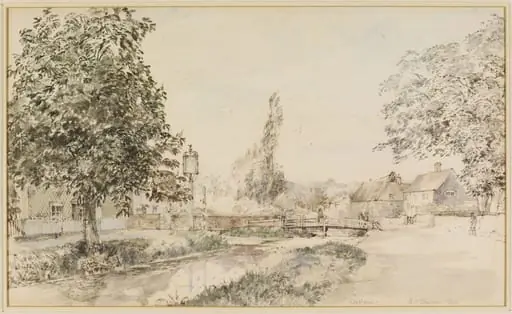 Dalham (the footbridge)
 River with Barges
 Landscape with pond and trees
 Mill with Bridge and Figures
 Capricho (Olivos 13 Nov. 1858)
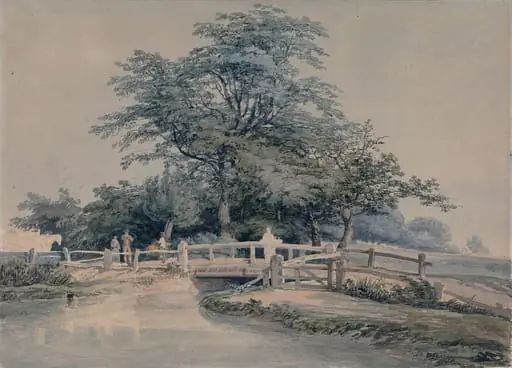 Landscape with trees, figures, bridge and stream
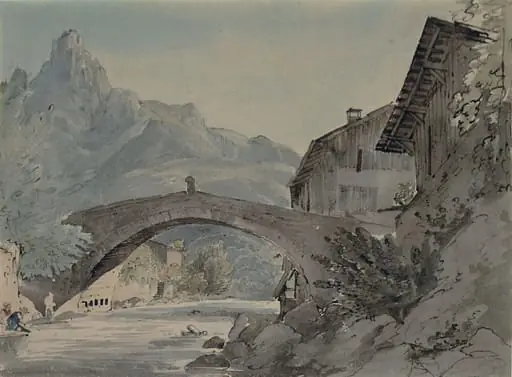 Bridge at Sallanches, and the Aiguille de Varens
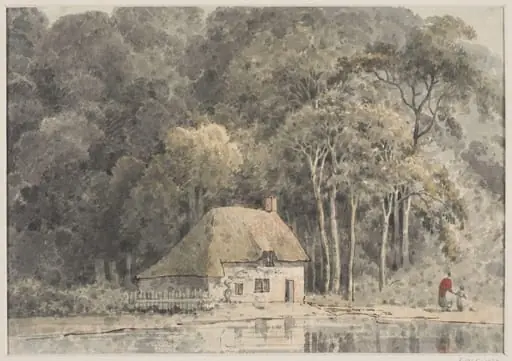 Cottage by a Lakeside, Somerset
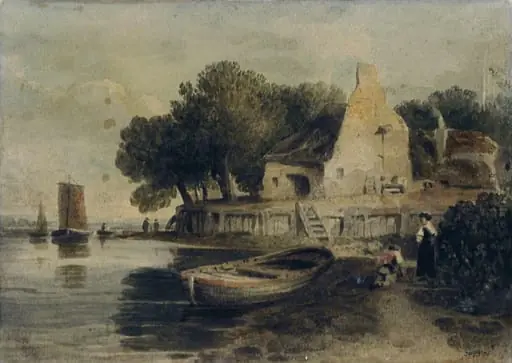 On the Thames at Millbank
 Landscape with cottage