Artwork
Floare
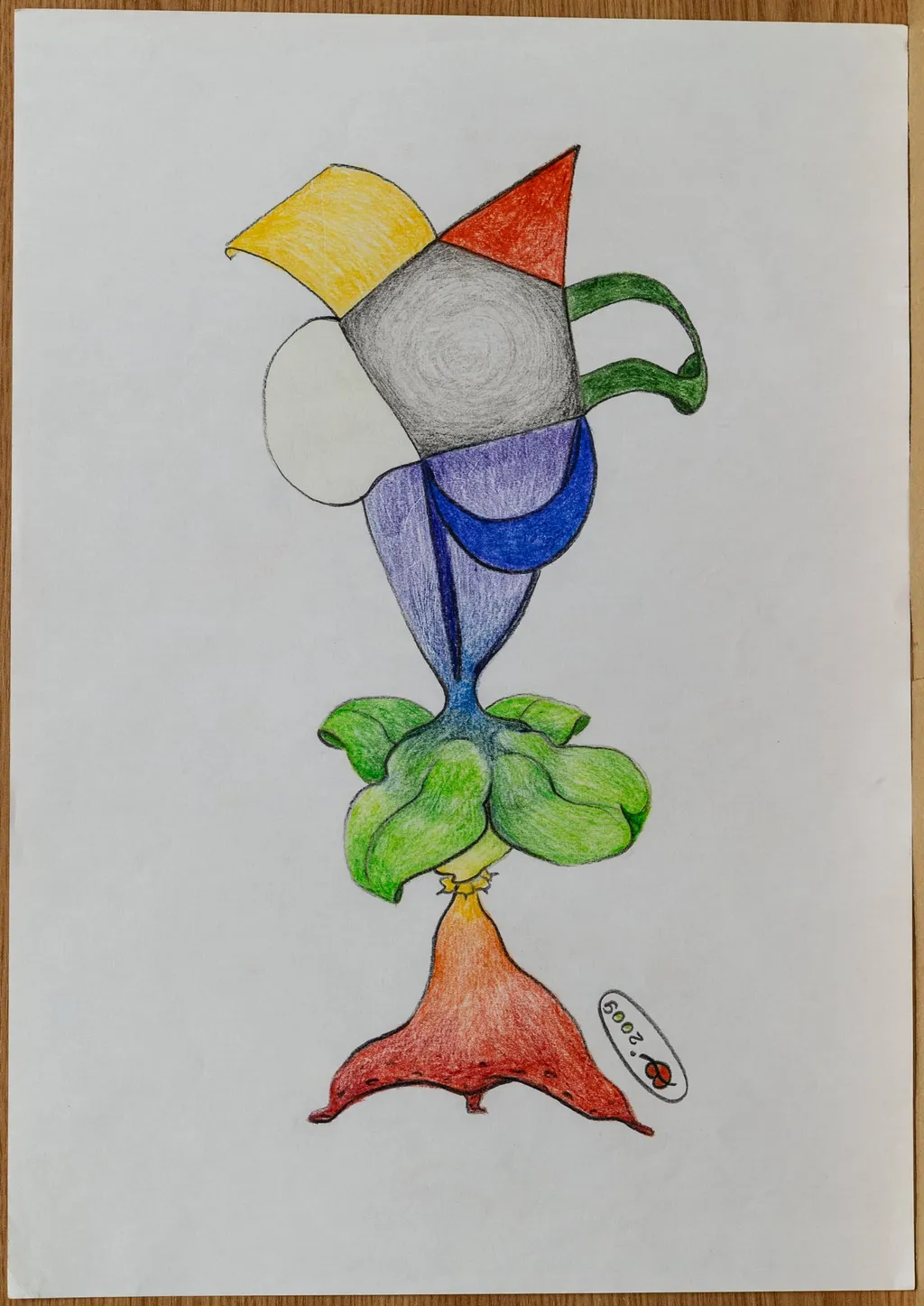
Floare is a print by Daniela Iacoblev-Barău. It is held in the collection of the Gavrila Simion Eco-Museum Research Institute Tulcea. This drawing depicts a stylized flower with anthropomorphic features, rendered in bold, flat colors and simplified forms.
About this work
Overview
Green arms curve from its sides, while yellow, red, and blue petals extend outward from a red stem ending in a tiny yellow star.
This drawing depicts a stylized flower with anthropomorphic features, rendered in bold, flat colors and simplified forms. The central face, rendered in grayish tones, has large eyes and a small speech bubble reading '600?'. Green arms curve from its sides, while yellow, red, and blue petals extend outward from a red stem ending in a tiny yellow star. The overall aesthetic is whimsical and deliberately non-naturalistic.
Subject & Meaning
The flower functions as a surreal, personified object, blending botanical elements with human expression. The speech bubble introduces ambiguity—possibly referencing a quantity, date, or internal monologue—inviting interpretation without offering clear resolution. Its playful demeanor suggests a commentary on the absurdity of assigning human traits to nature, or a quiet, cryptic observation on value or time.
Technique & Style
The artist employs flat, unmodulated color fields and minimal linework, avoiding shading or texture. Forms are reduced to essential shapes: circles for eyes, curves for arms, straight lines for stems. The palette is intentionally unnatural—vivid petals against a gray face—emphasizing symbolic over representational intent. The style aligns with graphic, cartoon-influenced illustration rather than traditional botanical drawing.
History & Provenance
The work is attributed to Daniela Iacoblev-Barău, an artist known for surreal, childlike imagery in contemporary Romanian illustration. This piece appears to be part of a broader series exploring personified flora and cryptic textual elements. No public record of its exhibition or acquisition exists, suggesting it may originate from private or unpublished work.
Context
Created within the context of late 20th-century Eastern European experimental illustration, the piece reflects a trend toward blending folk motifs with absurdist humor. Its simplicity and enigmatic text echo the influence of underground comics and postmodern graphic design, where ambiguity and visual wit replace narrative clarity. The work resists categorization as purely art or design.
Legacy
Though not widely exhibited, the drawing exemplifies a niche aesthetic in contemporary Romanian visual culture—where the mundane is reimagined with quiet surrealism. It has influenced a small circle of illustrators interested in anthropomorphic nature and textual ambiguity. Its enduring appeal lies in its open-endedness, inviting viewers to project meaning onto its playful, unexplained form.
Artist & collection
Artist
She kept a jar of dried cornflowers on her studio shelf and painted them every winter, even though they turned to powder the moment her brush touched the canvas.
Museum
Gavrila Simion Eco-Museum Research Institute Tulcea
Continue through works from the same source collection.