Artwork
The Beggars: Old Woman and Cats
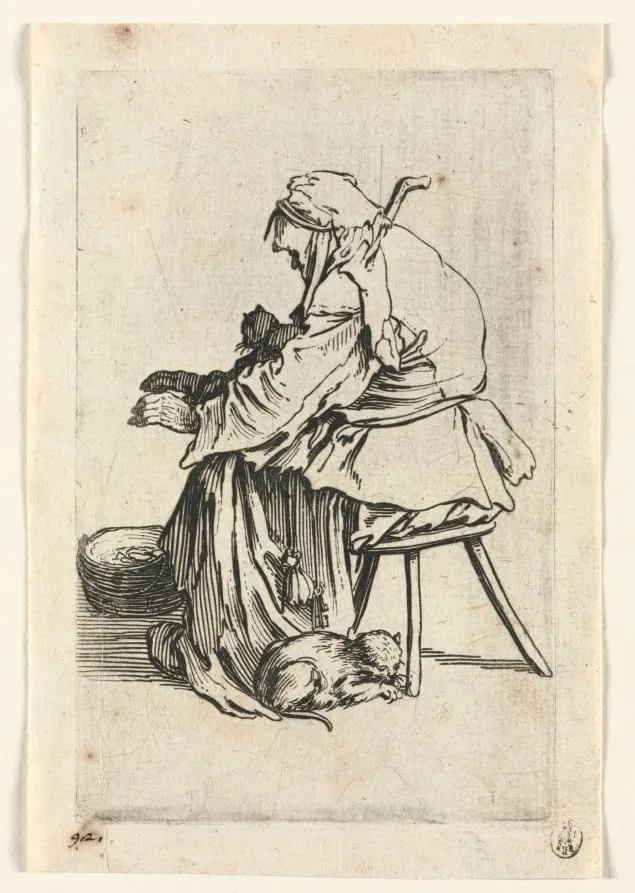
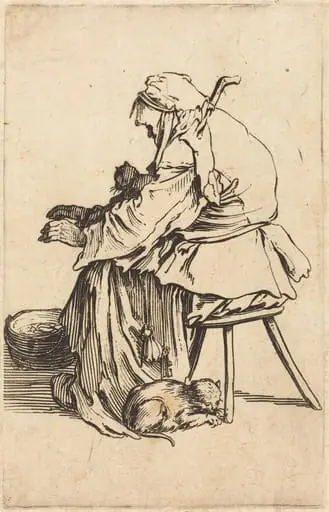
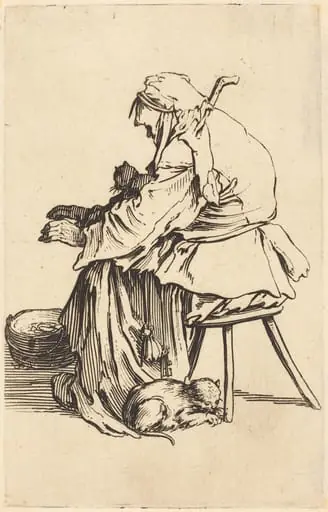
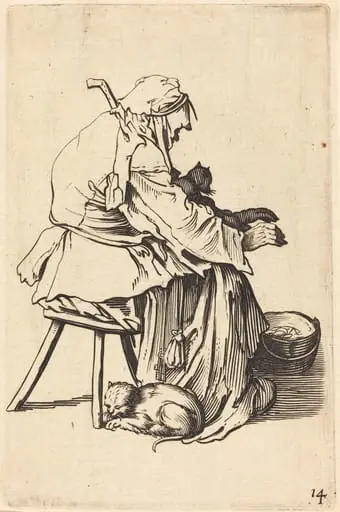
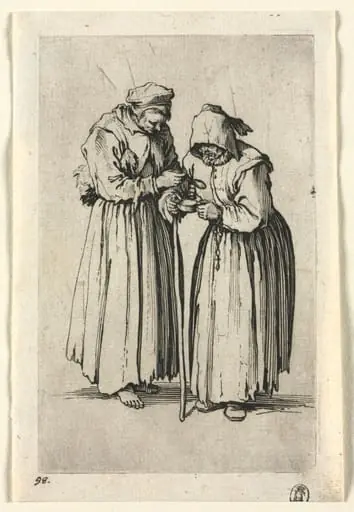
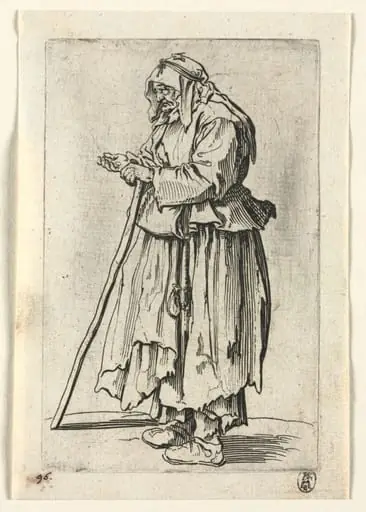
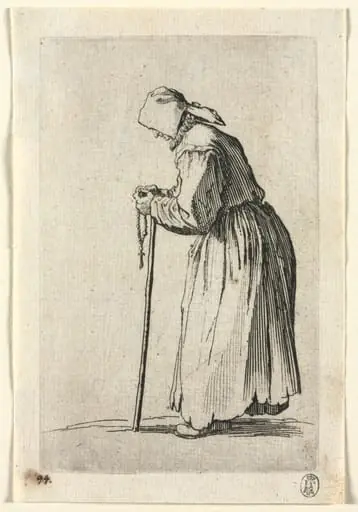
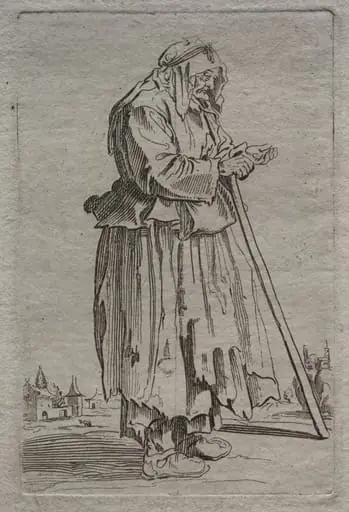
The Beggars: Old Woman and Cats is a print by the Baroque artist Jacques Callot. It dates from 1623 and is held in the collection of the Cleveland Museum of Art.
About this work
Overview
Created around 1623 by Jacques Callot, this print depicts an elderly woman in a state of quiet stillness, surrounded by two cats.
Created around 1623 by Jacques Callot, this print depicts an elderly woman in a state of quiet stillness, surrounded by two cats. Rendered in etching, the work belongs to a series portraying marginalized figures of early 17th-century France. The Cleveland Museum of Art holds the impression, which exemplifies Callot’s interest in social observation through printmaking. The composition is spare, emphasizing posture and atmosphere over ornamentation.
Subject & Meaning
The figure is an anonymous beggar, her identity obscured by a hooded garment and downward-turned head. Her outstretched hands and slung bag suggest dependence on alms, while the cats—one asleep, one watchful—mirror her vulnerability and alertness. The absence of facial detail universalizes her condition, inviting reflection on poverty and endurance rather than individual narrative. The scene avoids sentimentality, presenting dignity in stillness.
Technique & Style
Callot employed fine-line etching to achieve sharp contrasts and subtle tonal gradations. Bold contours define the woman’s form, while minimal shading suggests texture and volume. Chiaroscuro directs focus to her hands and the space around her, enhancing emotional weight without overt drama. The background is left largely empty, isolating the figure and amplifying the sense of solitude. The technique reflects Callot’s mastery of the medium’s capacity for psychological nuance.
History & Provenance
The print was produced during Callot’s mature period in Nancy, following his time in Florence and Paris. It was likely part of a larger series on beggars and street life, circulated among collectors and artists. The Cleveland Museum of Art acquired the work in the 20th century, its provenance tracing back through European collections. No early documentation survives, but its stylistic consistency with Callot’s known prints supports its attribution.
Context
In early 17th-century France, urban poverty was widespread, and images of beggars appeared in both popular prints and moralizing literature. Callot’s series departed from caricature by portraying subjects with restraint and humanity. His work responded to a growing interest in everyday life among Northern European artists, aligning with contemporaries like Rembrandt and the Caravaggisti in their focus on ordinary people under quiet duress.
Legacy
Callot’s beggar series influenced later generations of printmakers who sought to depict social realism without overt judgment. His use of etching to convey emotional depth became a model for artists exploring marginal lives. Though not widely exhibited in his lifetime, the series gained recognition in the 19th century as an early example of empathetic visual anthropology, shaping how poverty was visually represented in art.
Artist & collection

Artist
Jacques Callot was a baroque printmaker and draftsman from the Duchy of Lorraine.

 Holy Family at supper
 Restoration of the Aqueduct at Pisa
 Restoration of the Aqueduct at Pisa
 Square in Paris with Many Figures
 Square in Paris with Many Figures
 Horsemen Attacked by Robbers
 HOW WILL A COVERED PART BE CORRECTED?HOW WIKA A COVERED HEART DEED CORRECTED?
![Christ Walking on the Water [second plate], by Jacques Callot](https://artifactworldgallery.com/img/jacques-callot--christ-walking-on-the-water-second-plate--2069f3bfe4cb2126-w320.webp) Christ Walking on the Water [second plate]
Christ Walking on the Water [second plate]