Artwork
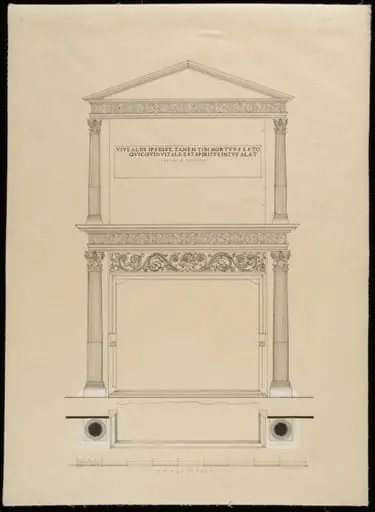
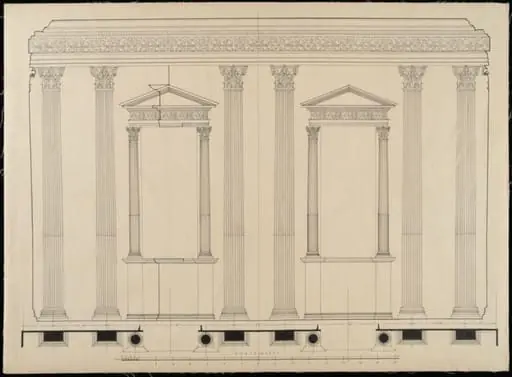
Elevation of wall showing mantelpiece.
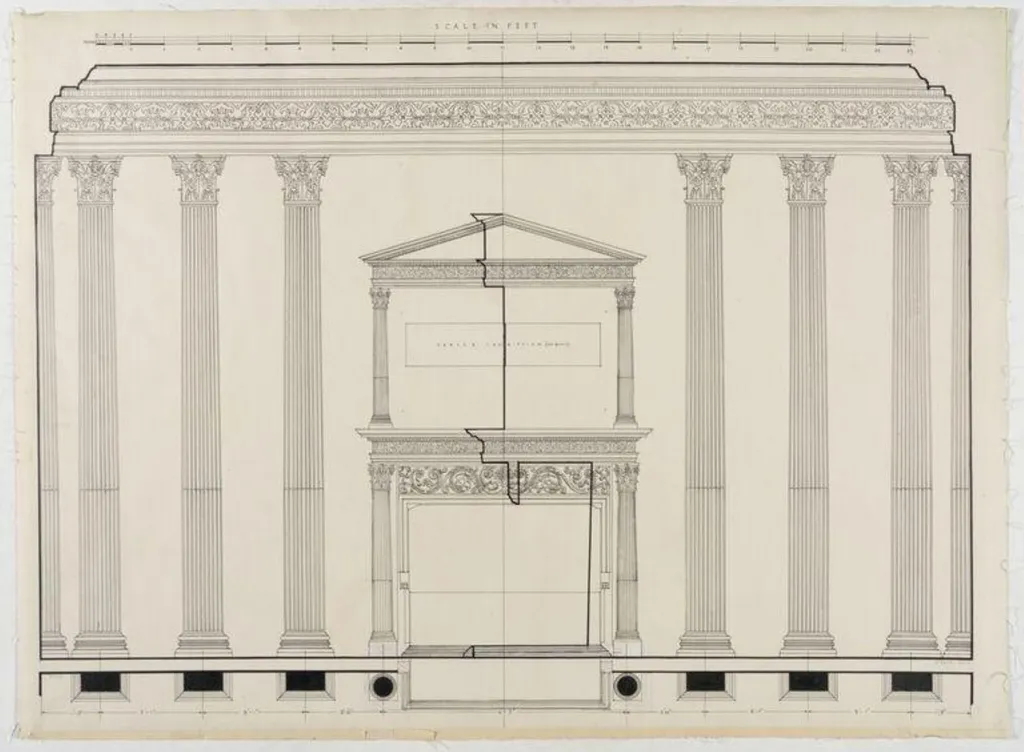
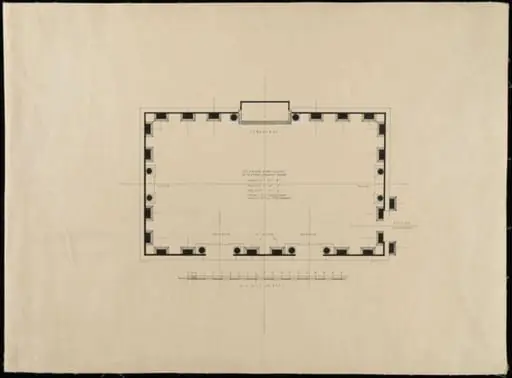
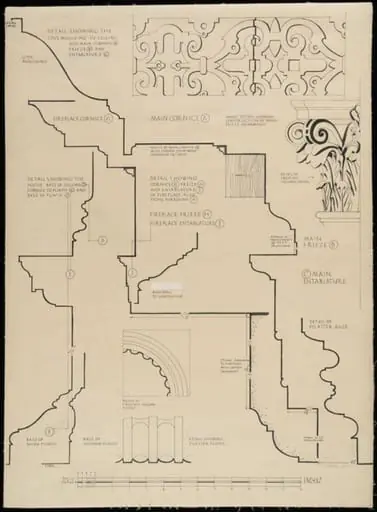
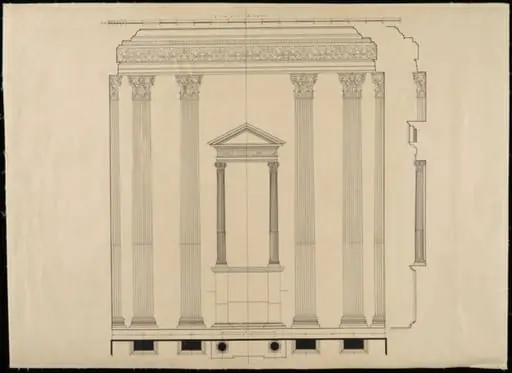
Elevation of wall showing mantelpiece. is a drawing by Joseph Jago. It dates from 1932 and is held in the collection of the Victoria and Albert Museum. This architectural drawing is a scaled elevation of a wall from the Haynes Grange Room, held at the Victoria and Albert Museum.
About this work
Overview
This architectural drawing is a scaled elevation of a wall from the Haynes Grange Room, held at the Victoria and Albert Museum.
This architectural drawing is a scaled elevation of a wall from the Haynes Grange Room, held at the Victoria and Albert Museum. Rendered in landscape orientation, it functions as a technical record rather than a decorative image. Precise linework and a labeled scale indicate its purpose in construction or restoration. The composition focuses on structural elements, with no indication of interior furnishings or ambient detail.
Subject & Meaning
The drawing centers on a fireplace with an ornate mantel, flanked by six evenly spaced columns. Below the hearth, a door is suggested by a simple outline, while small vents are marked along the base. These features reflect 18th-century interior design conventions, where symmetry and carved ornamentation conveyed refinement. The absence of color or texture underscores its role as a functional blueprint, not a finished space.
Technique & Style
Executed in fine, uniform lines, the drawing employs architectural drafting conventions of its time. The use of a measured scale at the top ensures dimensional accuracy, typical of professional workshop practices. Carved leaf motifs on the mantel are rendered with controlled detail, while the columns and vents are simplified to geometric clarity. The style prioritizes legibility and precision over aesthetic expression.
History & Provenance
The drawing originates from the Haynes Grange Room, an interior relocated to the Victoria and Albert Museum in the 19th century. It likely served as a record for the room’s reconstruction or as a reference for similar designs. Its survival suggests it was valued by conservators or architects involved in the museum’s early collection efforts, preserving a snapshot of period craftsmanship.
Context
This drawing belongs to a broader tradition of architectural documentation in Georgian and early Victorian Britain. Such plans were essential for transferring interior designs between sites, especially as historic rooms were dismantled and reassembled in museums. Similar drawings in the V&A’s collection reflect a growing institutional interest in preserving domestic architecture as cultural heritage.
Legacy
The drawing remains a key reference for scholars studying the transmission of interior design in the 18th and 19th centuries. Its clarity and technical rigor make it useful for restoration projects and comparative analysis. While not publicly displayed as a standalone object, it contributes to the museum’s archival understanding of how historical interiors were recorded and reconstructed.
Artist & collection
Artist
Joseph Jago spent years locked in a single house, sketching every inch of it—walls, windows, moldings—like a detective tracing invisible lines.