Artwork
Still Life with Westerwald Jug and Smoking Paraphernalia
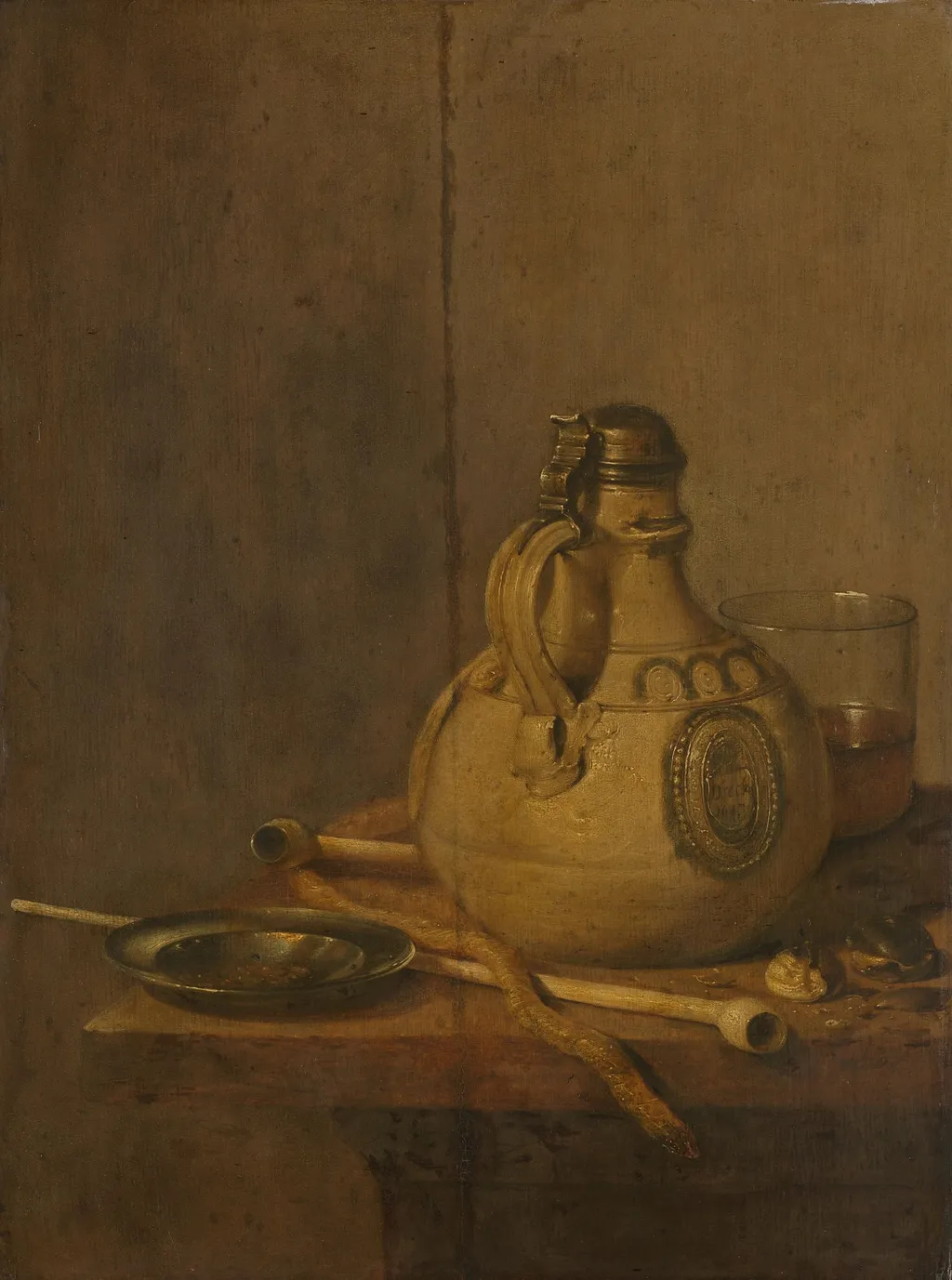
Still Life with Westerwald Jug and Smoking Paraphernalia is an unspecified painting by the Dutch Golden Age artist Jan Treck. It dates from 1647 and is held in the collection of the Rijksmuseum.
About this work
Overview
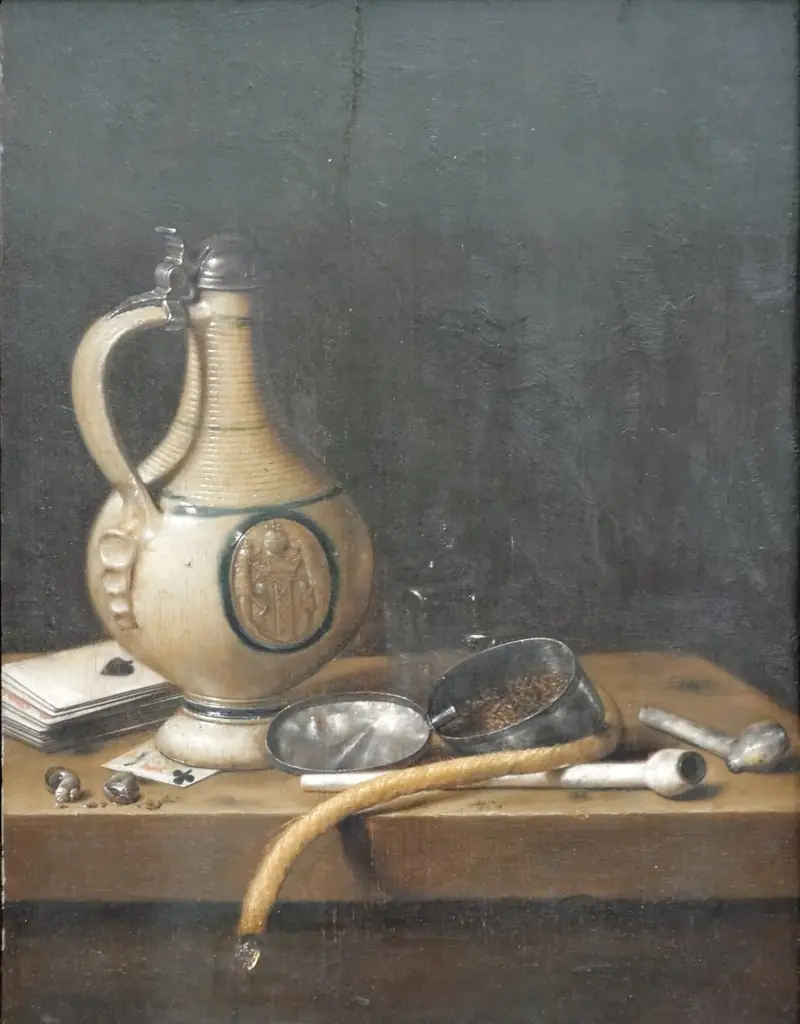
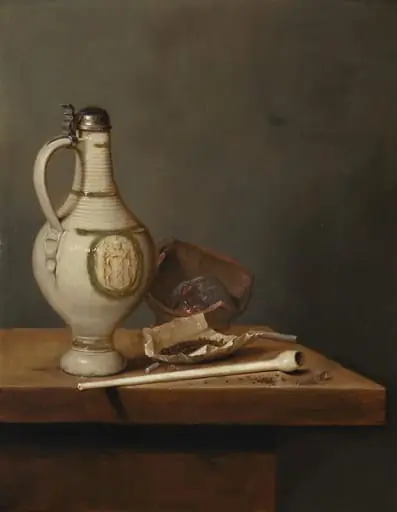
The work, titled *Still Life with Westerwald Jug and Smoking Paraphernalia*, presents a modest arrangement of domestic objects on a darkened surface. A clay jug bearing a blue shield identifies its origin in the Westerwald region of Germany, accompanied by two earthenware pipes, a tin plate, a tightly wound rope coil, a handful of walnuts, and a wine glass half filled with liquid.
Subject & Meaning
The composition foregrounds ordinary, utilitarian items rather than the opulent silverware typical of many Dutch Golden Age still lifes. By assembling a smoking set, a simple jug, and modest foodstuffs, the painter invites contemplation of everyday consumption, the transience of pleasure, and the quiet dignity of commonplace material culture.
Technique & Style
Rendered with careful attention to texture, the artist captures the matte surface of the clay jug, the metallic sheen of the tin plate, and the intricate twist of the rope fibers. Light falls softly across the objects, creating subtle contrasts against the deep, almost black tabletop, while the palette remains restrained, emphasizing tonal harmony over vivid coloration.
History & Provenance
The painting belongs to the tradition of 17th‑century Dutch still‑life painting, though the specific date and original owner remain undocumented. Its provenance traces through private collections before entering a public institution, where it is catalogued alongside comparable works from the period.
Context
During the Dutch Golden Age, still‑life painters often used luxurious items to signal wealth and status. This piece diverges by focusing on modest, everyday objects, reflecting a broader cultural interest in moralizing themes and the fleeting nature of material pleasures.
Legacy
The work continues to be referenced in studies of genre variation within Dutch still life, illustrating how artists could subvert conventional expectations by highlighting the aesthetic potential of humble, functional objects.
Own this work as a print
Artist & collection
Artist
Jan Jansz. Treck (1606, Amsterdam, 25 September 1652 ) was a still-life painter during the Dutch Golden Age. Treck used economy in the number of his objects.