Artwork
Still life with Implements of War
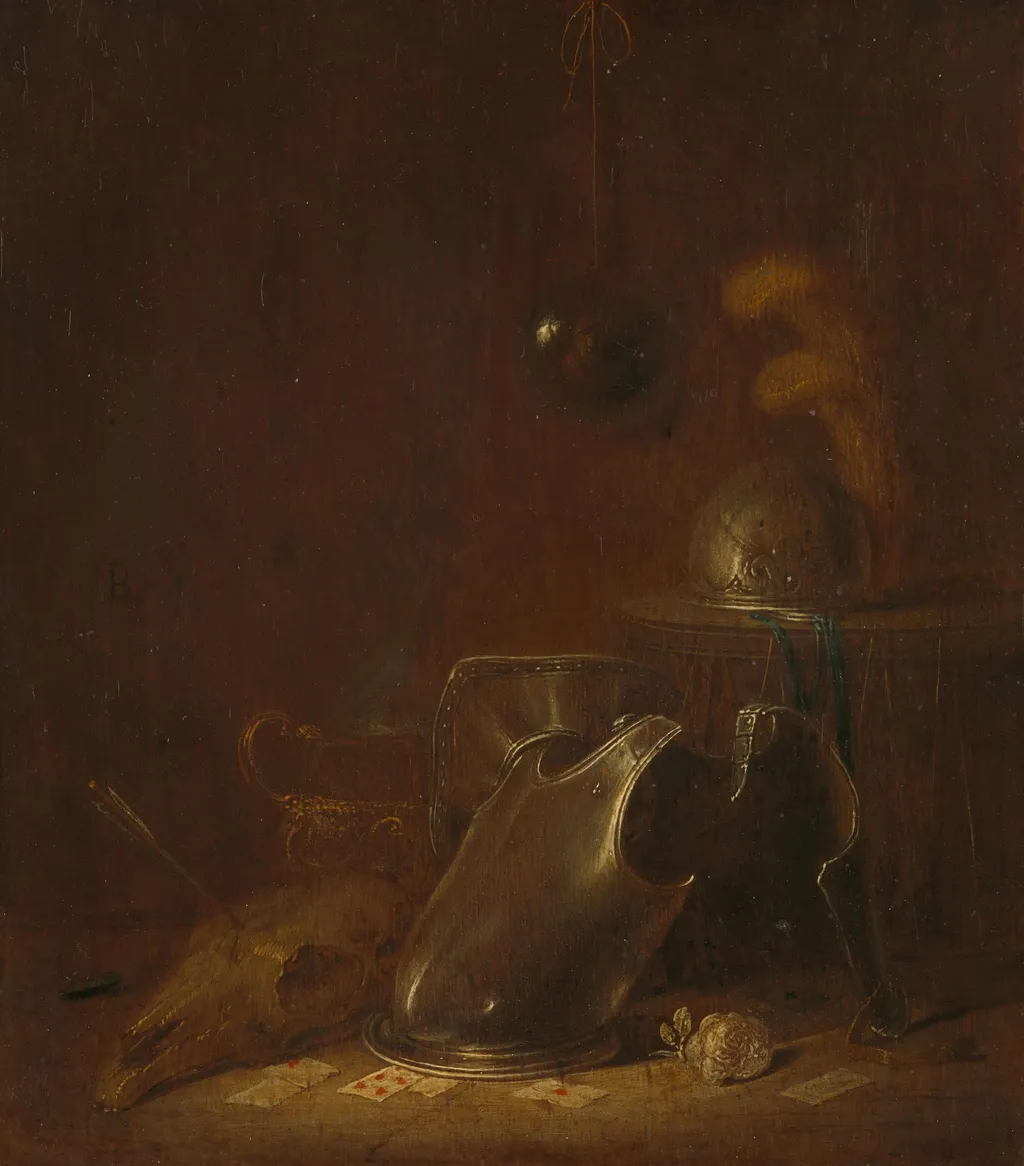
Still life with Implements of War is an unspecified painting by the Dutch Golden Age artist Unknown. It dates from 1635 and is held in the collection of the Rijksmuseum.
About this work
Overview
This painting arranges military equipment alongside fragile, transient objects: a suit of armor, a skull pierced by an arrow, a rose, and playing cards. A feathered helmet rests on a table, while a mirror on the wall reflects a man’s face. The composition unites symbols of conflict and mortality with elements of leisure and beauty, creating a quiet but layered meditation on impermanence.
Subject & Meaning
The armored pieces and skull suggest the violence of war, while the arrow embedded in the skull implies sudden death. The rose, blooming yet fleeting, and the playing cards, associated with chance and transience, reinforce themes of ephemerality. The reflected face in the mirror introduces an observer, subtly implicating the viewer in the scene’s contemplation of mortality.
Technique & Style
Objects are rendered with precise, muted detail, emphasizing texture—rust on metal, the grain of bone, the softness of petals. Light falls evenly, avoiding dramatic contrast, which enhances the stillness. The mirror’s reflection is rendered with subtle clarity, anchoring the scene in a real space while deepening its psychological resonance.
History & Provenance
The work originates from the Dutch Golden Age, likely painted in the early 17th century. It belongs to a tradition of vanitas still lifes that emerged in the Netherlands, reflecting contemporary philosophical and religious preoccupations with life’s brevity. Its early provenance is unrecorded, but it entered a major Dutch collection by the late 1800s.
Context
During this period, Dutch artists frequently combined objects of daily life with moral symbols, responding to both Calvinist ideals and the uncertainties of war. The presence of armor may reference the ongoing Eighty Years’ War, while the mirror’s reflection aligns with broader artistic interests in perception and self-awareness.
Legacy
The painting contributes to a broader visual language of mortality in Northern European art. Its restrained composition and symbolic economy influenced later still lifes that avoided overt sentimentality. It remains a quiet example of how ordinary objects could carry profound existential weight in 17th-century Dutch painting.
Artist & collection

 Domestic Scene
 Giacomo and Cardinal Marco, investing Andrea, Abbot of San Zeno, with his Benefice
 The Nymph of Fontainebleau
 Portrait of a Woman
 Madonna and Child with Saints in the Enclosed Garden
 Venus and Minerva
 Family Group of Four on Sofa
 Wall painting from Room H of the Villa of P. Fannius Synistor at Boscoreale