Artwork
Madame Désiré Raoul-Rochette
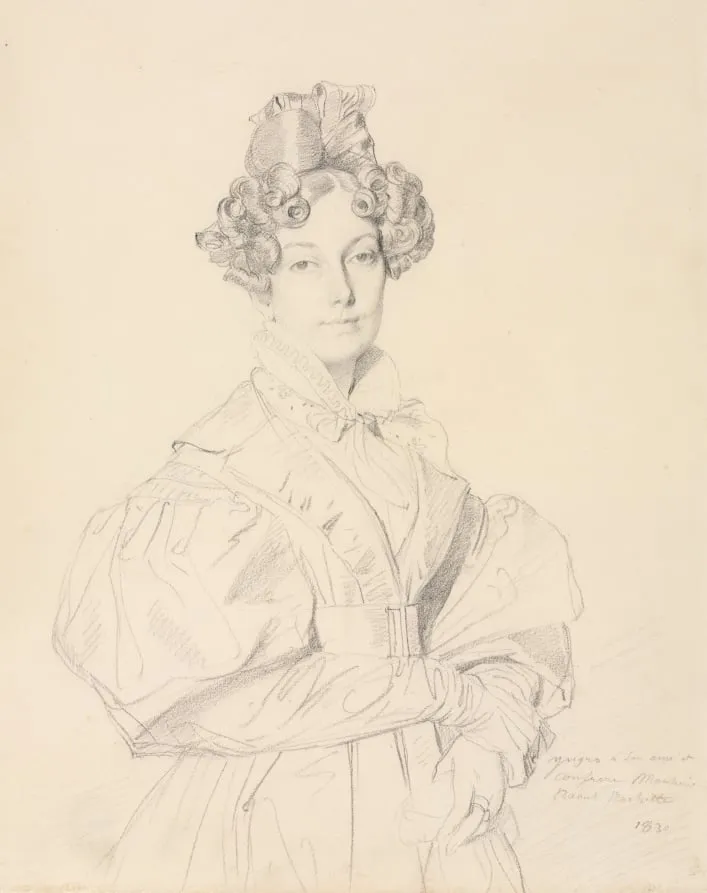
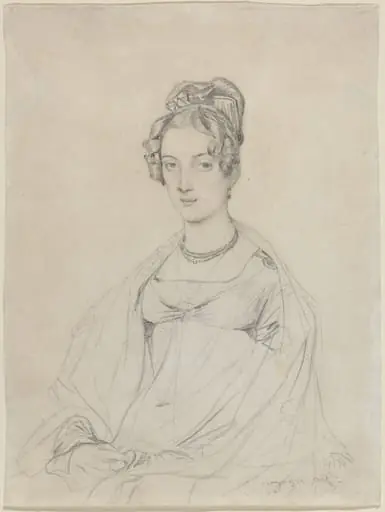
Madame Désiré Raoul-Rochette is a drawing by the Romanticist artist Jean Auguste Dominique Ingres. It dates from 1830 and is held in the collection of the Cleveland Museum of Art. Jean-Auguste-Dominique Ingres created this graphite portrait during his time in Rome as a personal gift, not a commercial commission.
About this work
Overview
Jean-Auguste-Dominique Ingres created this graphite portrait during his time in Rome as a personal gift, not a commercial commission.
Jean-Auguste-Dominique Ingres created this graphite portrait during his time in Rome as a personal gift, not a commercial commission. Though he aspired to be known for historical painting, he occasionally produced intimate portraits for friends and associates. This drawing was given to the husband of the sitter, Antoinette-Claude Houdon, and bears Ingres’s dedication at the lower right, signaling its private, thoughtful nature.
Subject & Meaning
The sitter, Antoinette-Claude Houdon, was the daughter of the renowned French sculptor Jean-Antoine Houdon. Her quiet, composed posture—turned slightly, hands folded—reflects a restrained elegance. The portrait was not intended for public display but as a gesture of respect toward her husband, a distinguished archaeologist. Ingres’s choice to depict her in stillness emphasizes personal connection over grandeur, aligning with the intellectual circles he moved within.
Technique & Style
Ingres rendered the portrait with precise, uncorrected graphite lines, demonstrating his mastery of contour and form. The absence of shading or smudging creates a clarity that defines the figure’s silhouette and the subtle folds of her dress. Light is suggested through delicate tonal variations, particularly along the collar and neckline, revealing his attention to quiet, observable details rather than dramatic contrast.
History & Provenance
The drawing was made during Ingres’s years in Rome, a period when he supplemented his income with portrait commissions. Though he later considered such works beneath his ambitions, this piece was retained as a gift, not sold. Its survival and eventual institutional acquisition suggest it was valued by the Houdon family and later recognized for its artistic significance within Ingres’s broader oeuvre.
Context
Ingres’s portrait practice in Rome intersected with the city’s vibrant community of artists and scholars. The sitter’s husband, an archaeologist, placed the drawing within a network of intellectual exchange. Such portraits, though modest in scale, served as cultural tokens among elites, reinforcing social ties through art. Ingres’s focus on line over tone aligned with his classical ideals, even in informal works.
Legacy
This drawing exemplifies Ingres’s ability to convey dignity through minimal means. Though overshadowed by his large-scale historical works, such intimate portraits reveal his discipline and sensitivity to form. Its preservation highlights how even private gifts contributed to the understanding of his artistic evolution, offering insight into the personal relationships that shaped his career.
Artist & collection

Artist
Jean-Auguste-Dominique Ingres was a French Neoclassical painter. Ingres was profoundly influenced by past artistic traditions and aspired to become the guardian of academic orthodoxy against the ascendant Romantic…