Artwork
Still Life with Monkey, Fruits, and Flowers
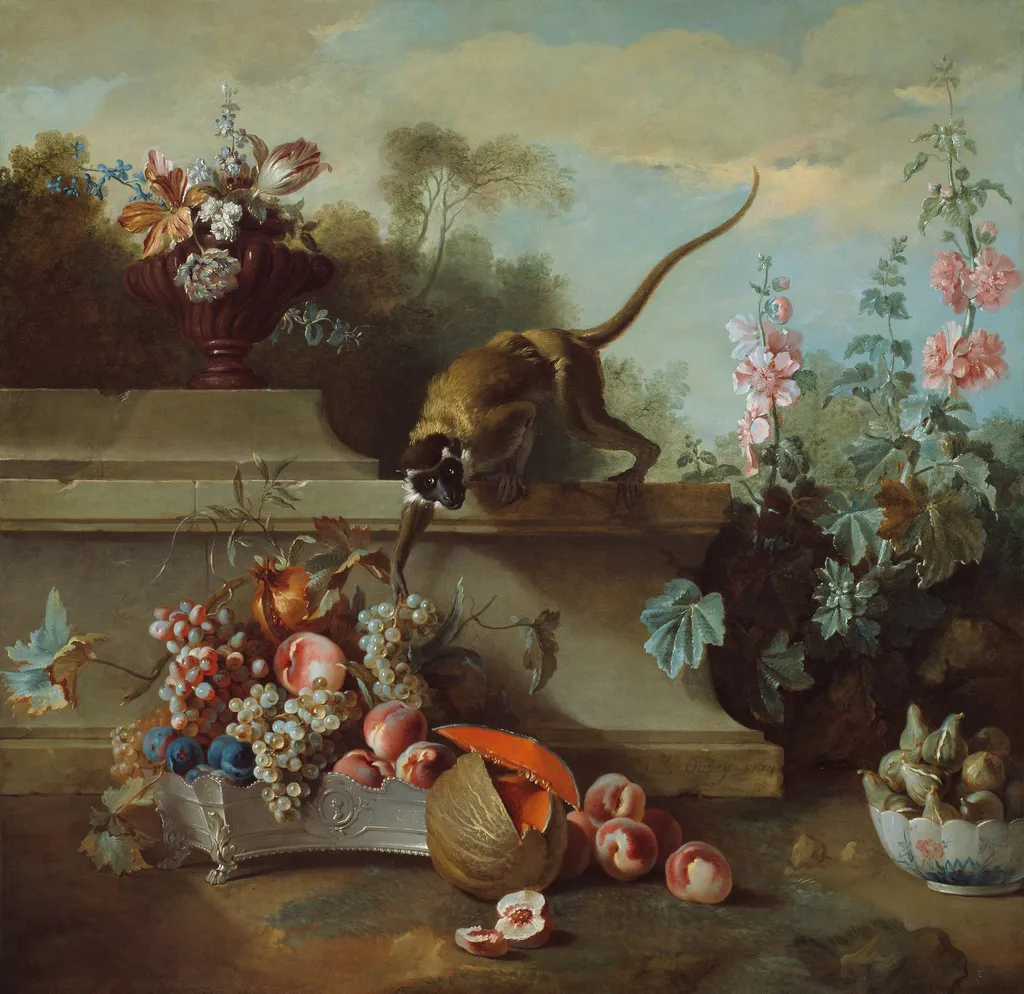
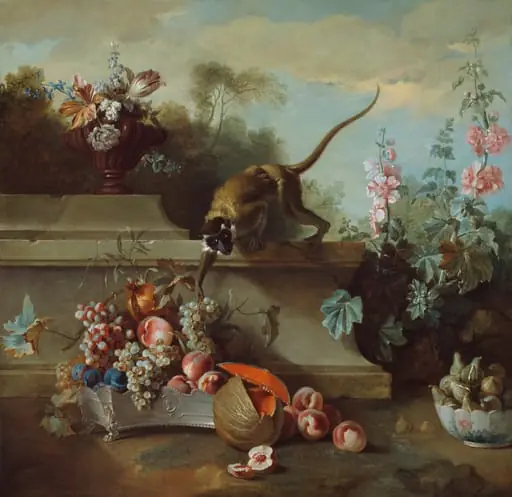
Still Life with Monkey, Fruits, and Flowers is an oil painting by the Rococo painting artist Jean-Baptiste Oudry. It dates from 1724 and is held in the collection of the Art Institute of Chicago.
About this work
Overview
Jean-Baptiste Oudry's 'Still Life with Monkey, Fruits, and Flowers,' executed in 1724, is a quintessential example of French Rococo still life painting.
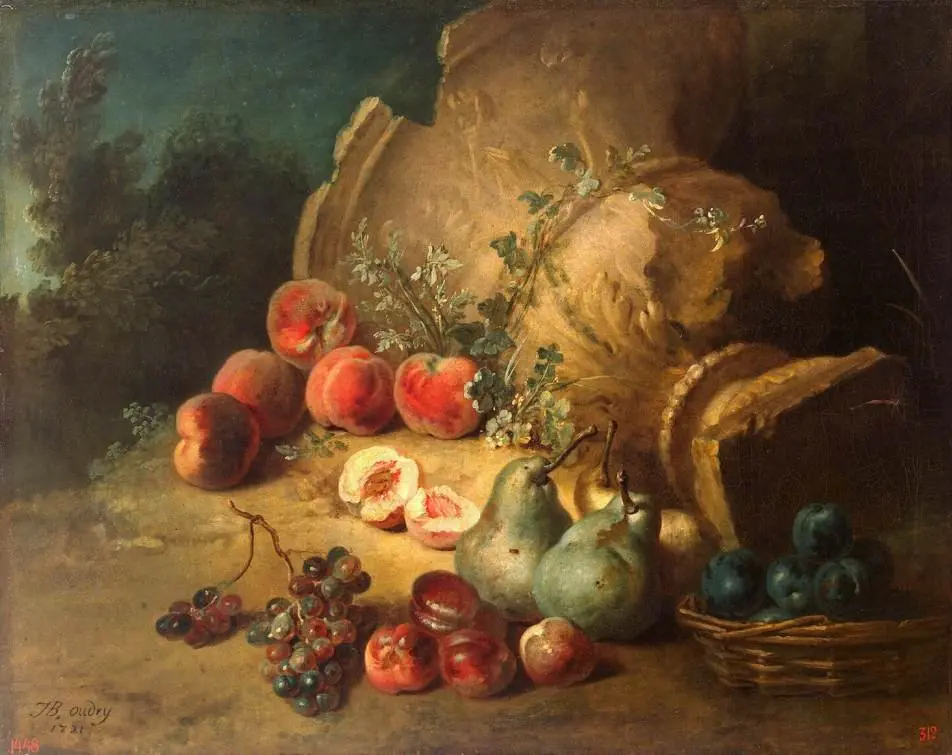
Jean-Baptiste Oudry's 'Still Life with Monkey, Fruits, and Flowers,' executed in 1724, is a quintessential example of French Rococo still life painting. The composition centers on a stone ledge where a monkey sits in profile, its hand extended toward a ceramic bowl overflowing with peaches, grapes, and a halved melon. Scattered fruit pieces on the ledge enhance the sense of naturalistic abundance and transience. Behind the central figure, a vase of flowers rests on the ledge, while a second floral arrangement sits on the ground to the right, creating a balanced, multi-layered arrangement. Oudry, renowned for his mastery of texture and light, renders the fur of the monkey, the translucent skin of the fruit, and the delicate petals with precise realism. This work reflects the artist's early career focus on still life before his appointment as the official painter to King Louis XV, a position he secured largely through his celebrated hunting scenes and tapestry designs. The painting demonstrates the 18th-century French interest in the interplay between the exotic and the domestic, utilizing the monkey as a symbol of nature's unpredictability amidst human order. The oil medium allows for the subtle gradations of tone that define the forms against a neutral, dark background, emphasizing the tactile qualities of the objects.
Subject & Meaning
At the center of the composition a monkey sits on a stone ledge, its hand poised near a peach, suggesting curiosity and the fleeting moment before interaction. Surrounding the animal are a bowl of peaches, grapes, and a sliced melon, alongside two vases of flowers, creating a balanced tableau of fauna and flora.
Technique & Style
Oudry employs a refined oil technique, rendering textures—from the soft fur of the monkey to the glossy skins of the fruit—with meticulous brushwork. The background features a muted sky and distant trees, using a delicate palette that enhances the calm atmosphere while allowing the central elements to stand out.
History & Provenance
Painted in the early eighteenth century, the piece has remained in public ownership, eventually entering the Art Institute of Chicago’s holdings. Its provenance reflects the museum’s focus on European decorative arts and the preservation of French Rococo still-life traditions.
Context
The inclusion of a primate within a still-life setting aligns with a broader eighteenth‑century French fascination with exotic animals and the display of abundance. Oudry, known for his animal paintings, often integrated such subjects to explore the interplay between nature’s vitality and human‑crafted order.
Own this work as a print
Artist & collection

Artist
Jean-Baptiste Oudry was a French Rococo painter, engraver, and tapestry designer. He is particularly well known for his naturalistic pictures of animals and his hunt pieces depicting game. His son, Jacques-Charles Oudry, was also a painter.