Artwork
Woman Carding Wool
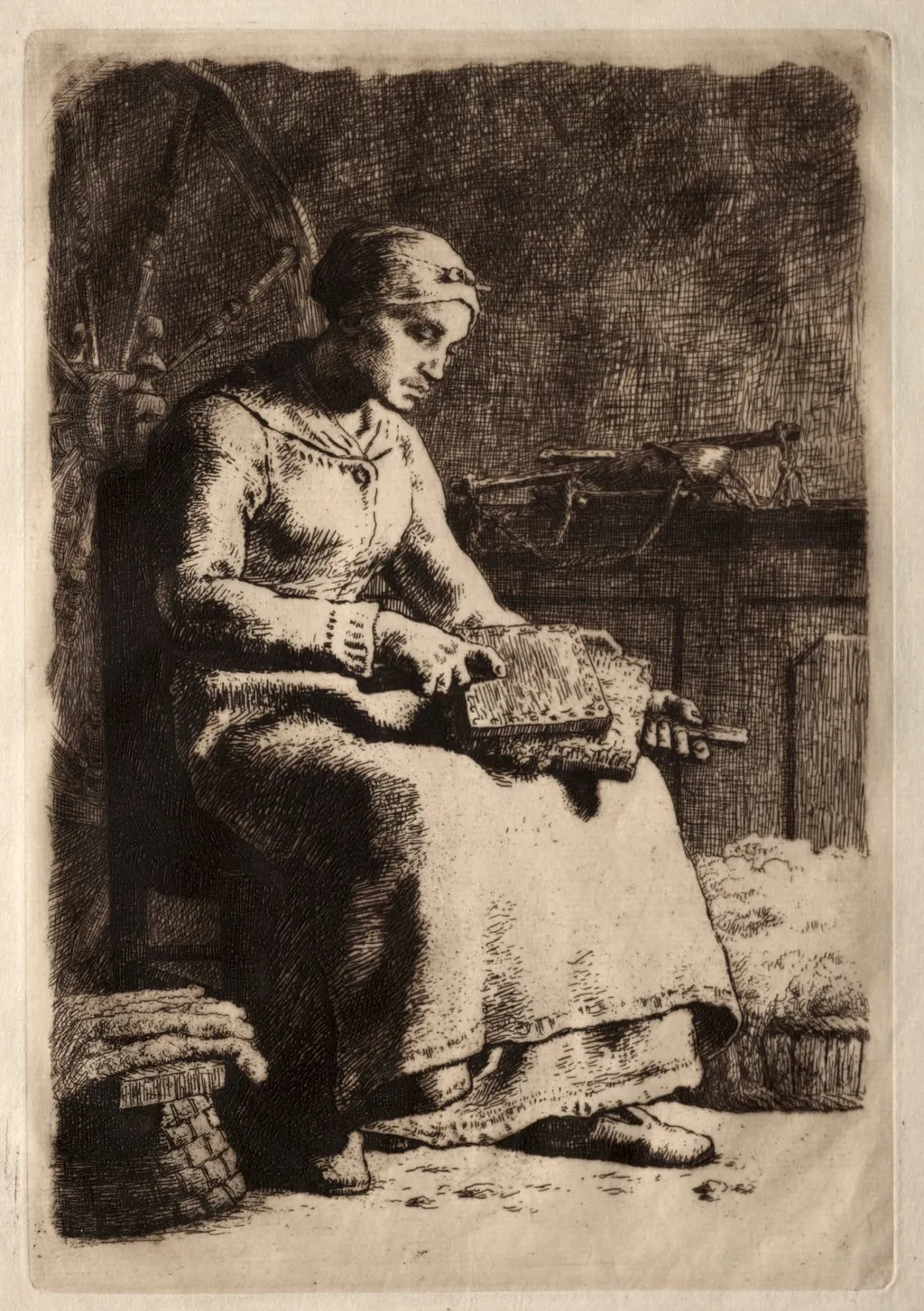
Woman Carding Wool is a print by the Impressionist artist Jean François Millet. It dates from 1856 and is held in the collection of the Cleveland Museum of Art.
About this work
Overview
This work exemplifies his dedication to portraying agricultural life with dignity and attention to detail, avoiding romanticization in favor of observed truth.
Created in 1856, *Woman Carding Wool* is a print by Jean-François Millet that captures a quiet moment of rural labor. As a key figure in the Realism movement and a member of the Barbizon school, Millet turned away from idealized subjects to document the daily routines of peasants. This work exemplifies his dedication to portraying agricultural life with dignity and attention to detail, avoiding romanticization in favor of observed truth.
Subject & Meaning
The print depicts a woman seated on the floor, intently carding wool with both hands. Her simple attire and the modest interior suggest a life defined by manual work. The focus on this solitary, repetitive task elevates it beyond mere domestic activity, framing it as an essential, unglamorous contribution to rural economy. The absence of narrative drama underscores the quiet endurance embedded in such labor.
Technique & Style
Millet employed fine, deliberate lines to render textures with tactile precision—the coarse wool, the worn fabric of her dress, the grain of the wooden basket, and the softness of her skin. The composition is restrained, with no extraneous detail, allowing the viewer’s attention to settle on the woman’s focused gesture. Light falls gently across her face, enhancing the sense of intimacy without theatricality.
History & Provenance
Produced during Millet’s mature period, the print emerged from his broader effort to document rural France beyond the canvas. Though less known than his paintings, these prints circulated among collectors and artists interested in Realism. The work reflects his engagement with printmaking as a medium for reaching wider audiences with images of peasant life, aligning with his social and artistic convictions.
Context
In mid-19th century France, industrialization and urbanization reshaped society, yet many still lived in agrarian conditions. Millet’s work stood in contrast to academic art’s grand historical or mythological themes. By centering the labor of rural women, he challenged prevailing artistic norms and invited viewers to recognize the dignity in work often rendered invisible by mainstream culture.
Legacy
Millet’s depictions of peasant labor influenced later generations of artists committed to social realism, including those in the 20th century who sought to portray working-class life with empathy. *Woman Carding Wool* remains a quiet but enduring example of how everyday gestures, rendered with care, can carry profound cultural weight—shifting perception through observation rather than spectacle.
Artist & collection
Artist
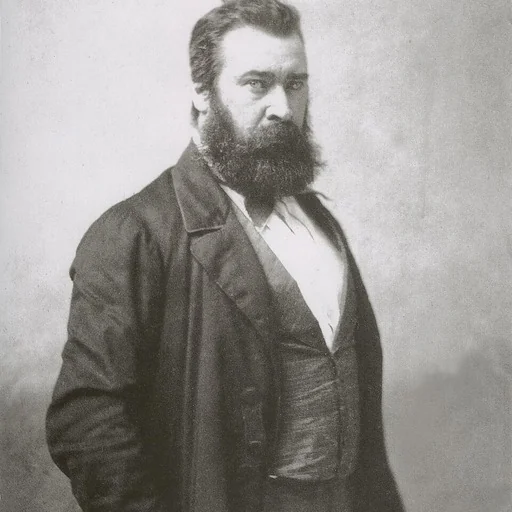
Jean-François Millet (French pronunciation: ; 4 October 1814 – 20 January 1875) was a French painter and one of the founders of the Barbizon school in rural France.

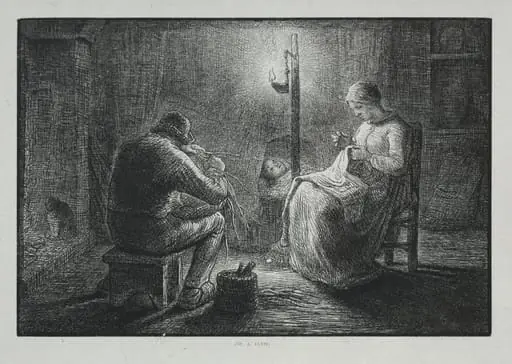 Four Hours of the Day: Night
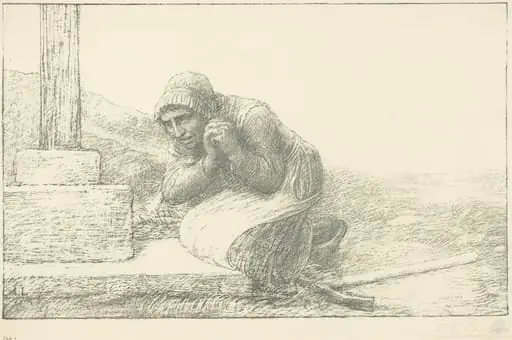 At the Foot of the Cross (Au pied de la croix)
 Woman Seated against a Wall, Child with His Head in Her Lap (Femme assis, muraille au fond, enfant la tete dans son giron)
 Woman Churning Butter
 Landscape in the Vicinity of Boulogne, called Woman with a Basket
 The Holy Family in an Interior
 The Family in the Room