Artwork
Untitled
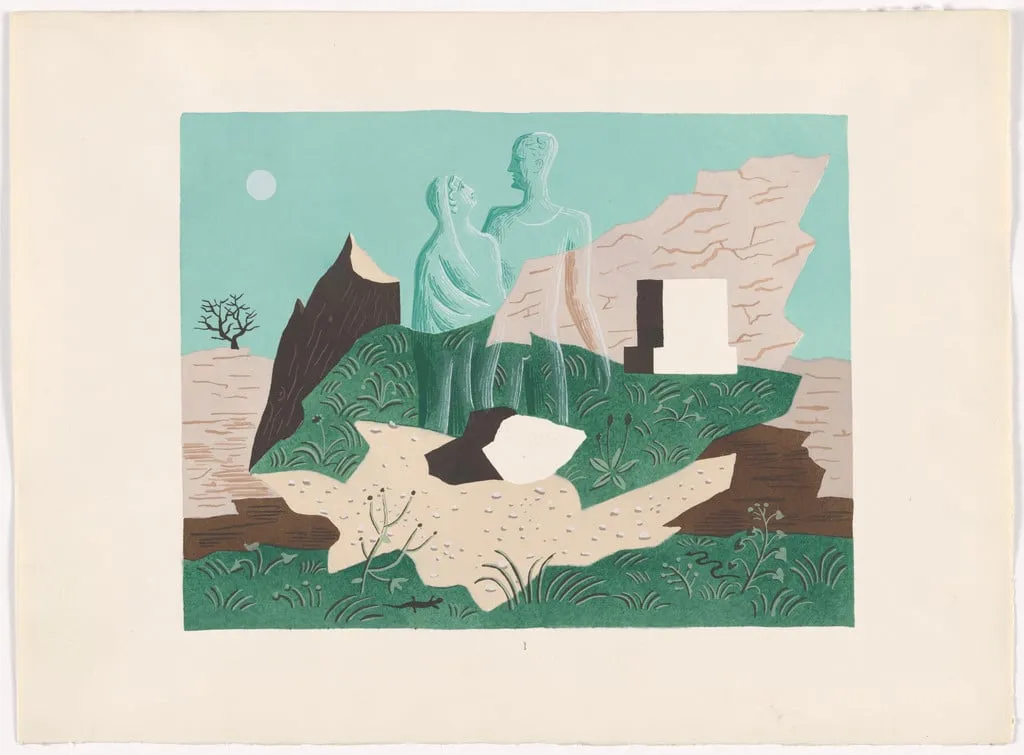
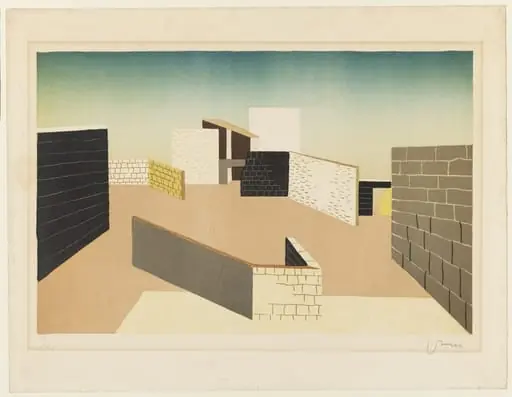
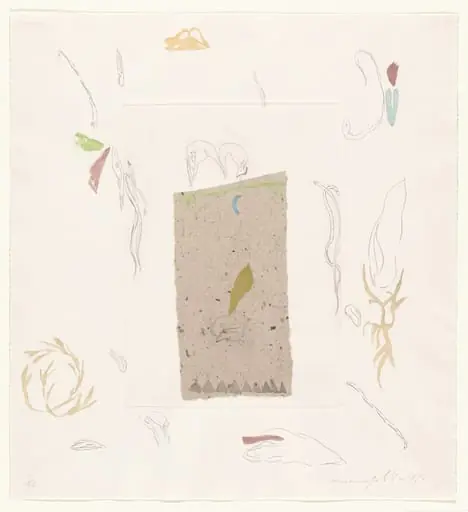
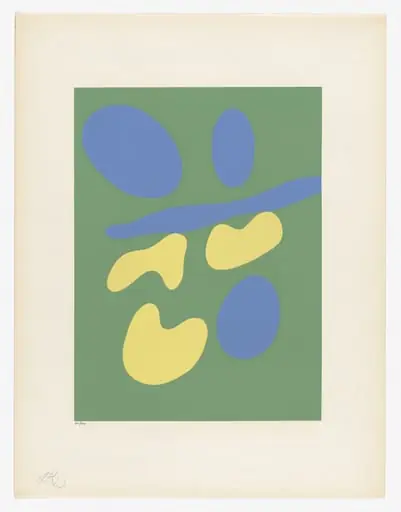
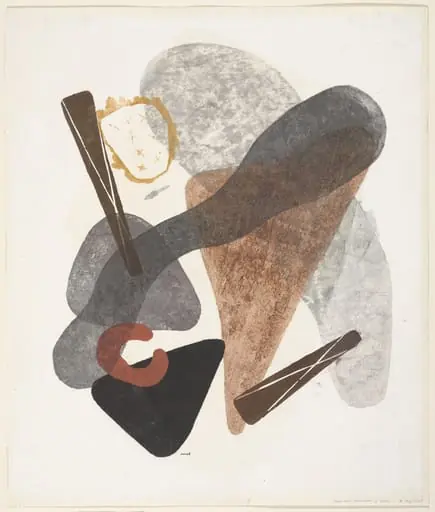
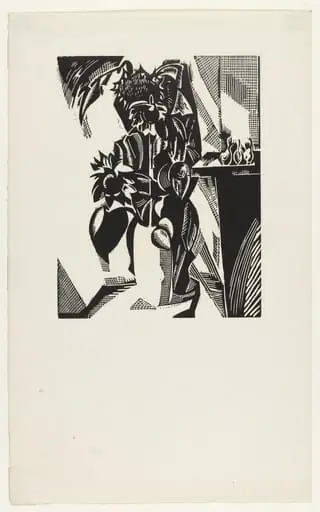
Untitled is a print by Jean Hugo. It dates from 1927 and is held in the collection of the Museum of Modern Art.
About this work
Overview
Jean Hugo produced this stencil print in 1927, part of his broader engagement with graphic techniques during the interwar period.
Jean Hugo produced this stencil print in 1927, part of his broader engagement with graphic techniques during the interwar period. As a French artist active across painting, illustration, and design, he explored simplified forms and flat color fields. The work reflects his interest in accessible, repetitive methods that distill visual elements into essential shapes, aligning with broader modernist tendencies to reduce imagery to its structural core.
Subject & Meaning
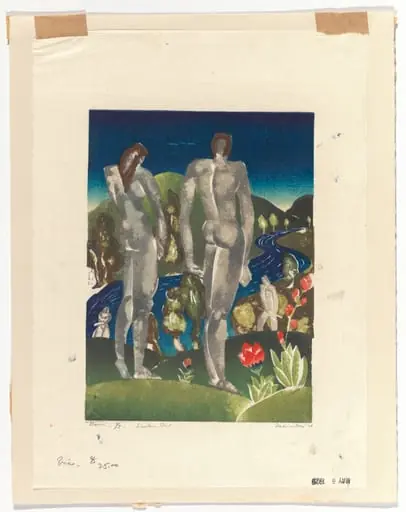
Two stylized figures stand on a low hill, one upright, the other leaning inward, suggesting a quiet moment of connection. The absence of facial features or detailed gesture invites interpretation without narrative specificity. The rocky backdrop and lone tree frame the scene with minimalism, emphasizing spatial relationships over emotional expression. The figures appear as symbolic presences rather than individuals, evoking themes of solitude and proximity without explicit context.
Technique & Style
The image was made using stencils, a method that produces sharp-edged, unmodulated shapes by blocking ink through cut-out templates. This technique eliminates shading and perspective, resulting in flat, graphic forms. Colors—green, blue, and pale tones—are applied uniformly, reinforcing the cut-out aesthetic. The approach aligns with early 20th-century experiments in printmaking that prioritized clarity and repetition over traditional modeling or brushwork.
History & Provenance
Created during Hugo’s time in Paris, this work emerged from his active participation in the city’s avant-garde circles following World War I. It entered the collection of The Museum of Modern Art as part of its broader effort to document experimental print practices of the period. The piece reflects Hugo’s transition from wartime documentation to more abstract, decorative forms, though it retains a sense of personal observation rooted in his surroundings.
Context
In the late 1920s, French artists increasingly turned to non-traditional methods to break from academic conventions. Stencil work, often associated with posters and commercial design, gained traction among fine artists seeking efficiency and visual economy. Hugo’s use of the technique placed him alongside contemporaries exploring the boundaries between art and craft, contributing to a wider redefinition of print as a legitimate medium for expressive experimentation.
Legacy
This work contributes to the recognition of stencil printing as a serious artistic tool beyond illustration or propaganda. Hugo’s restrained compositions influenced later generations interested in minimalism and graphic reduction. While not widely exhibited, its presence in MoMA’s collection affirms its role in documenting the diversity of interwar European printmaking practices and the quiet innovation of artists working outside dominant movements.
Artist & collection
Artist
Jean Hugo (French pronunciation: ; 19 November 1894 – 21 June 1984) was a painter, illustrator, theatre designer and author.