Artwork
The Relics
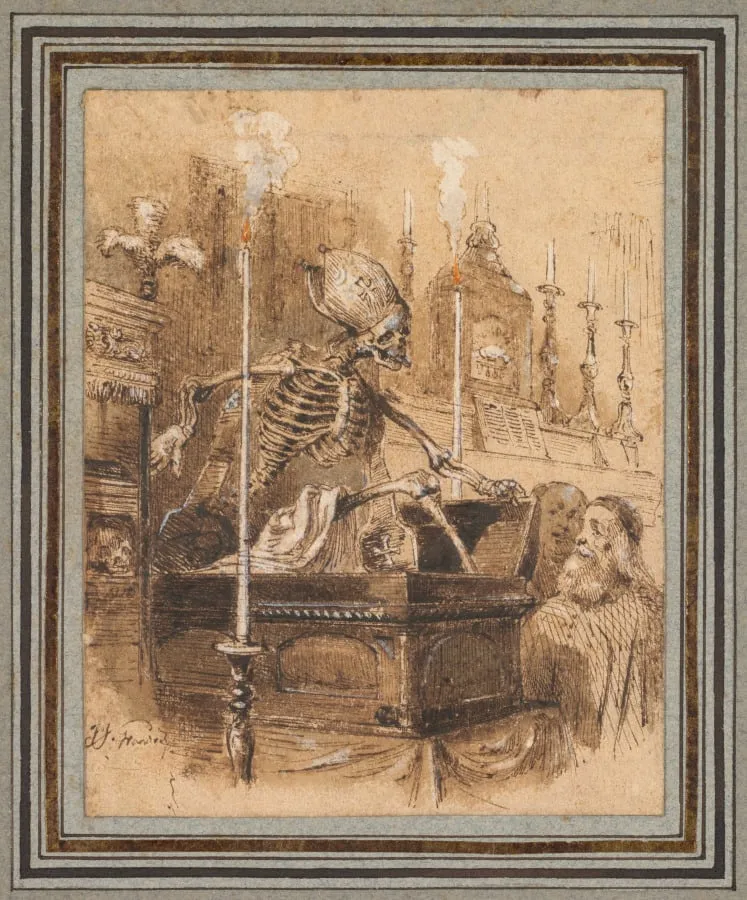
The Relics is a drawing by the Romanticist artist Jean-Jacques Grandville. It dates from 1835 and is held in the collection of the Cleveland Museum of Art.
About this work
Overview
Unlike standalone artworks, this piece functioned as a visual counterpart to literature, blending narrative and imagery for a broad readership.
This drawing by Grandville was created as an illustration for Pierre Jean de Béranger’s 1835 collection of songs, specifically accompanying the poem 'Les Reliques.' It depicts a skeletal figure in a dim urban setting, embodying the darkly whimsical tone of the verse. Unlike standalone artworks, this piece functioned as a visual counterpart to literature, blending narrative and imagery for a broad readership.
Subject & Meaning
The skeleton, grinning and armed with a lantern and cane, speaks from beyond the grave in Béranger’s lyrics, treating death as a matter of casual observation. Grandville’s rendering amplifies the song’s ironic humor—death is not terrifying, but oddly familiar, even companionable. The figure’s tattered clothing and alleyway setting ground the supernatural in the mundane, reflecting 19th-century fascination with mortality as both absurd and inevitable.
Technique & Style
Executed in ink or pencil, the drawing employs precise linework to define the skeleton’s angular form and the alley’s oppressive shadows. Grandville’s style merges realism with fantasy, rendering the impossible with clinical detail. The absence of color and the focus on contour and contrast heighten the eerie stillness, aligning with the illustrative conventions of periodical publishing rather than fine art traditions.
History & Provenance
The drawing originated as a preparatory or published plate for Béranger’s collected songs, widely circulated in mid-1830s France. As a prolific illustrator, Grandville frequently collaborated with literary publishers, making such works common in bourgeois households. Its survival as a standalone sheet suggests later appreciation beyond its original print run, though its exact provenance after publication remains undocumented.
Context
In the 1830s, French illustrated periodicals thrived as vehicles for satire and social commentary. Grandville’s work, often infused with anthropomorphism and grotesque humor, aligned with a broader cultural interest in the macabre, influenced by Romanticism and post-revolutionary disillusionment. His illustrations for songs like 'Les Reliques' tapped into public fascination with death as a subject both feared and trivialized.
Legacy
Grandville’s integration of text and image helped shape the evolution of graphic storytelling in Europe. While not widely studied as fine art during his lifetime, his approach influenced later illustrators and Surrealists drawn to his blending of the mundane and the uncanny. 'Les Reliques' remains a representative example of how visual art could extend literary meaning without overpowering it.
Artist & collection

 Fragonard and Bergeret with Their Wives Visiting a Tomb in Pompeii
 Der Reiche und der Tod
 Allegory on the birth of Frederik Hendrik
 Asetelma, pääkallo ja kynttilä
 Der Artzet (The Physician)
 Which One? (Lequel?)
 A Winged Skeleton Holding an Anatomical Drawing
 The Hour of Death
 On the Lookout (Aux aguets)
 Der Alt man (The Old Man)
 Vom Tode I, (Opus II, 1889) No. 6
 Dance of Death: The Old Man