Artwork
Woman Entering a Fiacre (recto); Right Profile of Man Wearing Tall Hat (verso)
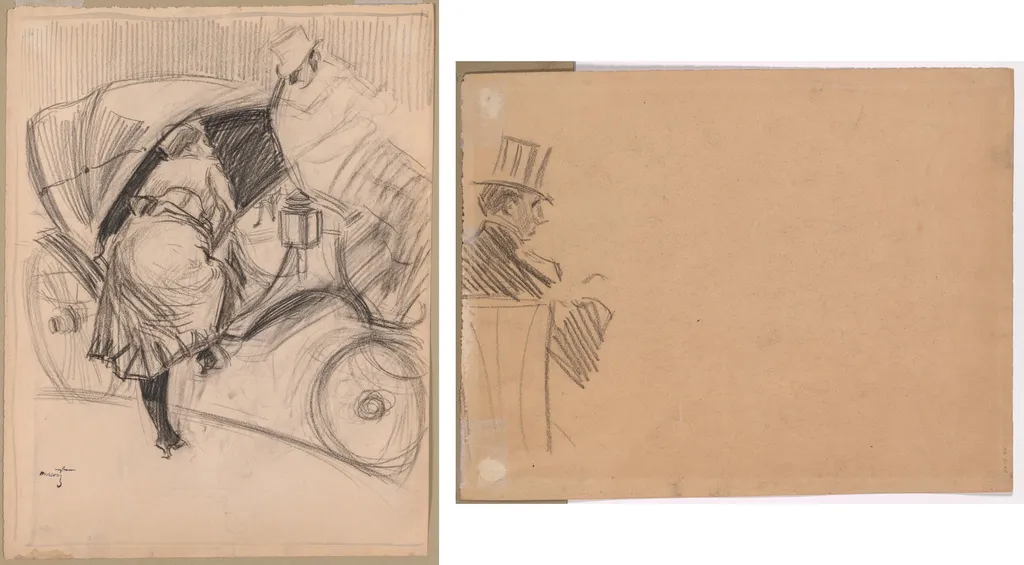
Woman Entering a Fiacre (recto); Right Profile of Man Wearing Tall Hat (verso) is a drawing by the Impressionist artist Jean-Louis Forain. It dates from 1804 and is held in the collection of the Cleveland Museum of Art.
About this work
Overview
One side depicts a woman boarding a fiacre, a common Parisian horse-drawn carriage, while the reverse presents a profile portrait of a man in a tall hat.
This double-sided drawing by Jean-Louis Forain features two distinct studies executed in charcoal. One side depicts a woman boarding a fiacre, a common Parisian horse-drawn carriage, while the reverse presents a profile portrait of a man in a tall hat. Both images were made rapidly, capturing fleeting moments of urban life without refinement. The paper’s dual use reflects the artist’s practical approach to materials and his focus on immediate observation.
Subject & Meaning
The recto portrays a routine scene of late 19th-century Paris: a woman in formal attire entering a fiacre, her movement caught mid-step as the driver remains alert. The verso offers a quiet counterpoint—a solitary male figure in profile, possibly a passerby or acquaintance. Together, they reflect Forain’s interest in the rhythms of city life, contrasting public action with private stillness without overt narrative or symbolism.
Technique & Style
Forain employed loose, energetic charcoal strokes to convey motion and texture. The woman’s dress and the carriage’s form are suggested rather than defined, with smudged lines and abrupt marks creating a sense of immediacy. The profile on the verso is rendered with similar economy, emphasizing contour over detail. The absence of shading or correction underscores the spontaneity of the drawing, aligning with the artist’s preference for direct observation.
History & Provenance
The drawing originates from Forain’s personal sketchbook, likely made during the 1880s or 1890s. It remained in his possession until his death in 1931, after which it entered a private collection. Its survival as a single sheet, rather than bound in a volume, suggests it was later separated from its original context. No public exhibition history is documented prior to its acquisition by the current institution.
Context
In late 19th-century Paris, fiacres were ubiquitous, serving as a primary mode of transport for the middle and upper classes. Forain, a keen observer of urban society, often recorded such scenes in his sketches. His work aligns with contemporaries like Degas and Toulouse-Lautrec, who similarly captured transient moments in public spaces, though Forain’s style remained more spontaneous and less stylized.
Legacy
This drawing exemplifies Forain’s commitment to unembellished observation, distinguishing his work from more polished academic traditions. While not widely exhibited during his lifetime, such sketches have since contributed to a broader appreciation of his role in documenting everyday Parisian life. His method influenced later generations of artists who valued immediacy over finish in observational drawing.
Artist & collection

Artist
Jean-Louis Forain (French pronunciation: ; 23 October 1852 – 11 July 1931) was a French Impressionist painter and printmaker, working in media including oils, watercolour, pastel, etching and lithograph.

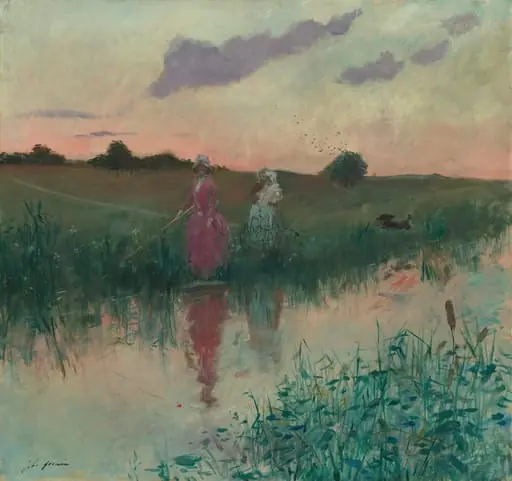
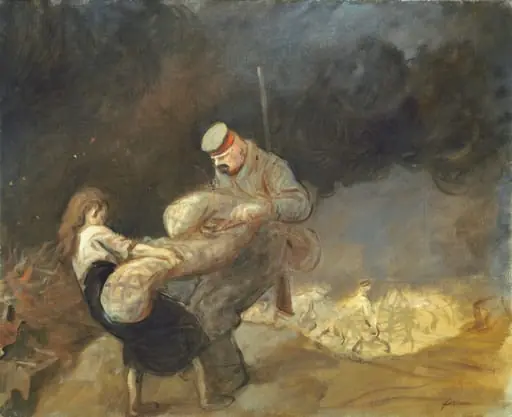
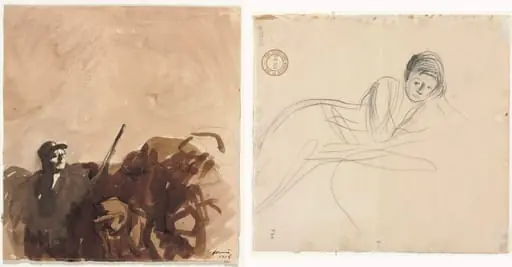 Soldier in a Trench (recto) Reclining Woman (verso)
![Soldiers; Four Soldiers and a Seated Figure [verso], by Paul Gauguin](https://artifactworldgallery.com/img/paul-gauguin--soldiers-four-soldiers-and-a-seated-figure-verso--03eb26713f1552e4-w320.webp) Soldiers; Four Soldiers and a Seated Figure [verso]
Soldiers; Four Soldiers and a Seated Figure [verso]![A Grazing Cow; Head of a Woman with Her Hand on Her Cheek, and Head of a Man with His Hand on His Ear [verso], by Paul Gauguin](https://artifactworldgallery.com/img/paul-gauguin--a-grazing-cow-head-of-a-woman-with-her-hand-on-her-cheek-and--634600a51135ea0b-w320.webp) A Grazing Cow; Head of a Woman with Her Hand on Her Cheek, and Head of a Man with His Hand on His Ear [verso]
A Grazing Cow; Head of a Woman with Her Hand on Her Cheek, and Head of a Man with His Hand on His Ear [verso] Studies Including a Straw Hat
![Studies of Jugs and Vases; A Man with Moustache and a Boy with a Hat [recto], by Paul Gauguin](https://artifactworldgallery.com/img/paul-gauguin--studies-of-jugs-and-vases-a-man-with-moustache-and-a-boy-wit--f45745e972a40252-w320.webp) Studies of Jugs and Vases; A Man with Moustache and a Boy with a Hat [recto]
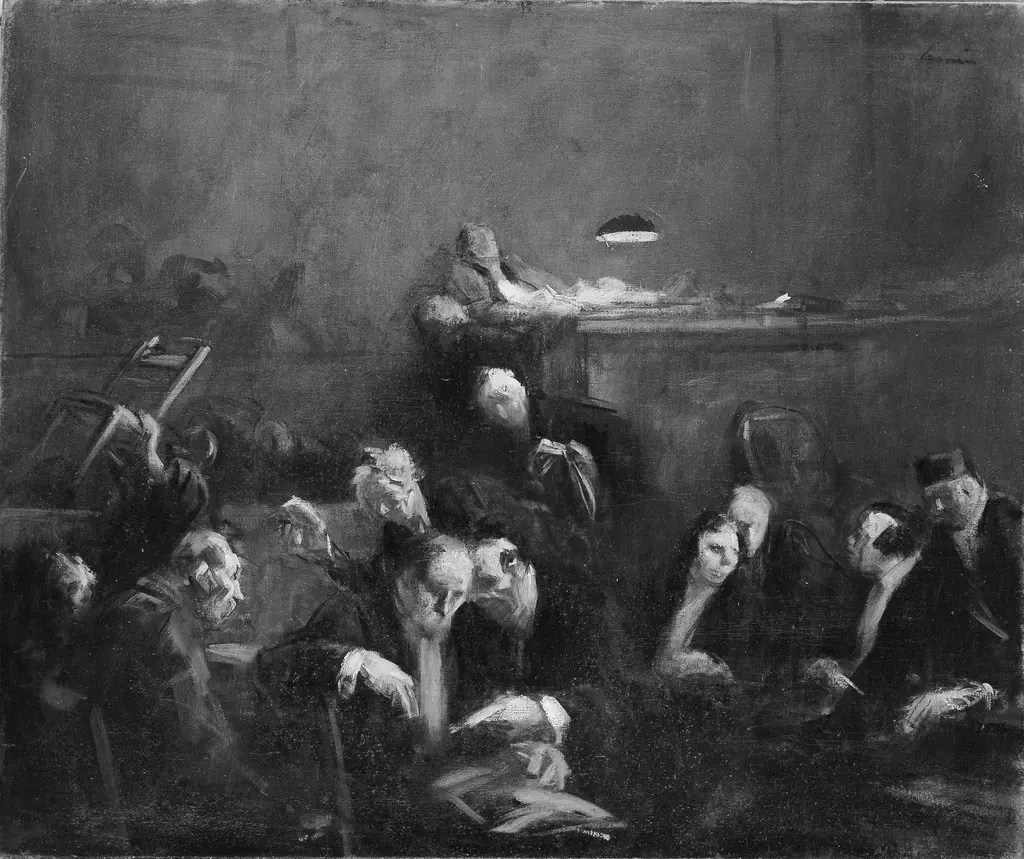
Studies of Jugs and Vases; A Man with Moustache and a Boy with a Hat [recto]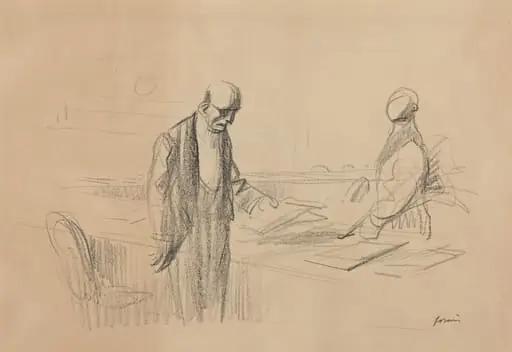 a) At the Conference (recto); b) Reclining Figure (verso)
![Head of a Man with a Study of His Back; Various Sketches with a Peasant Woman and a Goose [recto], by Paul Gauguin](https://artifactworldgallery.com/img/paul-gauguin--head-of-a-man-with-a-study-of-his-back-various-sketches-with--2fa4d0cd45c52509-w320.webp) Head of a Man with a Study of His Back; Various Sketches with a Peasant Woman and a Goose [recto]
Head of a Man with a Study of His Back; Various Sketches with a Peasant Woman and a Goose [recto]![A Man Leaning on a Wall with Five Other Studies; Two Bearded Men Wearing Hats, and Five Other Studies [recto], by Paul Gauguin](https://artifactworldgallery.com/img/paul-gauguin--a-man-leaning-on-a-wall-with-five-other-studies-two-bearded--2df262058c2bfe48-w320.webp) A Man Leaning on a Wall with Five Other Studies; Two Bearded Men Wearing Hats, and Five Other Studies [recto]
A Man Leaning on a Wall with Five Other Studies; Two Bearded Men Wearing Hats, and Five Other Studies [recto]![Two Breton Figures; Bridge at Pont-Aven [recto], by Paul Gauguin](https://artifactworldgallery.com/img/paul-gauguin--two-breton-figures-bridge-at-pont-aven-recto--c0e464ebc5606803-w320.webp) Two Breton Figures; Bridge at Pont-Aven [recto]
Two Breton Figures; Bridge at Pont-Aven [recto]![Five Studies of Soldiers and a Woman's Face; Two Figures [recto], by Paul Gauguin](https://artifactworldgallery.com/img/paul-gauguin--five-studies-of-soldiers-and-a-woman-s-face-two-figures-rect--9d09632e7e517067-w320.webp) Five Studies of Soldiers and a Woman's Face; Two Figures [recto]
Five Studies of Soldiers and a Woman's Face; Two Figures [recto]![Eye and Part of Face; A Breton Woman and Two Men [recto], by Paul Gauguin](https://artifactworldgallery.com/img/paul-gauguin--eye-and-part-of-face-a-breton-woman-and-two-men-recto--81c9125f35b9b9e6-w320.webp) Eye and Part of Face; A Breton Woman and Two Men [recto]
Eye and Part of Face; A Breton Woman and Two Men [recto]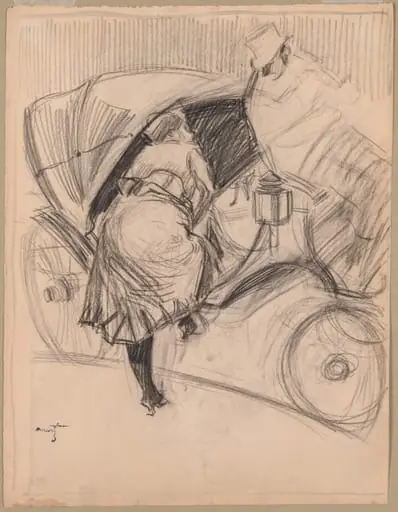 Woman Entering a Fiacre (recto)