Artwork
Untitled
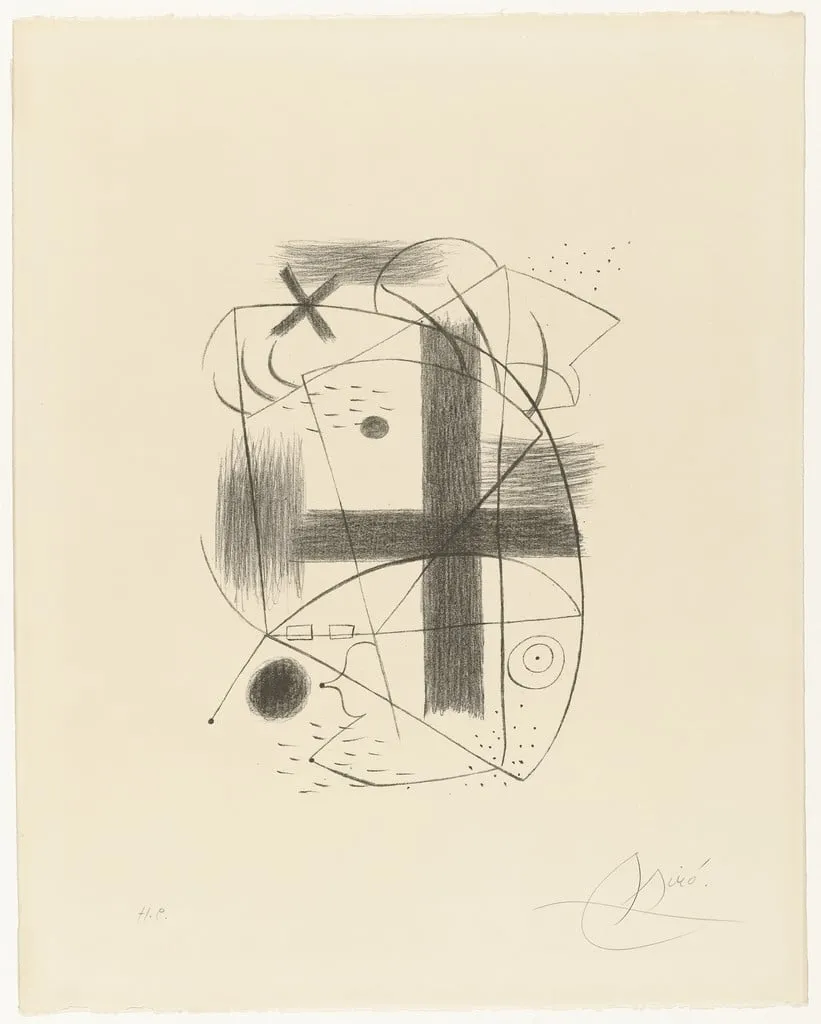
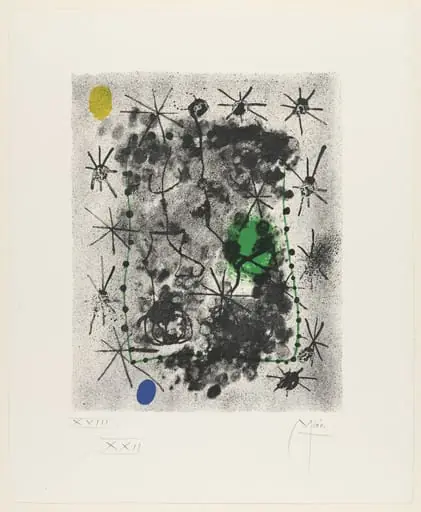
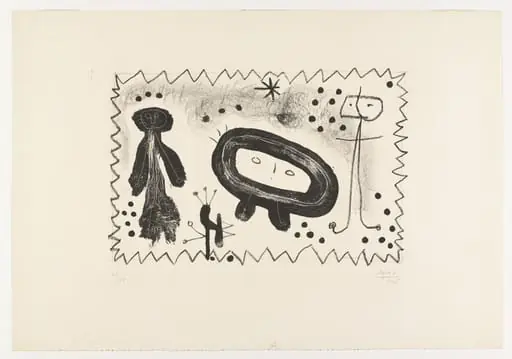
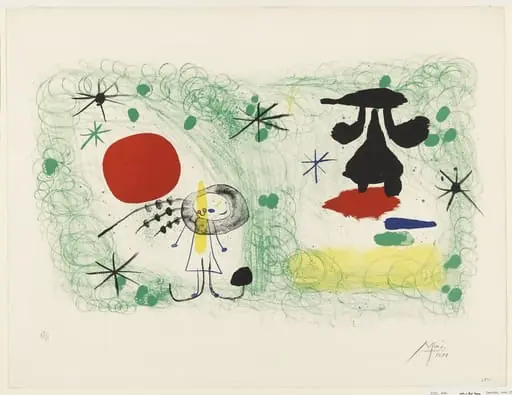
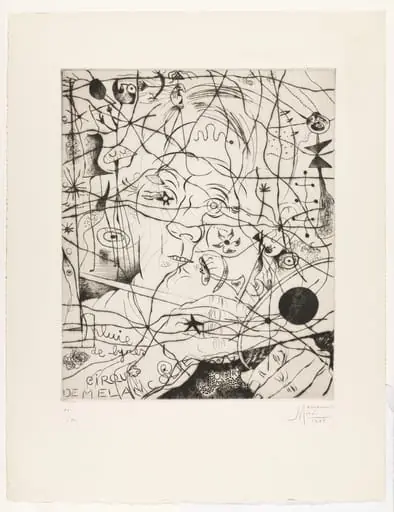
Untitled is an ink print by Joan Miró. It dates from 1930 and is held in the collection of the Museum of Modern Art.
About this work
Overview
The work is one of many prints he created alongside painting and sculpture, demonstrating his sustained interest in printmaking as a medium for experimentation.
Joan Miró produced this 1930 lithograph during a phase of international recognition, when his visual language was frequently linked to Surrealism, though he maintained a unique approach distinct from the movement’s broader aims. The work is one of many prints he created alongside painting and sculpture, demonstrating his sustained interest in printmaking as a medium for experimentation. It resides in The Museum of Modern Art’s collection, underscoring its place in modern graphic art.
Subject & Meaning
The composition centers on a bold black cross, flanked by abstract geometric forms and spontaneous marks that suggest symbols or glyphs without fixed meaning. These elements evoke a personal lexicon rather than narrative content, reflecting Miró’s interest in subconscious expression and visual poetry. The absence of representational imagery invites open interpretation, aligning with his broader rejection of literalism in favor of symbolic resonance.
Technique & Style
Executed in lithography, the piece relies on the medium’s capacity for fluid line and tonal contrast, with dense black ink on a pale ground creating strong visual tension. Forms are simplified yet dynamically arranged, combining precise geometry with gestural spontaneity. The signature in the lower right and the 'H.P.' mark in the left corner indicate artist verification and possibly a printer’s notation, common in limited print editions of the period.
History & Provenance
Created in 1930, the lithograph emerged during Miró’s active engagement with European avant-garde circles and his growing reputation beyond Spain. It entered The Museum of Modern Art’s collection as part of a broader institutional effort to document modern printmaking. Its preservation reflects the museum’s early commitment to recognizing print as a serious artistic medium, not merely a reproductive technique.
Context
In the late 1920s and early 1930s, Miró was refining a visual vocabulary that merged Catalan folk motifs, childhood imagery, and abstract signs. While Surrealist groups embraced his work, he resisted full alignment with their theories. This lithograph exemplifies his independent path: rooted in symbolic abstraction, yet free from doctrinal constraints, reflecting a broader shift in modern art toward personal myth-making.
Legacy
This print contributes to Miró’s enduring influence on postwar abstraction and the legitimization of printmaking in fine art. Its restrained palette and symbolic forms anticipated later developments in minimalist and sign-based art. As part of a major museum’s permanent holdings, it remains a reference point for artists exploring non-representational mark-making and the poetic potential of simple forms.
Artist & collection
Artist
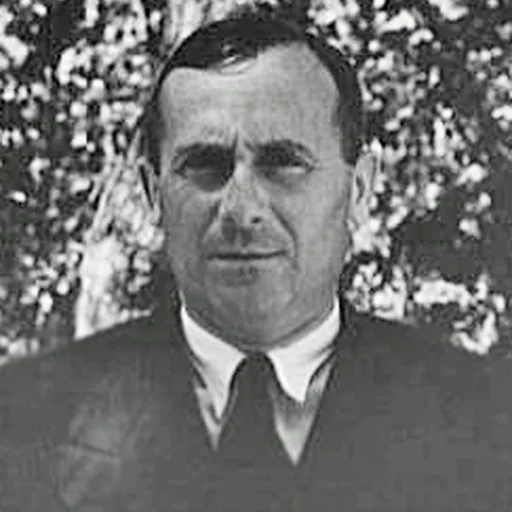
Joan Miró i Ferrà ( mirr-OH, US also mee-ROH, Catalan: ; 20 April 1893 – 25 December 1983) was a Catalan painter, sculptor and ceramist from Spain.