Artwork
Untitled
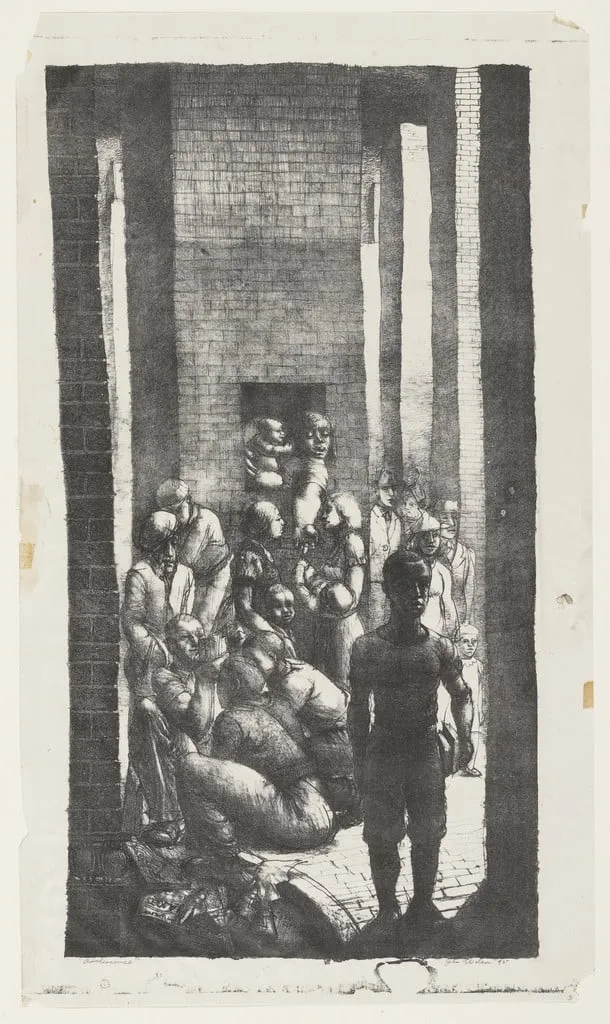
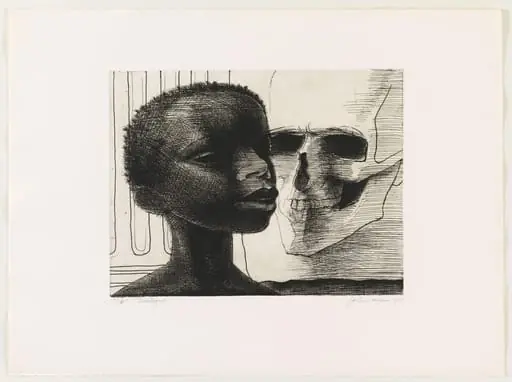
Untitled is an ink print by John Wilson. It dates from 1943 and is held in the collection of the Museum of Modern Art.
About this work
Overview
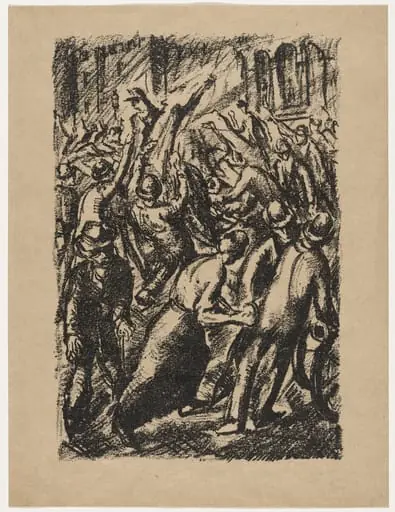
John Wilson created this black-and-white lithograph in 1943. It is part of The Museum of Modern Art’s collection. The print depicts an interior space densely occupied by figures, rendered with minimal detail but strong compositional energy. The technique of lithography allowed Wilson to achieve a textured, spontaneous quality, emphasizing atmosphere over individual identity.
Subject & Meaning
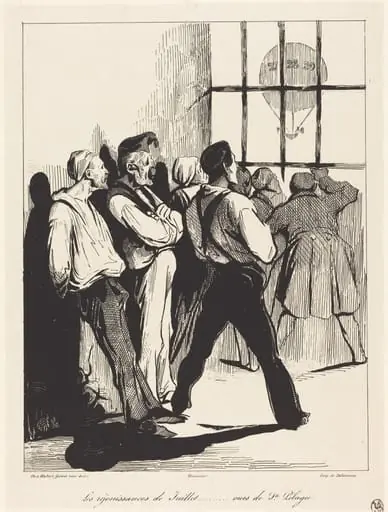
Figures are arranged in clusters—some seated on the floor, others leaning against walls—while a solitary man in the foreground stands with arms crossed.
The scene portrays a group of people in a confined, dimly lit room, suggesting a moment of shared stillness or waiting. Figures are arranged in clusters—some seated on the floor, others leaning against walls—while a solitary man in the foreground stands with arms crossed. Buckets held by figures in the background hint at utility or labor, but no clear narrative is given, leaving the emotional tone ambiguous.
Technique & Style
Wilson employed lithography to produce a rough, gestural line quality that conveys urgency and compression. The absence of facial detail shifts focus to posture and spatial relationships. Heavy shadows cast by a distant light source deepen the sense of enclosure. The textured walls and tiled floor are suggested with minimal strokes, reinforcing the print’s raw, immediate character.
History & Provenance
Created in 1943, the work entered The Museum of Modern Art’s collection shortly after its production. Wilson, an African American artist active during the Harlem Renaissance, often depicted everyday scenes with social resonance. This print reflects his interest in quiet, unidealized moments of communal life, though its specific context of creation remains undocumented.
Context
Made during World War II, the image resonates with themes of confinement and collective endurance common in wartime art. Wilson’s approach aligns with social realism, yet avoids overt political messaging. The lithograph’s intimacy contrasts with the era’s grand narratives, offering instead a subdued observation of human presence under constrained conditions.
Legacy
Though not widely exhibited, the work contributes to a broader understanding of mid-century printmaking by Black artists. Wilson’s use of lithography to capture spatial tension and anonymity influenced later generations interested in the emotional potential of minimal form. The piece remains a quiet but persistent example of observational art from a marginalized perspective.
Artist & collection