Artwork
Spanish Dancers
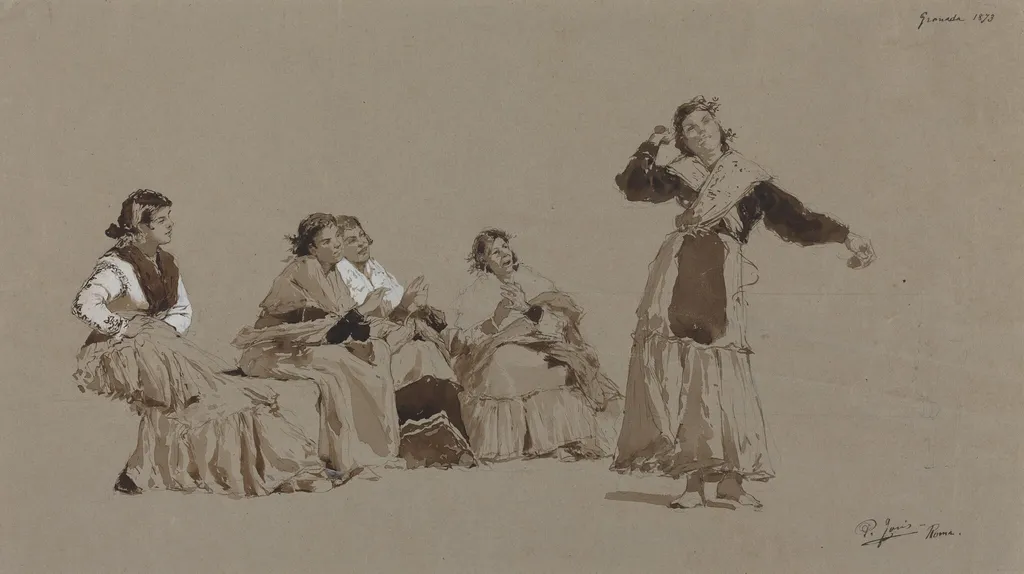
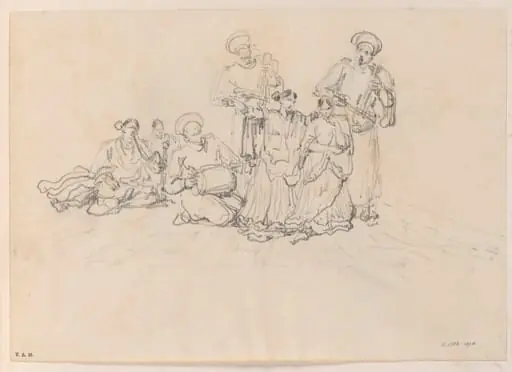
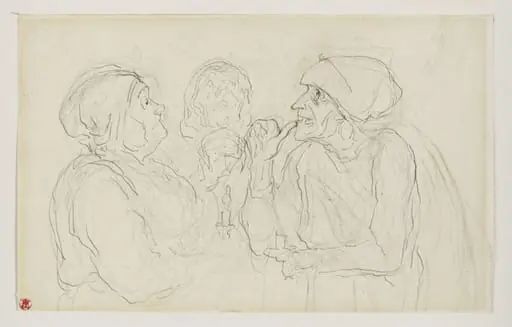
Spanish Dancers is an ink drawing by the Impressionist artist Pio Joris. It dates from 1873 and is held in the collection of the National Gallery of Art.
About this work
Overview
Created in 1873 by Pio Joris, this drawing captures a moment of informal performance among Spanish dancers. Executed in pen and brown ink with wash and white highlights over graphite, the work conveys movement and atmosphere through rapid, expressive marks. Its sketch-like quality suggests it was made on-site, possibly as a study for larger compositions or as a personal record of observed life.
Subject & Meaning
Five women are depicted in a casual, unposed grouping, with one central figure raising her arms in motion while others rest nearby. Their postures and fleeting facial expressions suggest a moment of spontaneous interaction—perhaps between performances or during a break. The scene avoids theatricality, instead emphasizing the humanity and rhythm of everyday cultural practice.
Technique & Style
Joris employed loose, uneven ink lines and diluted washes to suggest form without definition, allowing the paper’s texture to contribute to the composition. White heightening adds contrast to folds of fabric and skin, while graphite underdrawing guides the overall structure. The absence of fine detail and the deliberate irregularity of strokes reinforce the immediacy of the observation.
History & Provenance
The drawing originates from Joris’s time in Spain, where he traveled to document local customs and folk traditions. Likely produced during a visit in the early 1870s, it reflects his interest in ethnographic observation. Its survival as a standalone sheet suggests it was valued for its documentary character rather than as a preparatory study for a finished painting.
Context
In the late 19th century, European artists increasingly turned to regional and folk subjects as part of a broader interest in authenticity and cultural specificity. Joris’s work aligns with this trend, capturing Spanish dancers not as exoticized figures but as individuals engaged in familiar, unguarded moments, reflecting contemporary shifts toward realism in visual culture.
Legacy
Though not widely exhibited, this drawing exemplifies Joris’s commitment to direct observation and his skill in translating transient movement into ink. It remains a quiet testament to the artist’s engagement with everyday life beyond the studio, offering insight into how 19th-century travelers recorded cultural practices with sensitivity and spontaneity.
Artist & collection


 Standing Woman
 Figures in Italia Costume
 Sketches of Figures
 A group of Indian musicians and dancers
 Illustration to Knightley's 'Westward Ho!'
 Woman in a Crinoline on the Beach of Trouville
 Three studies for a portrait of a Western woman and child
 Women of Algiers
 The Terrace, Luxembourg
 Promenaders in St. James' Park
 Study for "Mind and Matter"
 Les trois commères