Artwork
El Niño Jesús y San Juan
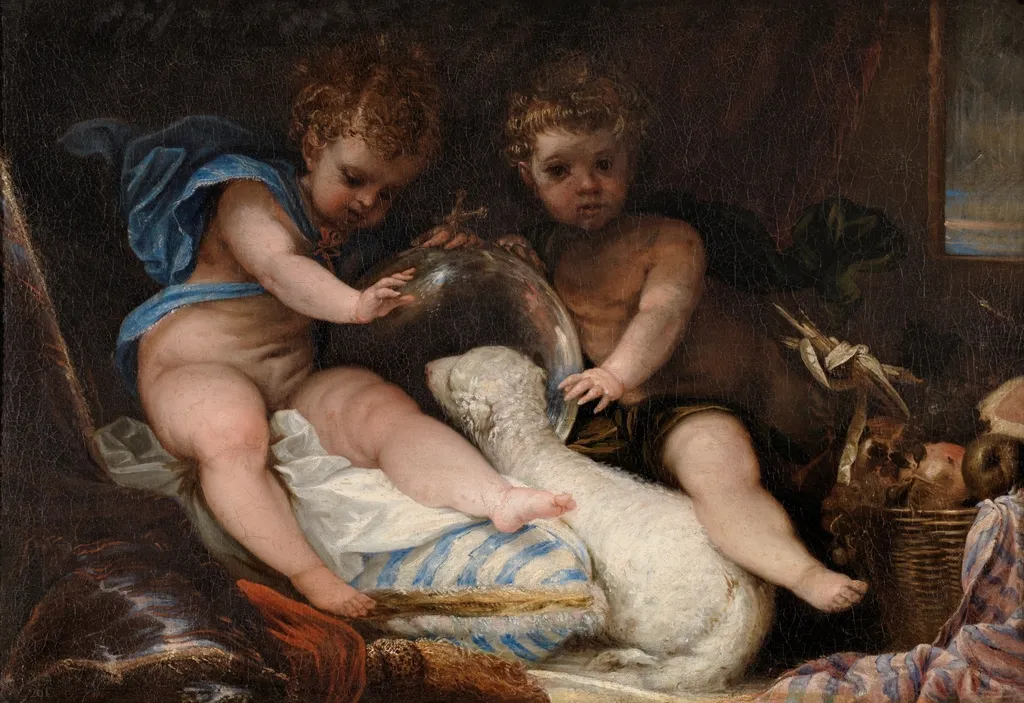
El Niño Jesús y San Juan is an oil painting by the Early Baroque Italian artist Juan Antonio de Frías y Escalante. It dates from 1668 and is held in the collection of the Museo del Prado.
About this work
Overview
Juan Antonio de Frías y Escalante, a Spanish painter born in Córdoba in 1633, completed the oil work *El Niño Jesús y San Juan* in 1668. Executed during the height of the Spanish Baroque, the canvas is now part of the collection of the Museo del Prado in Madrid. The composition centers on two infant figures and a lamb, rendered with the dramatic contrast characteristic of the period.
Subject & Meaning
The painting presents two plump, unclothed children—identified as the Christ Child and the young Saint John—engaged in a playful interaction with a sheep. One boy, draped in a blue cloth, grasps the animal’s head while the other sits upon its back. A basket and fruit placed in the background allude to pastoral abundance and carry traditional Christian symbolism of nourishment and innocence.
Technique & Style
Escalante employs a strong chiaroscuro, allowing the luminous skin tones and the wool of the lamb to emerge from a deep, muted backdrop.
Escalante employs a strong chiaroscuro, allowing the luminous skin tones and the wool of the lamb to emerge from a deep, muted backdrop. The handling of light recalls the influence of Venetian masters such as Tintoretto and Veronese, while the brushwork retains the vigorous, tactile quality of early Baroque painting. The figures are rendered with rounded forms and soft modeling, emphasizing a tender, almost sculptural presence.
History & Provenance
Trained in the workshop of Francisco Ricci, Escalante absorbed both Spanish and Italian artistic currents before establishing his career in Madrid. *El Niño Jesús y San Juan* remained in private collections before entering the Prado’s holdings, where it has been displayed as an example of mid‑17th‑century Spanish religious art. The work predates the artist’s later shift toward Rococo elements, marking it as a pure expression of his Baroque phase.
Own this work as a print
Artist & collection
Artist
Juan Antonio de Frías y Escalante
Juan Antonio de Frías y Escalante (1633 in Cordoba–1669 in Madrid) was a Spanish Baroque Golden Age painter.