Artwork
Untitled
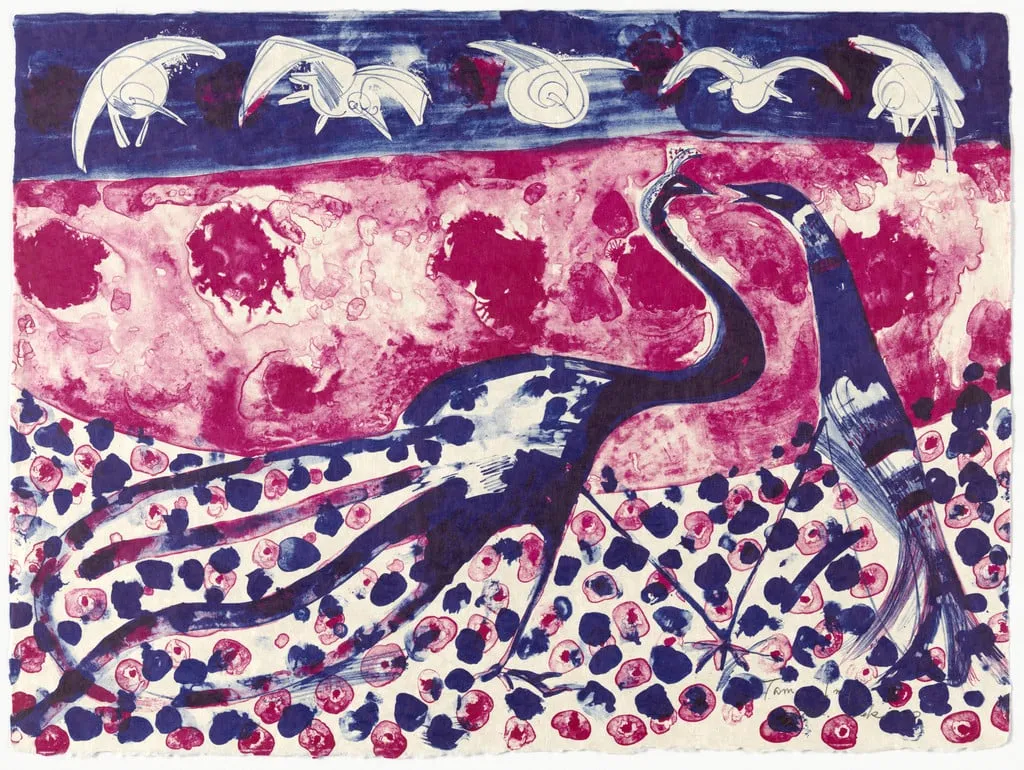
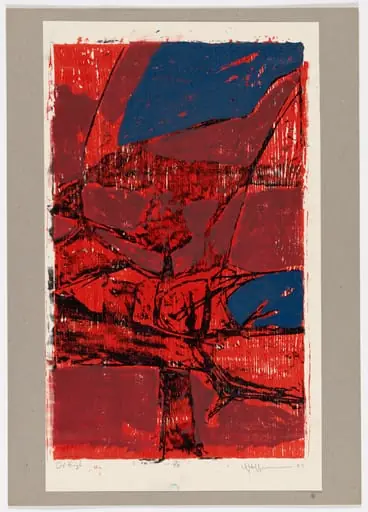
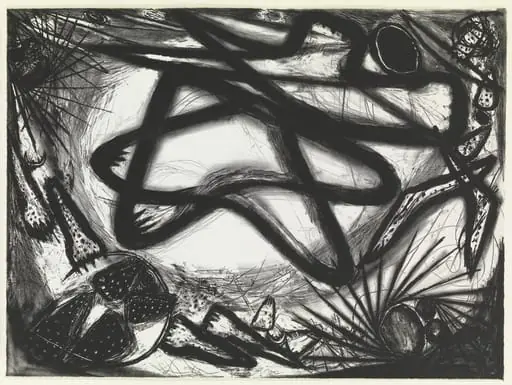
Untitled is an ink print by Jun'ichiro Sekino. It dates from 1963 and is held in the collection of the Museum of Modern Art.
About this work
Sekino made this in 1963 at the Tamarind Lithography Workshop in Los Angeles, where American and Japanese artists worked side by side.
This black-and-white print shows a tangle of thin, jagged lines that look like bare branches or cracks in ice. The lines twist and overlap, filling the whole page without any empty space.
Sekino made this in 1963 at the Tamarind Lithography Workshop in Los Angeles, where American and Japanese artists worked side by side. The workshop helped bring printmaking back as a serious art form after World War II.
To see how other artists used the same technique, look up lithography.
Overview
Jun'ichiro Sekino, a central figure in Japan’s sosaku hanga movement, produced this 1963 lithograph during a residency at the Tamarind Lithography Workshop in Los Angeles. The work reflects his commitment to printmaking as a personal, expressive medium rather than a reproductive craft. His engagement with American printmaking circles during this period marked a significant cross-cultural exchange in postwar art.
Subject & Meaning
The image consists entirely of dense, interwoven black lines that suggest natural fractures—like ice splitting or bare branches in winter. There is no figurative element, no horizon, no clear focal point. The composition evokes organic chaos, perhaps hinting at the fragility or resilience of nature, but deliberately avoids literal interpretation, inviting contemplation through abstraction.
Technique & Style
Sekino employed lithography to achieve fine, controlled linework with high contrast. The entire surface is filled with intricate, overlapping strokes, demonstrating mastery of the stone medium. His style merges Japanese sensibilities of minimalism and negative space with the technical possibilities of Western lithographic practice, resulting in a visually dense yet restrained composition.
History & Provenance
Created in 1963 at the Tamarind Lithography Workshop, this print emerged from a pivotal initiative that revived lithography as a fine art medium in the United States. Sekino was among several international artists invited to collaborate with American printmakers. The work entered The Museum of Modern Art’s collection shortly after its creation, affirming its significance in postwar printmaking.
Context
In the decades following World War II, Japanese artists like Sekino redefined traditional printmaking by emphasizing individual authorship and experimental techniques. Simultaneously, American workshops like Tamarind sought to elevate lithography beyond commercial use. This work sits at the intersection of these two movements, embodying a shared pursuit of artistic renewal through print.
Legacy
Sekino’s *Untitled* exemplifies how postwar printmakers bridged cultural traditions to expand the boundaries of the medium. His work at Tamarind influenced both Japanese and American artists, reinforcing printmaking’s legitimacy as a vehicle for personal expression. The piece remains a reference point in discussions of transnational modernism in 20th-century print art.
Artist & collection
Artist
Sekino Jun'ichirō (Japanese: 関野 凖一郎; born 1914 – 1988) was a Japanese woodblock printer, one of the major postwar artists of the sosaku hanga ("creative print") movement.