Artwork
Untitled
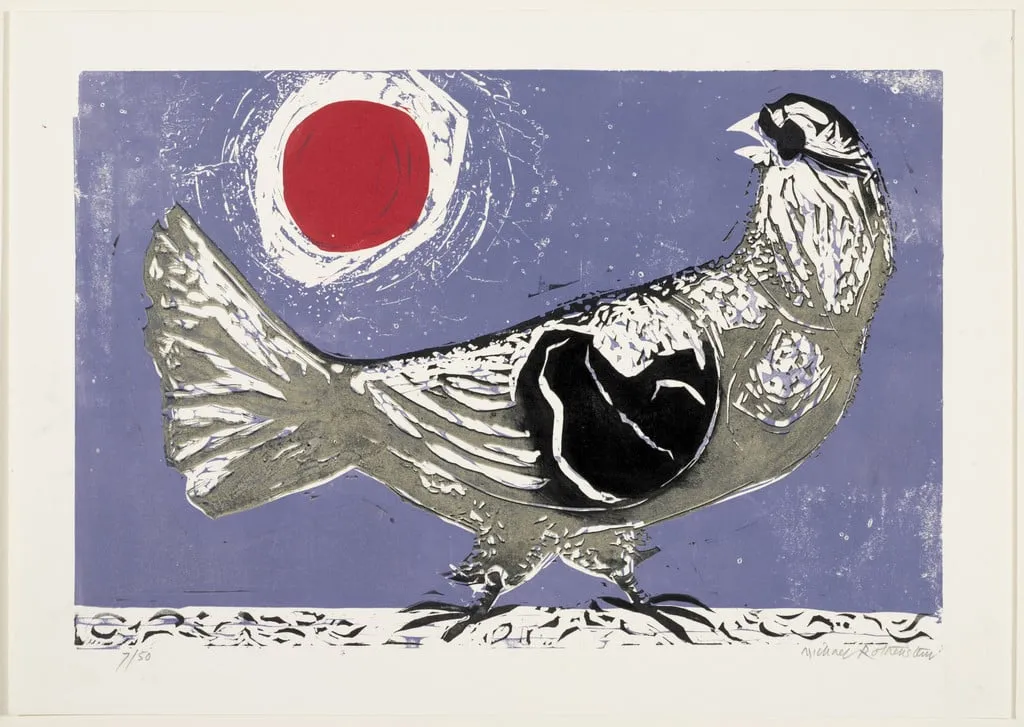
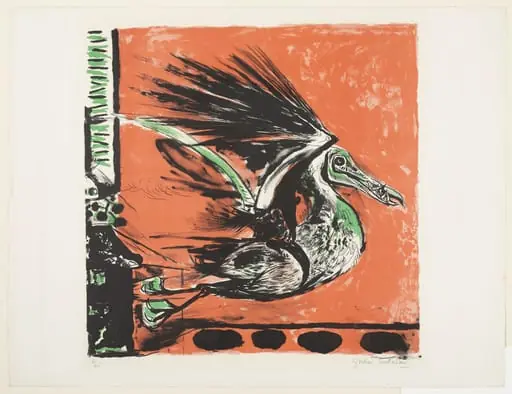
Untitled is a print by Michael Rothenstein. It dates from 1955 and is held in the collection of the Museum of Modern Art.
About this work
Overview
Its composition centers on a stylized rooster, rendered with strong contrasts and minimal detail, set against an abstracted sky.
Created around 1955, this linoleum cut by Michael Rothenstein is part of The Museum of Modern Art’s collection. The print employs the relief technique of carving into linoleum to produce bold, flat areas of ink. Its composition centers on a stylized rooster, rendered with strong contrasts and minimal detail, set against an abstracted sky. The method emphasizes the physicality of the carving process and the immediacy of the printed mark.
Subject & Meaning
The rooster, a recurring symbol in folk and modernist art, appears here as a simplified, almost emblematic form. Its upright posture and sharp contours suggest vigilance or presence, while the large red circle behind it evokes celestial bodies—sun or moon—without specifying time or season. The ambiguity invites interpretation without anchoring the image to a single narrative, leaving room for personal or cultural resonance.
Technique & Style
Using linoleum cut, Rothenstein carved away areas to leave raised surfaces that received ink. The result is a print defined by stark black and white contrasts, with subtle gray tones added through selective inking. Bold outlines define the rooster’s form, while the background’s pale blue and red circle are applied with flat, unmodulated color. The technique favors clarity and structure over naturalistic detail.
History & Provenance
The work entered The Museum of Modern Art’s collection in the mid-20th century, during a period when the institution actively acquired prints by British modernists. Rothenstein, associated with the London Group and postwar British printmaking, was recognized for his experimental approach to relief printing. This piece reflects his engagement with simplified forms and symbolic imagery common in mid-century print revival.
Context
In the 1950s, British artists like Rothenstein turned to printmaking as a means of exploring abstraction and symbolic content outside the dominant trends of pure abstraction. Linoleum cuts offered an accessible, tactile alternative to etching or lithography. The work aligns with broader European modernist interests in folk motifs and primal forms, filtered through a restrained, graphic sensibility.
Legacy
Rothenstein’s linoleum cuts contributed to the reinvigoration of printmaking in postwar Britain. His use of simplified forms and symbolic elements influenced a generation of artists seeking to merge traditional techniques with modernist aesthetics. While not widely exhibited today, this work remains a quiet example of how printmaking could convey psychological and visual economy through minimal means.
Artist & collection