Artwork
Clio
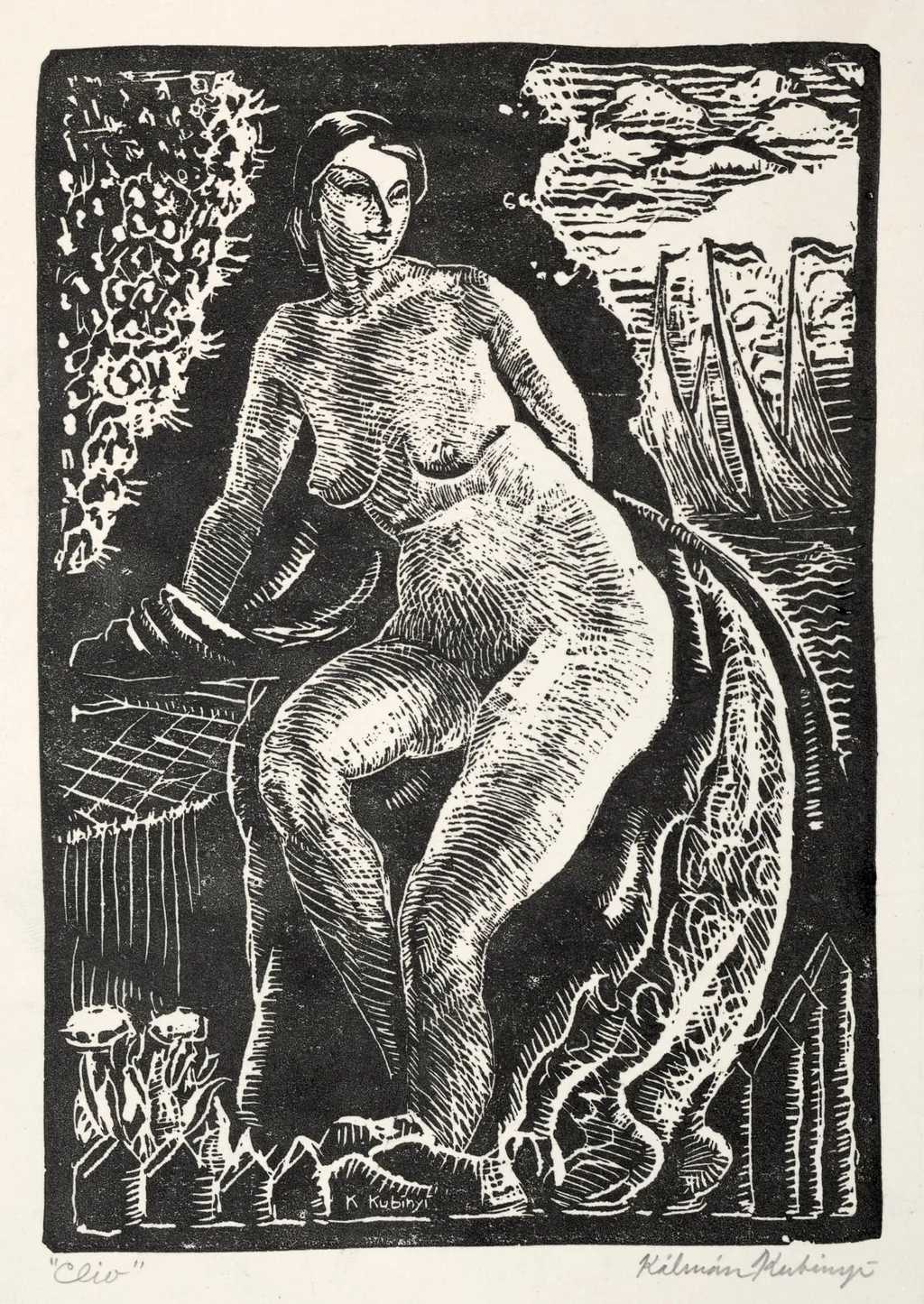
Clio is a print by Kálmán Kubinyi. It dates from 1930 and is held in the collection of the Cleveland Museum of Art.
About this work
Overview
Clio, an etching created by Kálmán Kubinyi around 1930, diverges from the artist's typical industrial and urban subjects, instead portraying a serene nude figure in a contemplative pose.
Subject & Meaning
The work depicts a nude woman seated in a chair, exuding calmness and serenity. Her relaxed posture and gentle facial expression suggest a moment of introspection, contrasting with Kubinyi's more common themes of the machine age.
Technique & Style
Kubinyi utilizes chiaroscuro, a technique emphasizing strong light and dark contrasts, to create depth and volume in the piece. This approach highlights the subject's form against a dark, ambiguously defined background.
History & Provenance
Although the exact exhibition history of *Clio* is not detailed here, Kubinyi's work was frequently showcased in the 1930s at prominent international events like the Venice Biennale and the New York World's Fair.
Context
While *Clio* stands out from Kubinyi's predominant Social Realist and modernist themes focused on industry and urban life, it reflects the artist's versatility within his broader exploration of everyday subjects.
Legacy
The legacy of *Clio* is not explicitly outlined in the provided information, though it contributes to the diverse oeuvre of Kálmán Kubinyi, an artist associated with the Cleveland School of modernist and Social Realist artists.
Artist & collection
Artist
Kálmán Mátyás Béla Kubinyi (June 29, 1906 Cleveland – September 3, 1973 Stockbridge, Massachusetts) was an influential etcher, engraver and enamelist and a member of the so-called Cleveland School, a number of…