Artwork
冨嶽三十六景 駿州江尻|Ejiri in Suruga Province (Sunshū Ejiri), from the series Thirty-six Views of Mount Fuji (Fugaku sanjūrokkei)
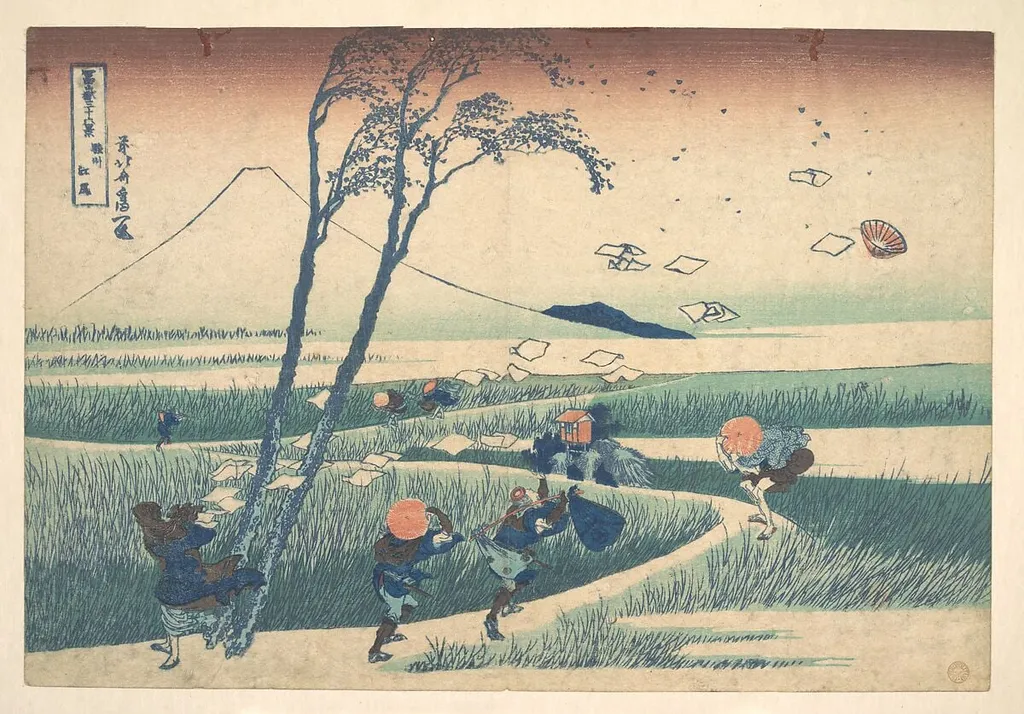
冨嶽三十六景 駿州江尻|Ejiri in Suruga Province (Sunshū Ejiri), from the series Thirty-six Views of Mount Fuji (Fugaku sanjūrokkei) is an ink print by the Japonisme artist Katsushika Hokusai. It dates from 1831 and is held in the collection of the Metropolitan Museum of Art.
About this work
Overview
Created around 1831, this woodblock print is part of Katsushika Hokusai’s series Thirty-six Views of Mount Fuji. Executed in ink and color on paper, it depicts a quiet moment in Suruga Province with Mount Fuji visible on the horizon. The scene balances human activity with natural elements, reflecting the series’ focus on everyday life framed by the sacred mountain.
Subject & Meaning
Four riders on horseback chase a small wooden box across a grassy plain, suggesting a local game or contest. The activity is unremarkable in itself, yet its placement beneath the distant, serene form of Mount Fuji imbues it with quiet significance. The mountain, ever-present but uninvolved, anchors the composition as a symbol of constancy amid transient human pursuits.
Technique & Style
Hokusai employed bold, flat areas of color—deep blues, earthy greens, and touches of red—to define forms with clarity. The sky is rendered with subtle gradations, while the distant mountain is minimized in scale to emphasize perspective. Fine linear details, including cross-hatching in the grass and tree bark, add texture and depth without overwhelming the composition’s simplicity.
History & Provenance
The print was produced during the peak of Hokusai’s career, when ukiyo-e prints were widely circulated among the merchant class. This impression is held by The Metropolitan Museum of Art, acquired as part of a broader collection of Japanese prints in the early 20th century. Its survival in good condition reflects its popularity and careful preservation over time.
Context
The Thirty-six Views series emerged during a period of growing public interest in travel and landscape in Edo-period Japan. Mount Fuji, a spiritual and cultural icon, was a unifying motif across diverse regional scenes. Hokusai’s approach blended observation with stylization, capturing both local specificity and universal harmony between people and nature.
Legacy
This print, like others in the series, influenced Western artists in the late 19th century, contributing to the Japonisme movement. Its compositional clarity and integration of nature with daily life became models for modern graphic design and landscape representation. The work remains a touchstone for understanding the aesthetic values of Edo-period printmaking.
Artist & collection

Artist
Katsushika Hokusai spent his life in Edo, now Tokyo, where he drew and carved prints for a living.

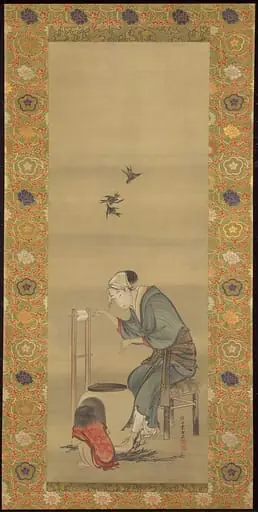
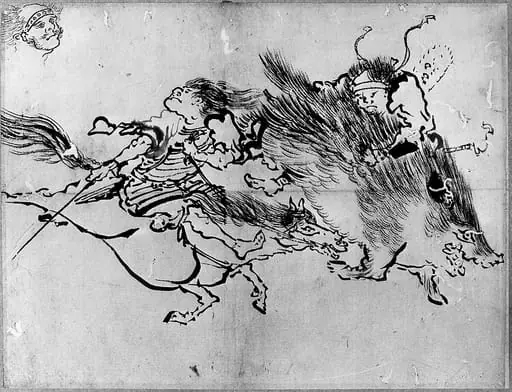
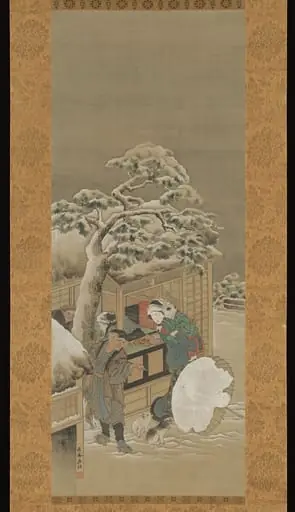
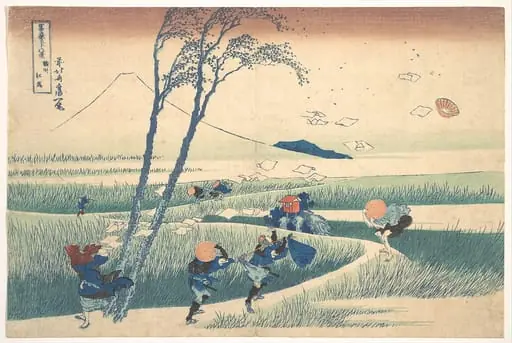 冨嶽三十六景 駿州江尻|Ejiri in Suruga Province (Sunshū Ejiri), from the series Thirty-six Views of Mount Fuji (Fugaku sanjūrokkei)
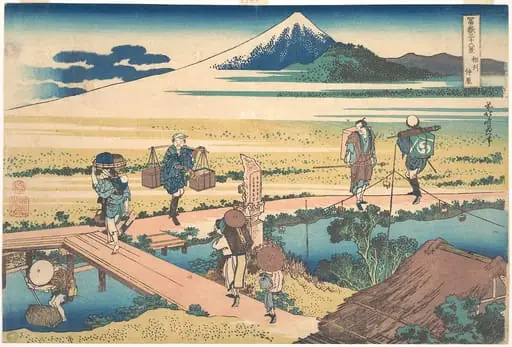 冨嶽三十六景 相州仲原|Nakahara in Sagami Province (Sōshū Nakahara), from the series Thirty-six Views of Mount Fuji (Fugaku sanjūrokkei)
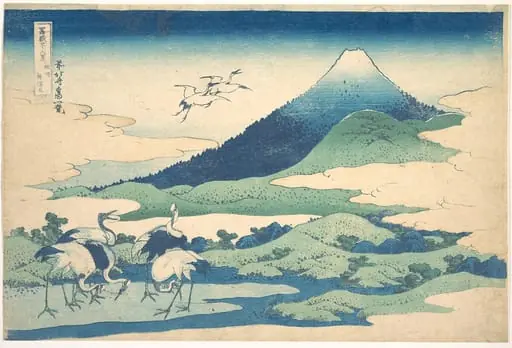 冨嶽三十六景 相州梅沢左|Umezawa Manor in Sagami Province (Sōshū Umezawa zai), from the series Thirty-six Views of Mount Fuji (Fugaku sanjūrokkei)
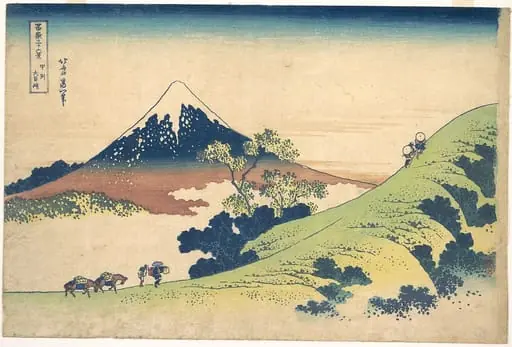 冨嶽三十六景 甲州犬目峠|The Inume Pass in Kai Province (Kōshū Inume tōge), from the series Thirty-six Views of Mount Fuji (Fugaku sanjūrokkei)
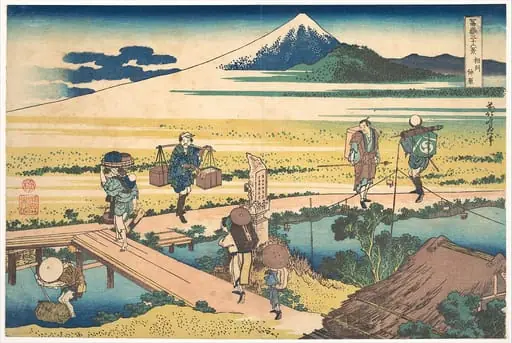 冨嶽三十六景 相州仲原|Nakahara in Sagami Province (Sōshū Nakahara), from the series Thirty-six Views of Mount Fuji (Fugaku sanjūrokkei)
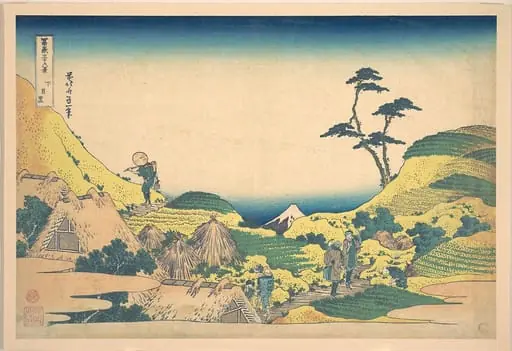 冨嶽三十六景 下目黒|Lower Meguro (Shimo Meguro), from the series Thirty-six Views of Mount Fuji (Fugaku sanjūrokkei)
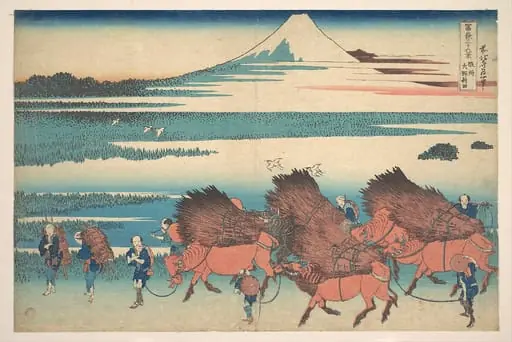 冨嶽三十六景 駿州大野新田|The New Fields at Ōno in Suruga Province (Sunshū Ōno shinden), from the series Thirty-six Views of Mount Fuji (Fugaku sanjūrokkei)
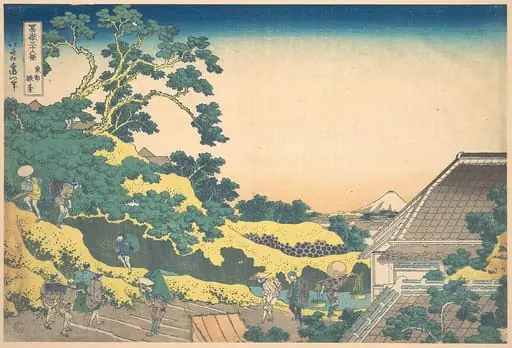 冨嶽三十六景 東都駿台|Surugadai in Edo (Tōto Sundai), from the series Thirty-six Views of Mount Fuji (Fugaku sanjūrokkei)