Artwork
冨嶽三十六景 隠田の水車|The Waterwheel at Onden (Onden no suisha), from the series Thirty-six Views of Mount Fuji (Fugaku sanjūrokkei)
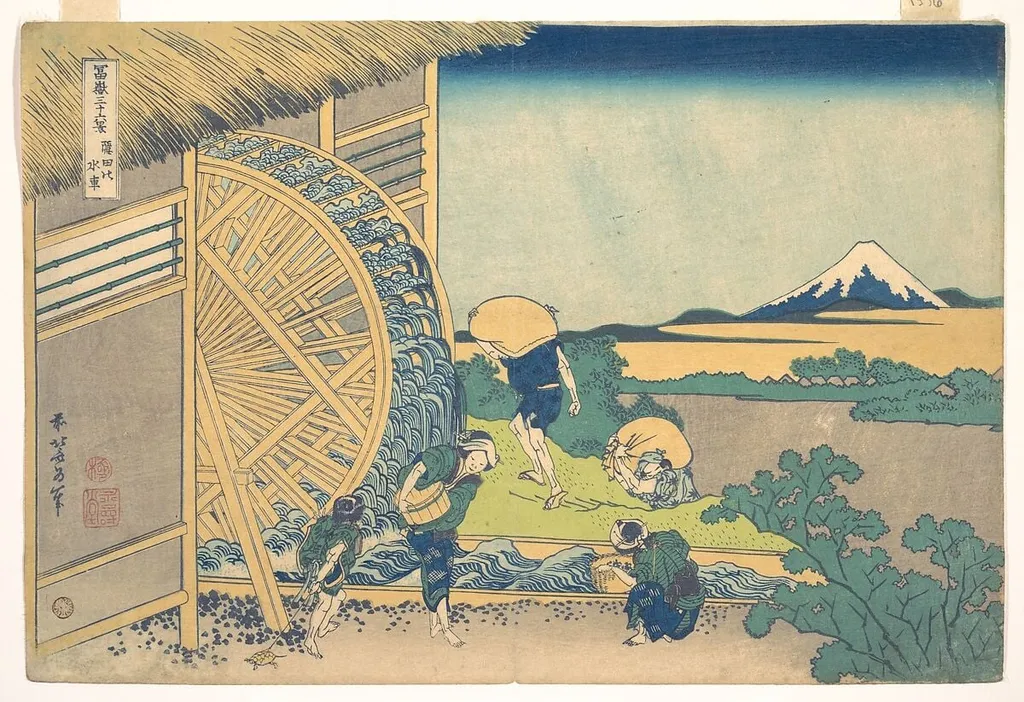
冨嶽三十六景 隠田の水車|The Waterwheel at Onden (Onden no suisha), from the series Thirty-six Views of Mount Fuji (Fugaku sanjūrokkei) is an ink print by the Japonisme artist Katsushika Hokusai. It dates from 1831 and is held in the collection of the Metropolitan Museum of Art.
About this work
Overview
The composition balances human activity with the distant presence of Mount Fuji, rendered in soft blue against a pale sky.
Created around 1831 by Katsushika Hokusai, this woodblock print is part of the series Thirty-six Views of Mount Fuji. It depicts a rural scene centered on a wooden waterwheel beside a river, with figures engaged in daily labor. The composition balances human activity with the distant presence of Mount Fuji, rendered in soft blue against a pale sky. The print exemplifies the ukiyo-e tradition of capturing ordinary life within a broader natural landscape.
Subject & Meaning
The scene portrays quiet rural industry: three individuals tend to the waterwheel, likely used for grinding grain or mechanical tasks. One carries a load, another works near the water, and a third rests on the ground. The mountain in the distance, though not dominant, anchors the scene in the series’ recurring theme—human life intertwined with Fuji’s enduring presence. The work suggests dignity in labor, not as spectacle but as routine, woven into the land.
Technique & Style
Hokusai employed flat planes of color and simplified forms, typical of ukiyo-e printing. The waterwheel and fence are outlined with clean, firm lines, while the mountain is rendered in a single wash of Prussian blue. Depth is suggested through layering rather than perspective—foreground figures are larger, background elements smaller. The use of limited pigments enhances clarity, emphasizing structure over detail.
History & Provenance
This print was produced during the peak of Hokusai’s career, when the Thirty-six Views series was widely circulated in Edo. It entered the collection of The Metropolitan Museum of Art through established channels of early 20th-century Japanese art acquisition. While individual impressions vary, this version retains the original ink and color integrity, reflecting its careful preservation over nearly two centuries.
Context
In early 19th-century Japan, waterwheels were vital to rural economies, powering mills and workshops. Hokusai’s choice to include such machinery reflects a growing interest in the mechanics of daily life. The series as a whole responded to rising domestic travel and print culture, offering viewers a visual tour of Japan’s landscapes—not just its grand vistas, but its working edges.
Legacy
This print, like others in the series, influenced Western artists in the late 19th century through its compositional clarity and use of color. Its quiet focus on labor and environment diverged from traditional heroic or mythological subjects, helping redefine what constituted worthy artistic content. Today, it remains a key example of how Japanese printmakers elevated the mundane into enduring visual form.
Artist & collection

Artist
Katsushika Hokusai spent his life in Edo, now Tokyo, where he drew and carved prints for a living.

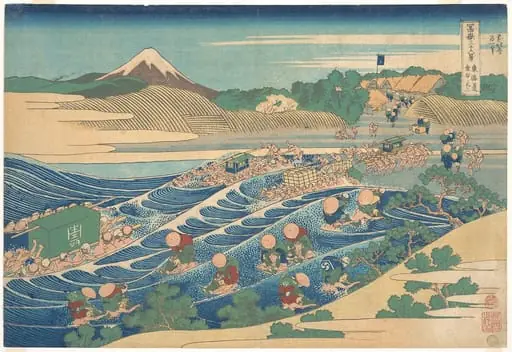 冨嶽三十六景 東海道金谷の不二|Fuji Seen from Kanaya on the Tōkaidō (Tōkaidō Kanaya no Fuji), from the series Thirty-six Views of Mount Fuji (Fugaku sanjūrokkei)
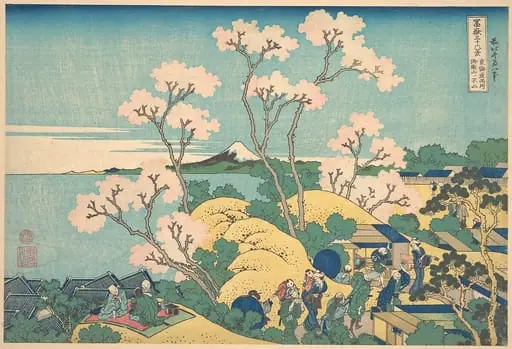 冨嶽三十六景 東海道品川御殿山の不二|Fuji from Gotenyama on the Tōkaidō at Shinagawa (Tōkaidō Shinagawa Gotenyama no Fuji), from the series Thirty-six Views of Mount Fuji (Fugaku sanjūrokkei)
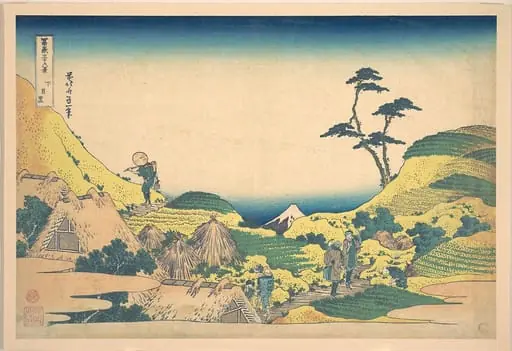 冨嶽三十六景 下目黒|Lower Meguro (Shimo Meguro), from the series Thirty-six Views of Mount Fuji (Fugaku sanjūrokkei)
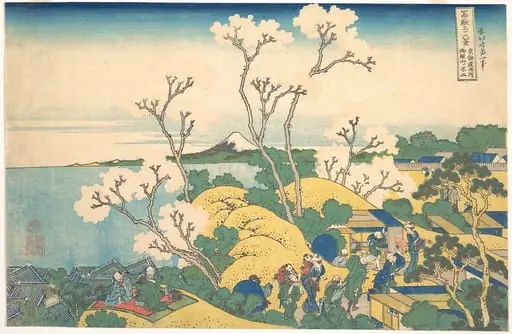 冨嶽三十六景 東海道品川御殿山の不二|Fuji from Gotenyama at Shinagawa on the Tōkaidō (Tōkaidō Shinagawa Gotenyama no Fuji), from the series Thirty-six Views of Mount Fuji (Fugaku sanjūrokkei)
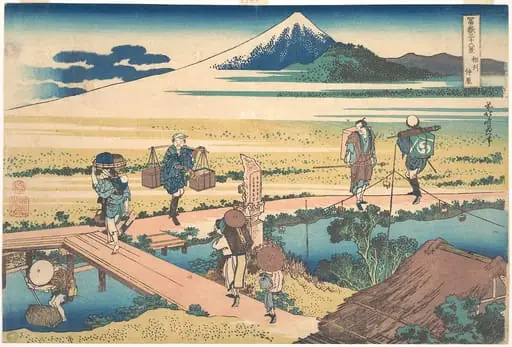 冨嶽三十六景 相州仲原|Nakahara in Sagami Province (Sōshū Nakahara), from the series Thirty-six Views of Mount Fuji (Fugaku sanjūrokkei)
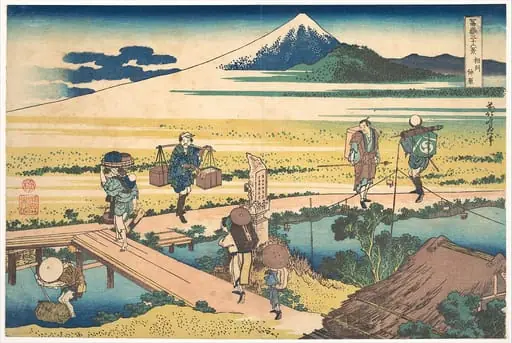 冨嶽三十六景 相州仲原|Nakahara in Sagami Province (Sōshū Nakahara), from the series Thirty-six Views of Mount Fuji (Fugaku sanjūrokkei)
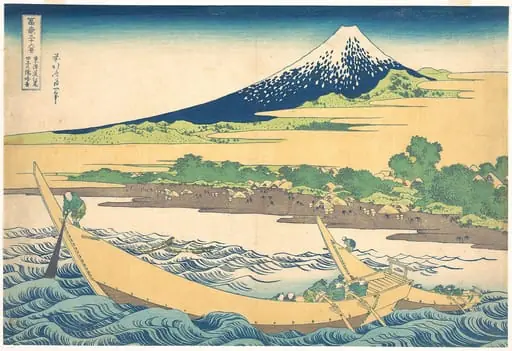 冨嶽三十六景 東海道江尻田子の浦略図|Tago Bay near Ejiri on the Tōkaidō (Tōkaidō Ejiri Tago no ura ryaku zu), from the series Thirty-six Views of Mount Fuji (Fugaku sanjūrokkei)