Artwork
A group of dancing-girls and musicians
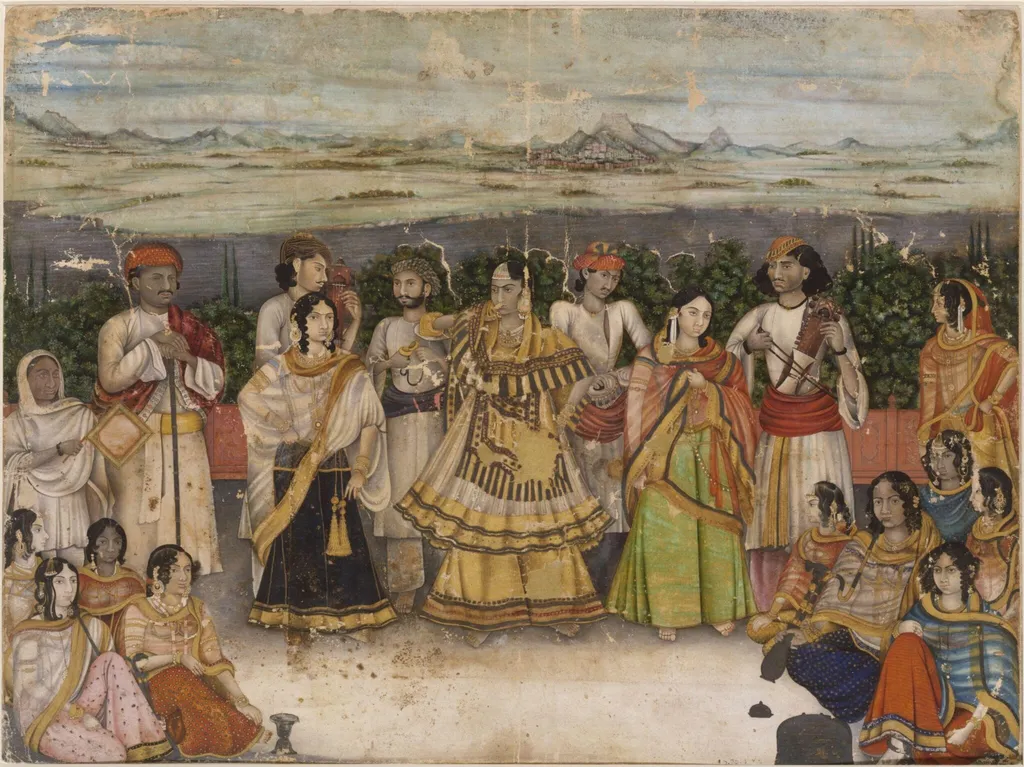
A group of dancing-girls and musicians is a paint painting by the Patna School of Painting artist Faiz Ali Khan. It dates from 1815 and is held in the collection of the Victoria and Albert Museum.
About this work
Overview
This painting belongs to a set of four works created around 1815, likely by the Indian artist Faiz Ali Khan, intended for European patrons in Delhi.
This painting belongs to a set of four works created around 1815, likely by the Indian artist Faiz Ali Khan, intended for European patrons in Delhi. It exemplifies the 'Company style'—a hybrid genre developed by local artists to meet the tastes of British officials and other residents of the Indian subcontinent under East India Company rule. The format blends indigenous Indian composition with Western naturalism, reflecting a commercial art market shaped by cross-cultural demand.
Subject & Meaning
The scene depicts a performance by three female dancers and four male musicians before a seated male official and a group of women, some engaged with huqqas. The setting suggests an intimate, possibly domestic or courtly entertainment, common in elite Delhi circles. The inclusion of both performers and spectators conveys social hierarchy and leisure practices, while the presence of European-style framing and lighting implies the patron’s desire for familiar visual conventions.
Technique & Style
The artist employs fine brushwork and muted tonal gradations, incorporating Western techniques such as soft modeling and spatial depth, while retaining Indian attention to pattern and detail. Facial features are rendered with delicate precision, and the use of sfumato-like transitions in shadows creates a subtle atmospheric effect. Unlike traditional Indian miniatures, the composition avoids flat planes, instead suggesting a shallow, receding space consistent with European pictorial norms.
History & Provenance
Created during the early 19th century in Delhi, the painting was likely produced for a British East India Company official or associate. Such works were often commissioned as souvenirs or ethnographic records. The set of four paintings may have been assembled as a visual catalog of Delhi’s social types. Their survival in private and institutional collections today reflects their role as cultural artifacts bridging colonial and indigenous worlds.
Context
Company paintings emerged as a distinct genre when Indian artists adapted their techniques to satisfy European preferences for realism, perspective, and portraiture. This work reflects the complex cultural negotiations of colonial Delhi, where local artisans navigated patronage from foreign elites while preserving elements of their own visual traditions. The depiction of musicians and dancers also speaks to the continued presence of performance arts in urban elite life despite shifting political powers.
Legacy
These works serve as historical records of social customs, dress, and performance in early colonial India. Though initially dismissed as derivative, Company paintings are now recognized for their unique synthesis of artistic traditions. They offer insight into how Indian artists negotiated identity and commerce under colonial rule, preserving indigenous subjects through a lens shaped by foreign expectations.
Artist & collection
Artist

 The Meeting of Radha and Krishna in the Forest of Brindaban
 Untitled
 Vasanta Raga
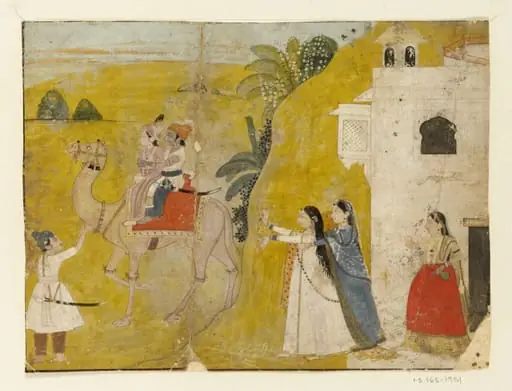 Sassi and Punun
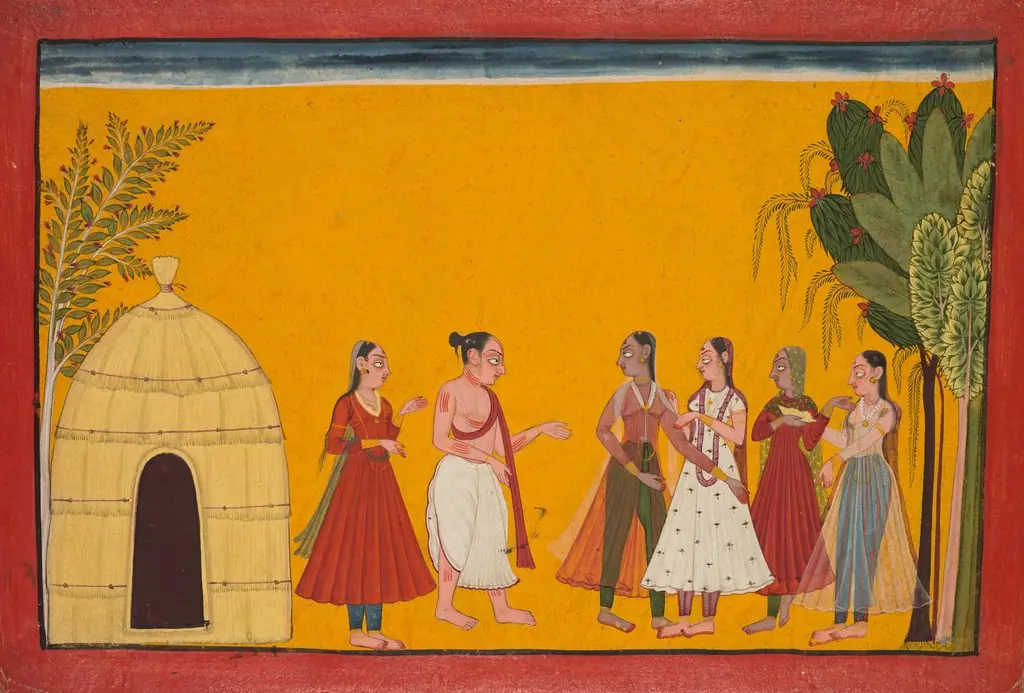 The royal priest Shatananda confirms that the four princesses of Mithila should marry the sons of King Dasharatha, from Chapter 70 of the Bala Kanda (Book of Childhood), folio 13 from a “Shangri” Ramayana (Rama’s Journey)
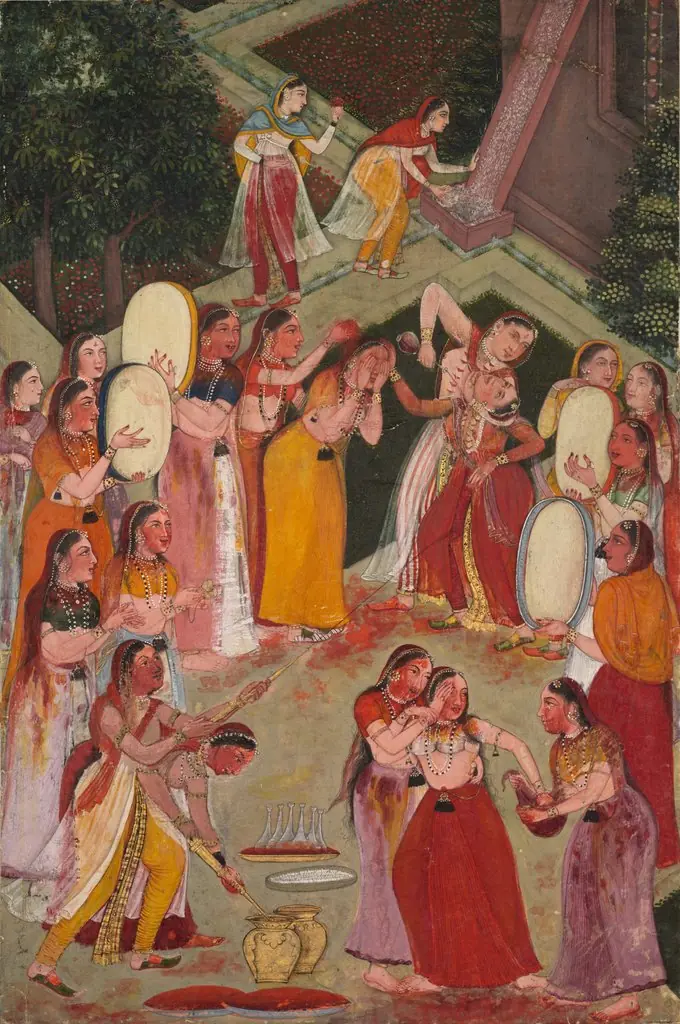 Girls Spraying Each Other at Holi
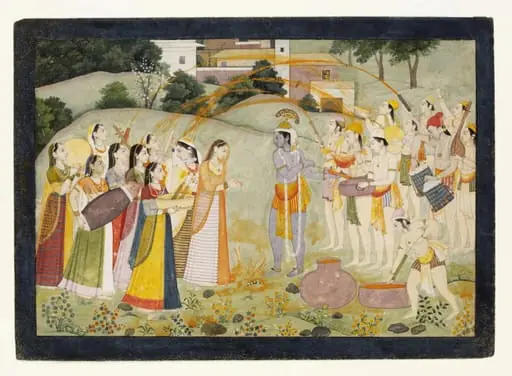 Krishna and Radha
 A blindfolded suitor is brought before a princess (recto)
 A blindfolded suitor is brought before a princess; verso: scrolling floral vines
 Maharaja Raj Singh