Artwork
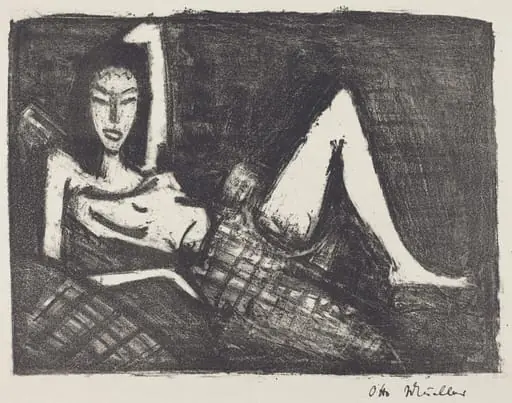
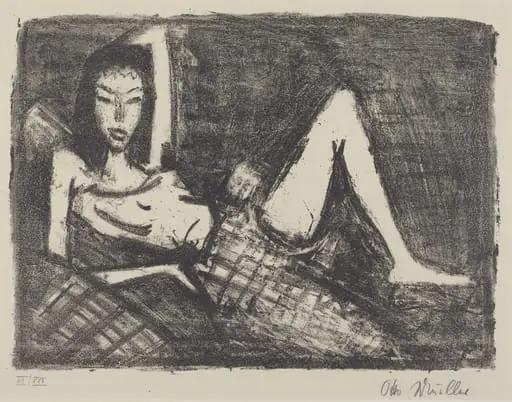
Nude Girl Lying on a Sofa
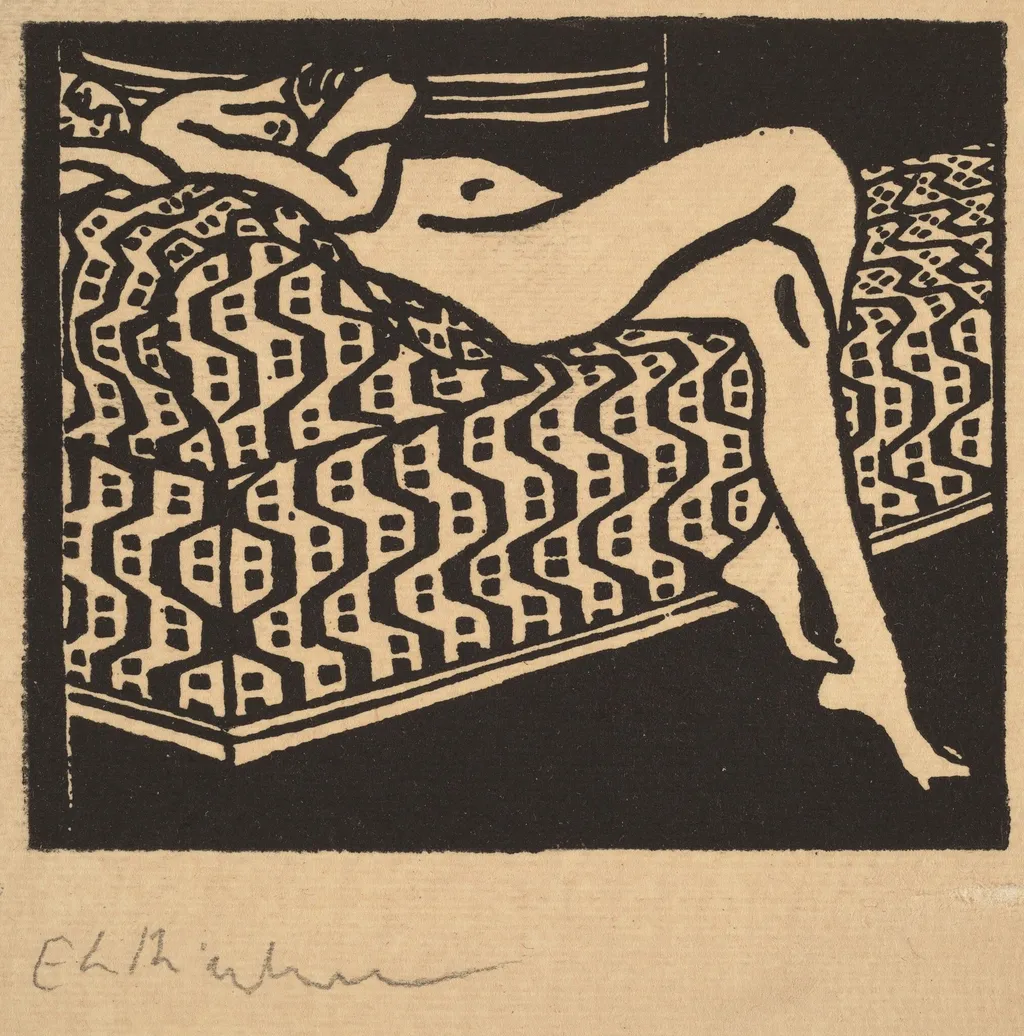
Nude Girl Lying on a Sofa is an ink print by Ernst Ludwig Kirchner. It dates from 1905 and is held in the collection of the National Gallery of Art.
About this work
Overview
Created in 1905, *Nude Girl Lying on a Sofa* is a black woodcut by German artist Ernst Ludwig Kirchner.
Created in 1905, *Nude Girl Lying on a Sofa* is a black woodcut by German artist Ernst Ludwig Kirchner. Executed in a single ink tone against the natural tone of the paper, the print exemplifies Kirchner’s early engagement with printmaking as a vehicle for emotional expression. It belongs to a series of works produced during the formative years of Die Brücke, the artist collective he co-founded, which sought to break from academic traditions through raw, direct visual language.
Subject & Meaning
The figure, a young woman reclining on a sofa, is depicted with unidealized simplicity, her posture relaxed yet charged with quiet presence. The setting—interior with a patterned textile and a window framing a tree branch—suggests a private, intimate space. Kirchner avoids romanticization; instead, the subject’s anonymity and the flattened environment emphasize psychological immediacy over narrative detail, reflecting Expressionism’s focus on inner experience over external realism.
Technique & Style
Kirchner employed the woodcut technique, carving lines directly into a wooden block to create bold, angular forms. The image relies entirely on contrast between black ink and the paper’s off-white surface, eliminating gradation and modeling. Sharp, rhythmic contours define the figure, furniture, and foliage, while the sofa’s geometric pattern introduces a stylized tension. This reduction to essential lines and shapes aligns with Die Brücke’s rejection of naturalism in favor of expressive abstraction.
History & Provenance
The print emerged from Kirchner’s Dresden period, when he and fellow Die Brücke artists experimented with printmaking as a democratic medium. It was produced before his later exile and the Nazi campaign against so-called 'degenerate art,' which led to the destruction of hundreds of his works. Though its early ownership is undocumented, the print survives as part of a broader body of work that documented the group’s radical aesthetic during its most inventive phase.
Context
In early 20th-century Germany, traditional academic art dominated institutions, but Kirchner and Die Brücke sought to revive the emotional power of medieval and non-Western art forms. Woodcut, with its tactile immediacy and folk associations, became a key medium for their rebellion. *Nude Girl Lying on a Sofa* reflects this interest in primal expression, aligning with contemporary shifts in psychology and modern life that prioritized subjective perception over objective representation.
Legacy
The work remains a defining example of early Expressionist printmaking, influencing later artists who embraced line and contrast to convey psychological states. Its stripped-down aesthetic and unidealized subject matter challenged conventions of the nude in Western art. Though Kirchner’s reputation suffered under Nazi persecution, postwar scholarship reaffirmed his role in redefining modern printmaking through emotional honesty and formal innovation.
Own this work as a print
Artist & collection

Artist
Ernst Ludwig Kirchner (6 May 1880 – 15 June 1938) was a German expressionist painter and printmaker.

![Dance Hall Bellevue [obverse], by Ernst Ludwig Kirchner](https://artifactworldgallery.com/img/ernst-ludwig-kirchner--dance-hall-bellevue-obverse--d1e14aac4297c69e-w320.webp)
![Nude Figure [reverse], by Ernst Ludwig Kirchner](https://artifactworldgallery.com/img/ernst-ludwig-kirchner--nude-figure-reverse--4b135f0364753e98-w320.webp)
![Two Nudes [obverse], by Ernst Ludwig Kirchner](https://artifactworldgallery.com/img/ernst-ludwig-kirchner--two-nudes-obverse--eb3914183f0bc96d-w320.webp)
![Dancing Couple in the Snow [reverse], by Ernst Ludwig Kirchner](https://artifactworldgallery.com/img/ernst-ludwig-kirchner--dancing-couple-in-the-snow-reverse--87ca007d7c05b553-w320.webp)