Artwork
Three Bathers in the Sea
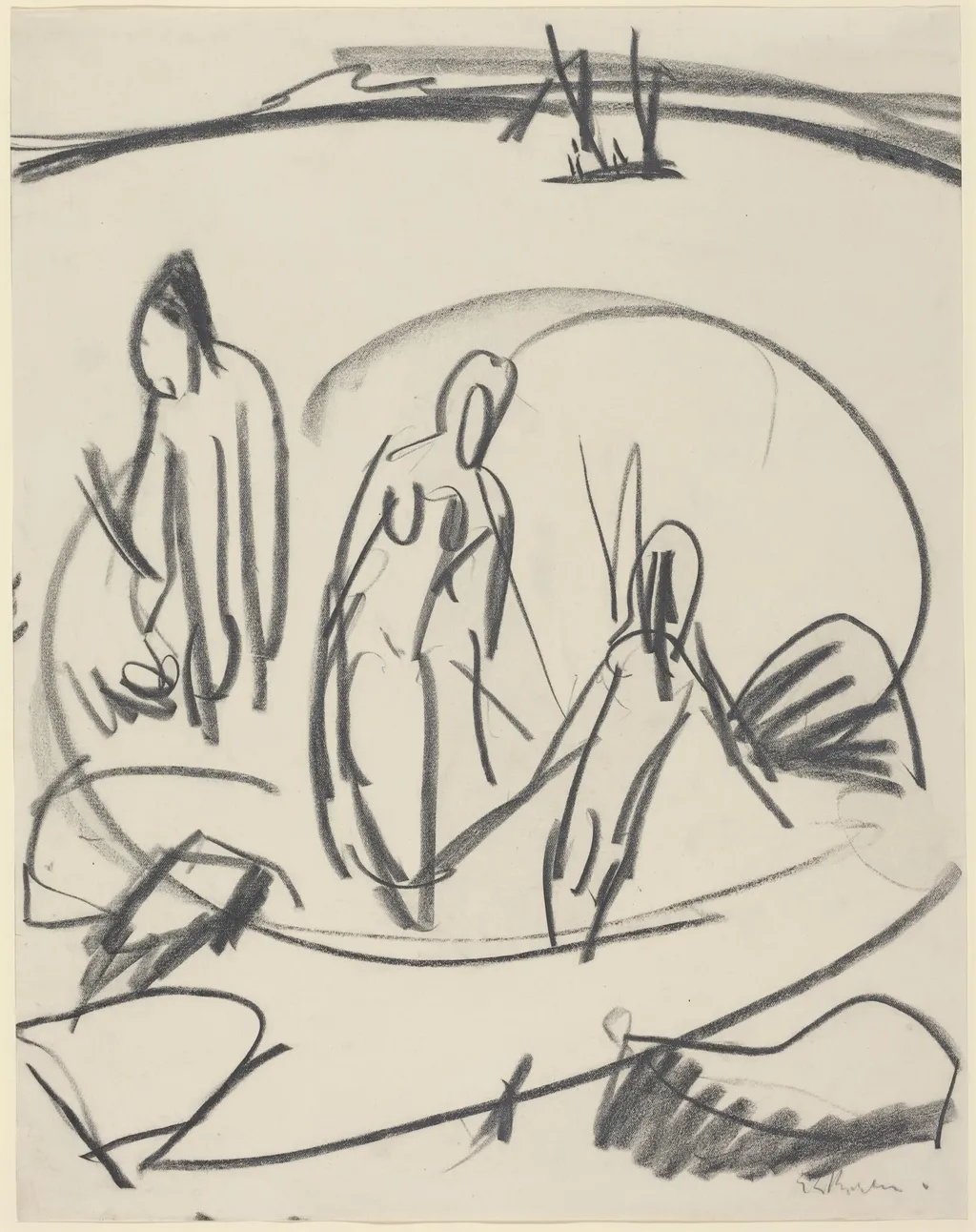
Three Bathers in the Sea is a crayon drawing by Ernst Ludwig Kirchner. It dates from 1914 and is held in the collection of the National Gallery of Art.
About this work
Overview
Ernst Ludwig Kirchner created this drawing in 1914 using black crayon on paper. As a key figure in the German Expressionist movement and co-founder of Die Brücke, he often explored the human form in natural settings. This work is a spontaneous study, capturing movement and presence with minimal means. Its raw, unpolished quality reflects the artist’s interest in immediacy over refinement.
Subject & Meaning
The drawing shows three nude figures in a coastal environment: two standing waist-deep in water, arms raised, and a third seated on the shore with bent legs.
The drawing shows three nude figures in a coastal environment: two standing waist-deep in water, arms raised, and a third seated on the shore with bent legs. Their poses suggest rest, interaction, or ritual, but no narrative is fixed. The figures are rendered without individualizing detail, emphasizing collective presence over identity. The setting evokes a quiet, unidealized moment of human connection with nature.
Technique & Style
Kirchner used only black crayon to create bold, gestural lines that define form and motion. The strokes are uneven and rapid, conveying energy rather than precision. Background elements like waves and rocks are suggested through loose, scribbled marks, leaving much to the viewer’s interpretation. The contrast between the dark lines and the untouched paper heightens the drawing’s urgency and emotional tone.
History & Provenance
Made in 1914, the work predates Kirchner’s wartime trauma and the Nazi campaign against modern art. It belongs to a series of seaside studies from his time in Moritzburg and Fehmarn, where he sought refuge and inspiration. The drawing remained in private hands until entering a public collection, its survival contrasting with many of his works destroyed or confiscated during the 1930s.
Context
In the years before World War I, Kirchner and Die Brücke artists rejected academic traditions in favor of emotional authenticity. They turned to nature and the nude as subjects free from societal constraints. This drawing aligns with their broader aim to capture raw experience through simplified forms and expressive line, positioning the body as both physical and psychological presence.
Legacy
Though not widely exhibited, this drawing exemplifies Kirchner’s commitment to expressive draftsmanship. Its unfinished quality influenced later generations of artists who valued process over polish. As one of many such studies, it contributes to understanding how Expressionists translated inner states into visual language, prioritizing feeling over representation.
Artist & collection
Artist
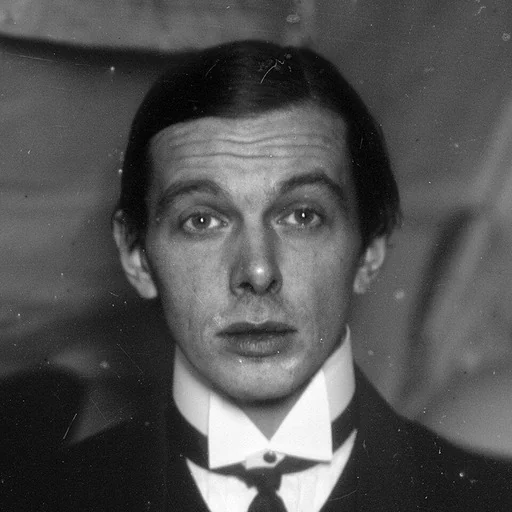
Ernst Ludwig Kirchner (6 May 1880 – 15 June 1938) was a German expressionist painter and printmaker.

![Dance Hall Bellevue [obverse], by Ernst Ludwig Kirchner](https://artifactworldgallery.com/img/ernst-ludwig-kirchner--dance-hall-bellevue-obverse--d1e14aac4297c69e-w320.webp)
![Nude Figure [reverse], by Ernst Ludwig Kirchner](https://artifactworldgallery.com/img/ernst-ludwig-kirchner--nude-figure-reverse--4b135f0364753e98-w320.webp)
![Two Nudes [obverse], by Ernst Ludwig Kirchner](https://artifactworldgallery.com/img/ernst-ludwig-kirchner--two-nudes-obverse--eb3914183f0bc96d-w320.webp)
![Dancing Couple in the Snow [reverse], by Ernst Ludwig Kirchner](https://artifactworldgallery.com/img/ernst-ludwig-kirchner--dancing-couple-in-the-snow-reverse--87ca007d7c05b553-w320.webp)
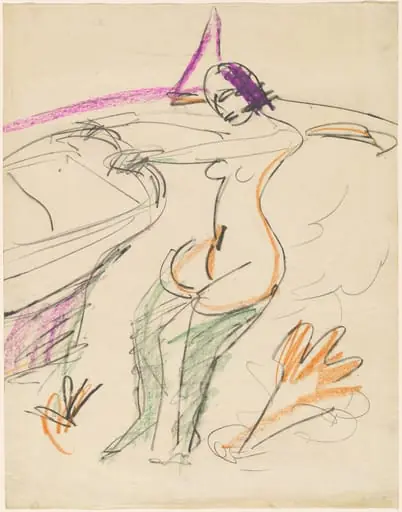 Bather
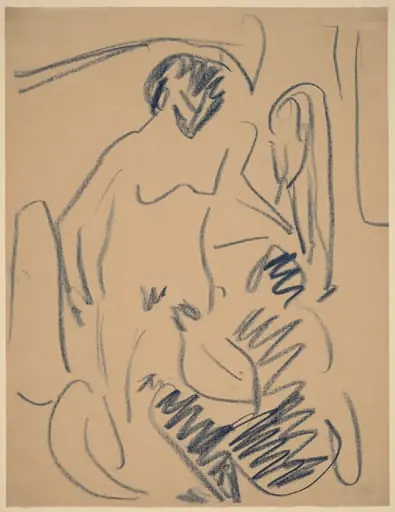 Nude on the Beach
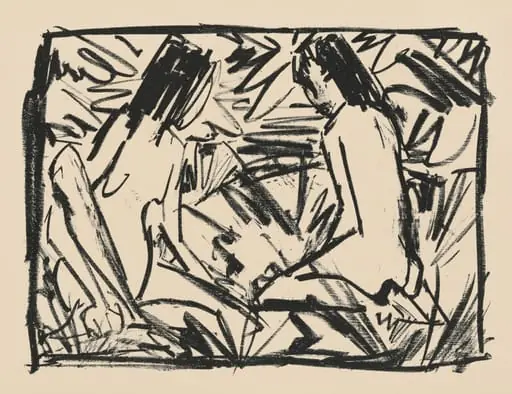 Badende (Bathers) from Deutsche Graphiker der Gegenwart (German Printmakers of Our Time)
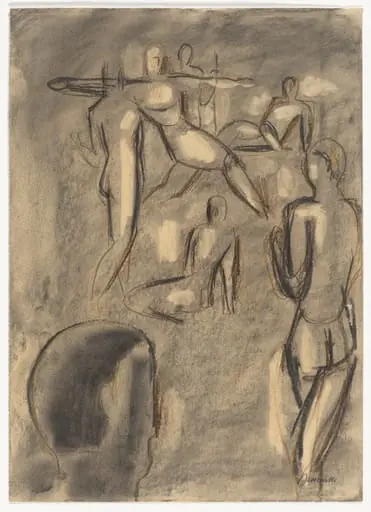 Untitled
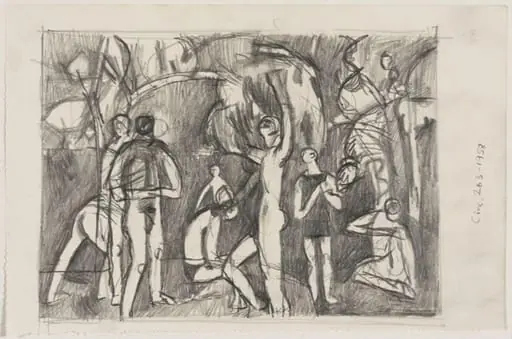 Landscape with figures
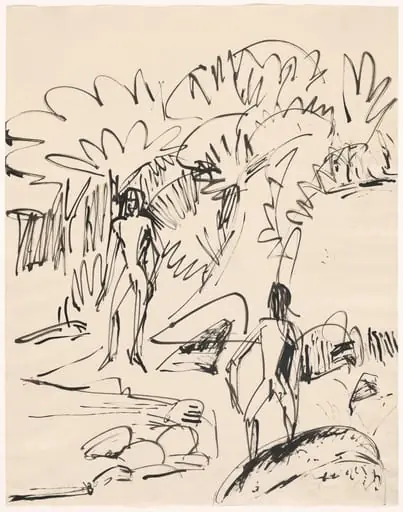 Two Bathers on the Fehmarn Coast (Zwei Badende am hoher Fehmarnküste)
 Figure group with cyclist
 Mother and Child
 Two Nudes in a Forest
 Drawing for Metal Sculpture
 Untitled
 Bather on the Beach