Artwork
Untitled
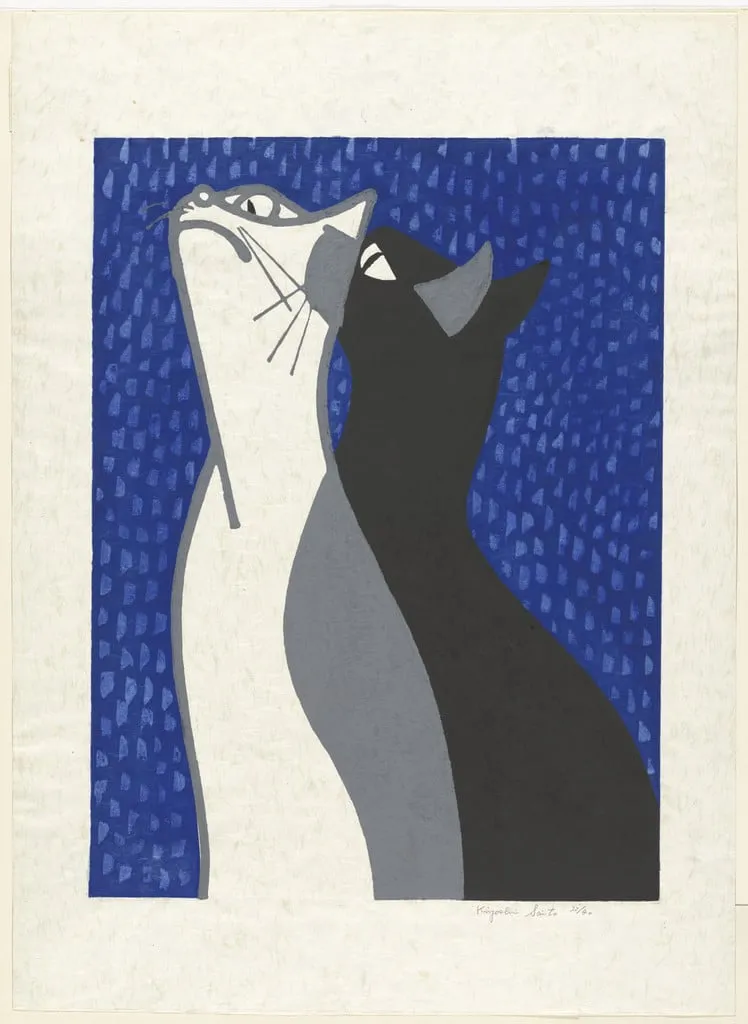
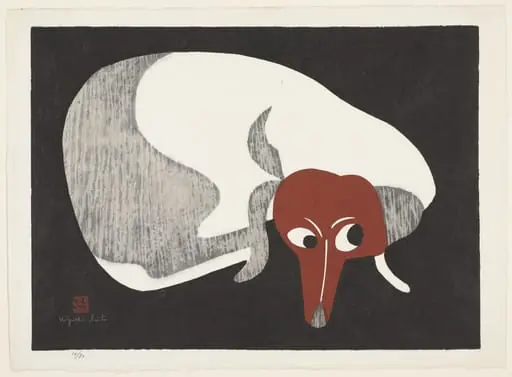
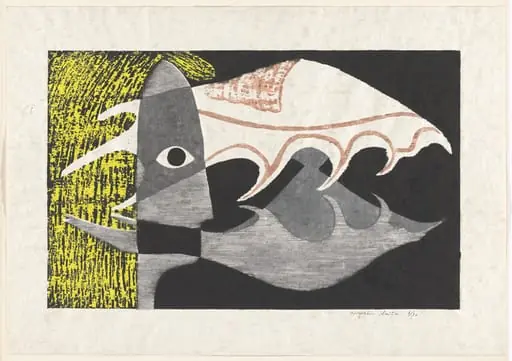
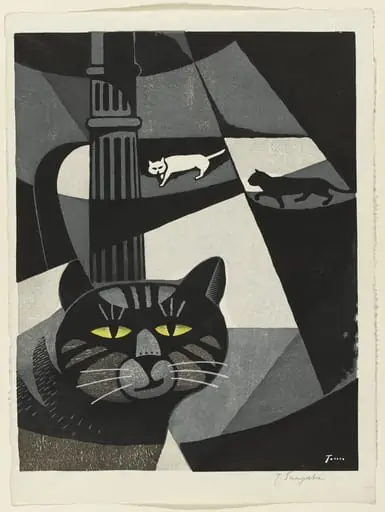
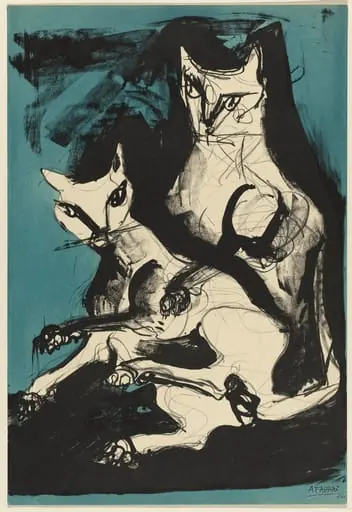
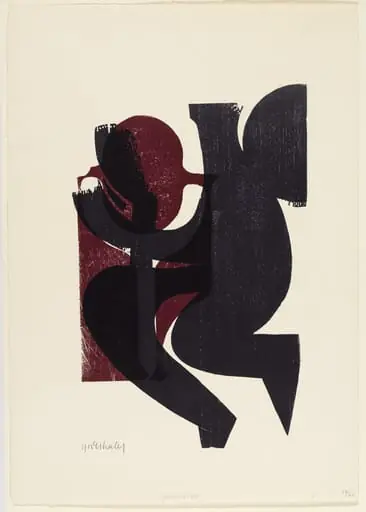
Untitled is an ink print by Kiyoshi Saito. It dates from 1952 and is held in the collection of the Museum of Modern Art. Kiyoshi Saitō produced this 1952 woodcut during a phase of refined abstraction in his printmaking career.
About this work
Overview
A central figure in Japan’s sōsaku-hanga movement, he embraced the artist-as-craftsman ideal, carving and printing his own blocks.
Kiyoshi Saitō produced this 1952 woodcut during a phase of refined abstraction in his printmaking career. A central figure in Japan’s sōsaku-hanga movement, he embraced the artist-as-craftsman ideal, carving and printing his own blocks. This work reflects his shift from detailed rural scenes toward minimalist forms, informed by both Japanese aesthetics and international modernism after his 1951 São Paulo Biennale recognition.
Subject & Meaning
Two cats, one white and one black, stand in quiet alignment, their heads tilted upward in unison. Their simplified forms suggest observation or anticipation, though no external stimulus is shown. The contrast in color and the absence of whiskers on the black cat introduce subtle asymmetry. The composition avoids narrative, inviting contemplation of stillness, duality, or quiet attention rather than literal representation.
Technique & Style
Saitō carved the image into wood and printed it using flat, unmodulated colors and strong, clean outlines. The deep blue background features faint, irregular lighter shapes, adding texture without detail. The cats’ forms are reduced to essential contours, eliminating shading and perspective. This approach reflects his mature style: geometric clarity, deliberate simplification, and a balance between traditional Japanese print methods and modernist abstraction.
History & Provenance
Created in 1952, this print emerged after Saitō’s international acclaim at the São Paulo Biennale in 1951, which elevated his profile in global art circles. While specific ownership history is not documented here, the work aligns with his output during a period when he increasingly exhibited abroad and refined his abstract idiom. It belongs to a body of prints from the early 1950s that marked his transition from figurative realism to stylized form.
Context
Saitō worked within the sōsaku-hanga movement, which emphasized the artist’s direct involvement in all stages of print production. Unlike commercial ukiyo-e, these prints were personal expressions. In postwar Japan, artists like Saitō sought new visual languages that honored tradition while engaging with global modernism. This woodcut reflects that synthesis—minimalist, non-narrative, yet rooted in Japanese compositional sensibilities.
Legacy
Saitō’s later prints, including this one, influenced how Japanese modernism was perceived internationally. His reduction of form to essential lines and flat color became a signature approach, distinguishing his work from both Western abstraction and traditional Japanese printmaking. Though less widely known than some contemporaries, his contributions helped define a quiet, contemplative strand of 20th-century Japanese print art.
Artist & collection
Artist
Kiyoshi Saitō (斎藤 清, Saitō Kiyoshi; April 27, 1907 – November 14, 1997, born in Aizubange, Fukushima) was a sōsaku-hanga artist in 20th-century Japan.