Artwork
Untitled
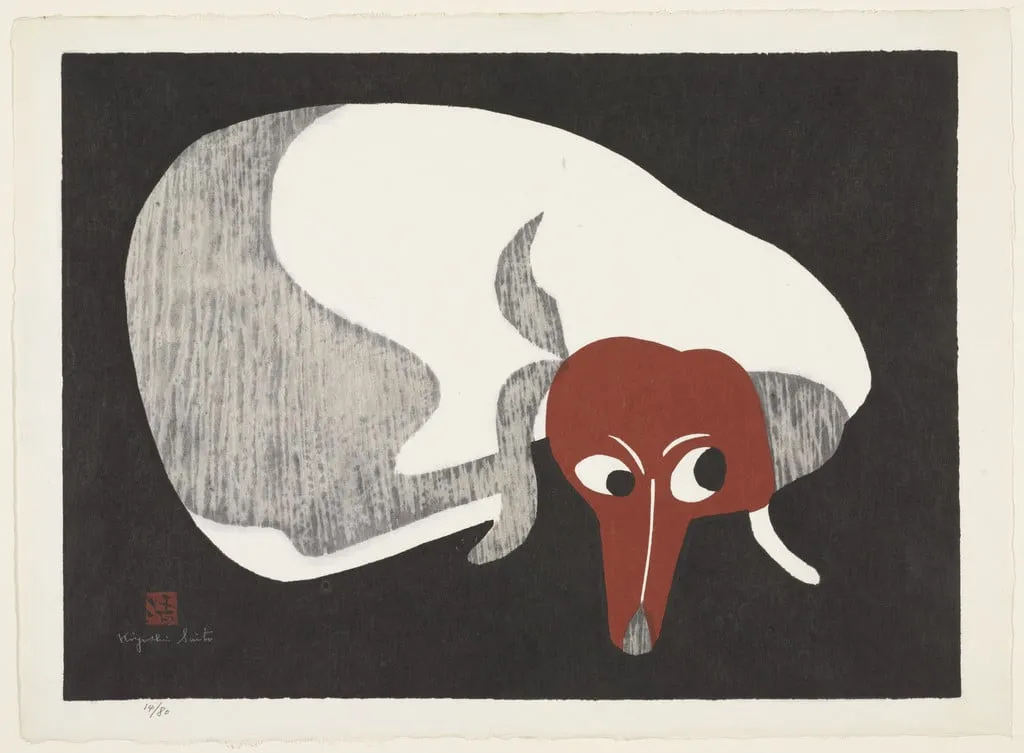
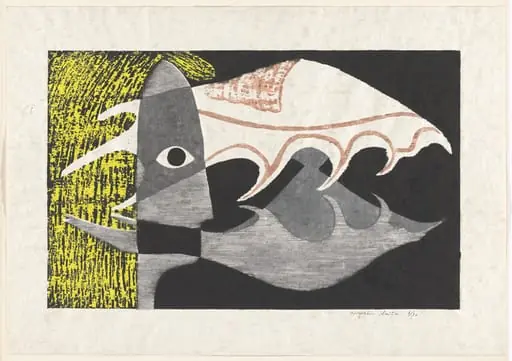
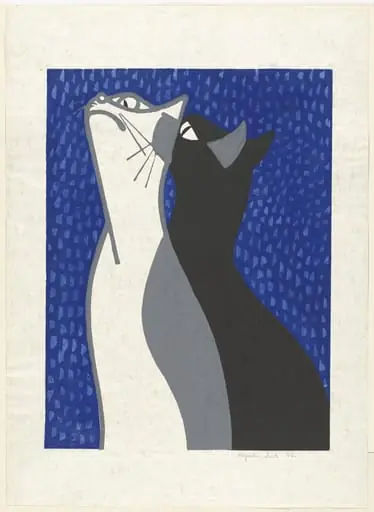
Untitled is an ink print by Kiyoshi Saito. It dates from 1954 and is held in the collection of the Museum of Modern Art.
About this work
Overview
The work belongs to the *sōsaku-hanga* movement, in which artists carved and printed their own designs, asserting full creative control.
Kiyoshi Saitō produced this woodcut in 1954 as part of his mature period, where he refined a personal visual language rooted in Japanese print traditions yet shaped by modernist abstraction. The work belongs to the *sōsaku-hanga* movement, in which artists carved and printed their own designs, asserting full creative control. Its minimalism and strong graphic presence reflect Saitō’s shift away from detailed realism toward expressive form.
Subject & Meaning
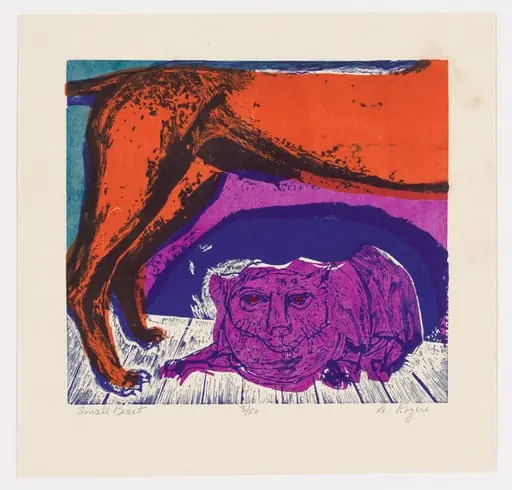
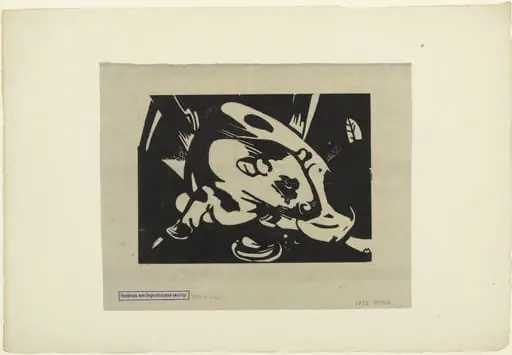
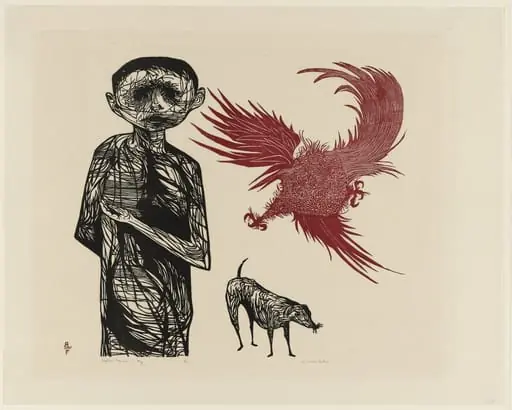
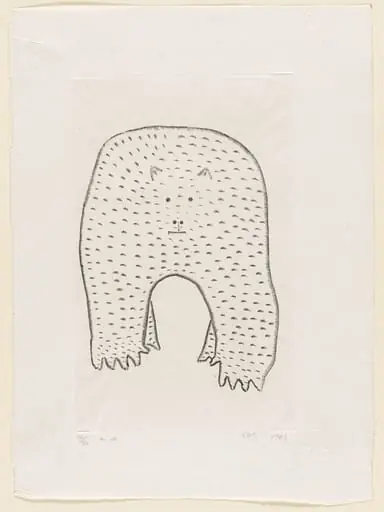
The image depicts a stylized animal, likely a dog, curled in a resting posture. Rendered with simplified contours and minimal detail, the form conveys stillness rather than narrative. The animal’s closed eyes and relaxed shape suggest repose, evoking quietude rather than action. The absence of context or environment focuses attention on the creature’s presence, transforming a common subject into a meditative symbol.
Technique & Style
Saitō employed woodcut techniques to achieve bold, flat planes of color and sharp contrasts. The white and gray body against a black background creates strong visual tension, while the brown head adds subtle tonal variation. Lines are clean and deliberate, with no shading or texture—each form reduced to its essential silhouette. This approach reflects his interest in Japanese aesthetics and modernist design principles.
History & Provenance
Created during Saitō’s most internationally recognized phase, this print entered the collection of The Museum of Modern Art in New York, affirming its significance in postwar Japanese printmaking. It was produced after his travels to Europe and the Americas, which influenced his formal experimentation. The work remains part of MoMA’s permanent holdings, representing the global reach of *sōsaku-hanga*.
Context
In the 1950s, Japanese artists like Saitō redefined traditional printmaking by rejecting commercial collaboration and embracing individual authorship. While earlier *ukiyo-e* prints were mass-produced by teams, *sōsaku-hanga* artists handled every step themselves. Saitō’s work, though abstracted, retained references to nature and architecture, bridging premodern motifs with contemporary visual language.
Legacy
Saitō’s prints, including this one, helped establish Japanese woodcuts as serious contributions to 20th-century modern art. His reduction of form influenced later generations of printmakers who sought emotional resonance through simplicity. The work endures as an example of how traditional materials and methods could be adapted to express universal themes of calm and containment.
Artist & collection
Artist
Kiyoshi Saitō (斎藤 清, Saitō Kiyoshi; April 27, 1907 – November 14, 1997, born in Aizubange, Fukushima) was a sōsaku-hanga artist in 20th-century Japan.