Artwork
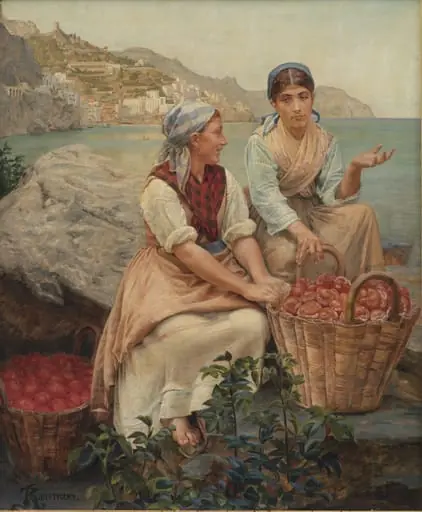
Italian girls with tomatoes in baskets
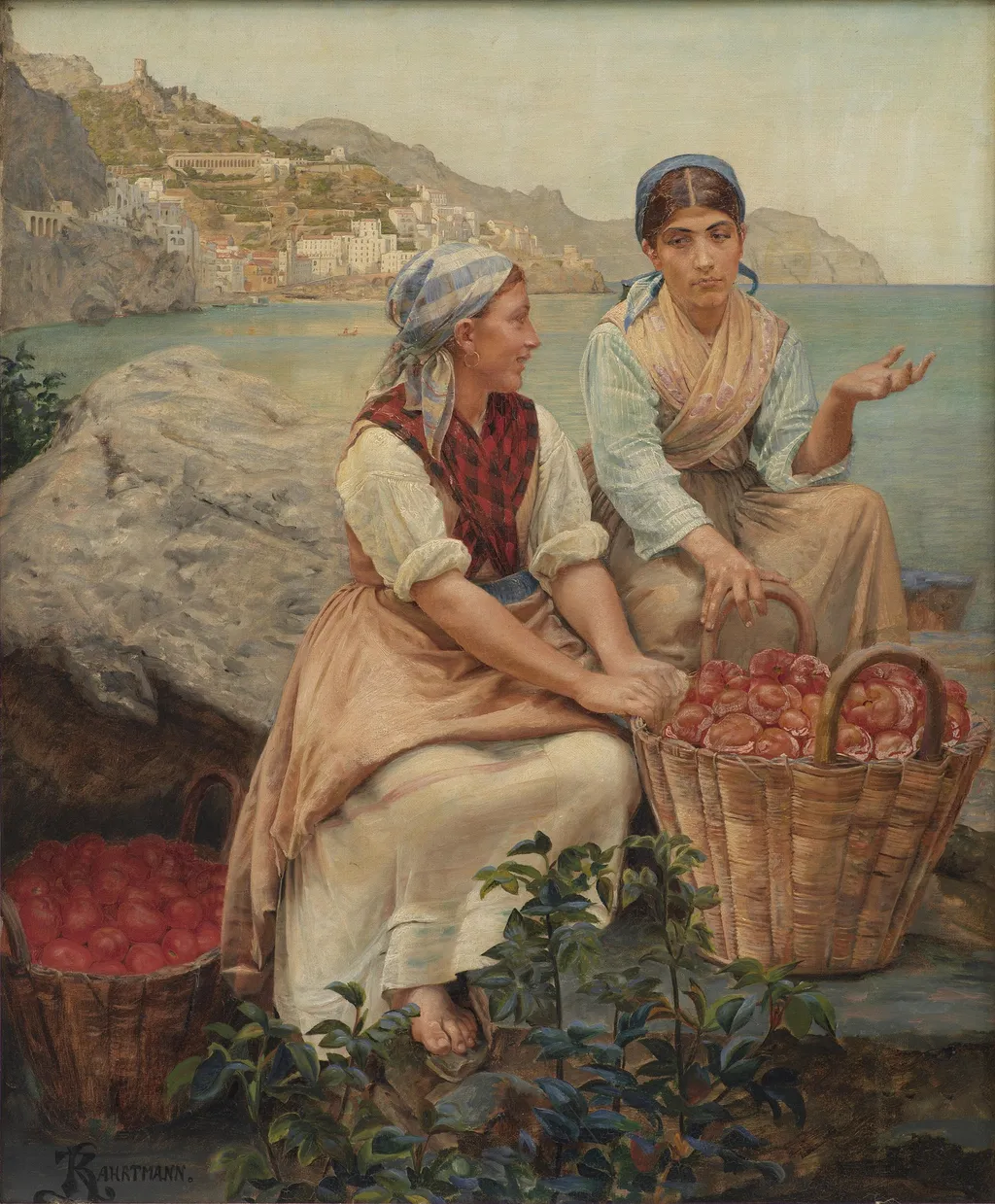
Italian girls with tomatoes in baskets is an oil painting by the Realist artist Kristian Zahrtmann. It dates from 1890 and is held in the collection of the Statens Museum for Kunst.
About this work
Overview
Though Zahrtmann is best known for historical subjects, this piece belongs to his lesser-known series of genre scenes from southern Europe.
Painted in 1890 by Danish artist Kristian Zahrtmann, this oil-on-canvas work depicts two young Italian girls resting on a rocky shoreline with baskets of tomatoes. Though Zahrtmann is best known for historical subjects, this piece belongs to his lesser-known series of genre scenes from southern Europe. It reflects his interest in everyday moments, rendered with quiet attention to light and local detail. The painting is part of the permanent collection at Statens Museum for Kunst in Copenhagen.
Subject & Meaning
The two girls, barefoot and dressed in simple regional attire, appear engaged in quiet conversation. Their postures and gestures suggest a moment of pause amid labor, perhaps after gathering or transporting tomatoes. The absence of overt narrative or symbolism invites interpretation grounded in observation rather than allegory. The scene captures a transient, unidealized instance of rural life, emphasizing dignity in routine rather than drama or sentiment.
Technique & Style
Zahrtmann employed oil paint to build a luminous, earth-toned palette dominated by ochres, greens, and warm reds from the tomatoes. Brushwork is loose yet deliberate, capturing texture in fabric, stone, and foliage without excessive detail. Light falls naturally across the figures and landscape, suggesting late afternoon sun. The composition is asymmetrical, with the girls placed off-center, enhancing the sense of spontaneity and immersion in the environment.
History & Provenance
Created during Zahrtmann’s travels in Italy, the painting entered the collection of Statens Museum for Kunst shortly after its completion. It was not exhibited widely at the time, and its significance grew gradually as scholars reevaluated his genre work beyond his more celebrated historical paintings. The work has remained in Danish public ownership since its acquisition, with no documented private ownership in its early history.
Context
In the late 19th century, Scandinavian artists increasingly traveled to southern Europe, drawn by light, color, and perceived authenticity in rural life. Zahrtmann’s Italian scenes reflect this trend, aligning with broader European Realism’s focus on ordinary people and environments. Unlike French Realists, however, he avoided social critique, favoring quiet observation. The painting resonates with contemporaneous works by artists seeking to capture regional character beyond urban or aristocratic subjects.
Legacy
While not among Zahrtmann’s most frequently reproduced works, this painting contributes to understanding his range beyond historical themes. It illustrates his sensitivity to light and local dress, influencing later Danish artists interested in genre scenes. Today, it is valued for its unembellished portrayal of labor and youth, offering a subtle counterpoint to the romanticized depictions of Mediterranean life common in 19th-century art.
Own this work as a print
Artist & collection
Artist
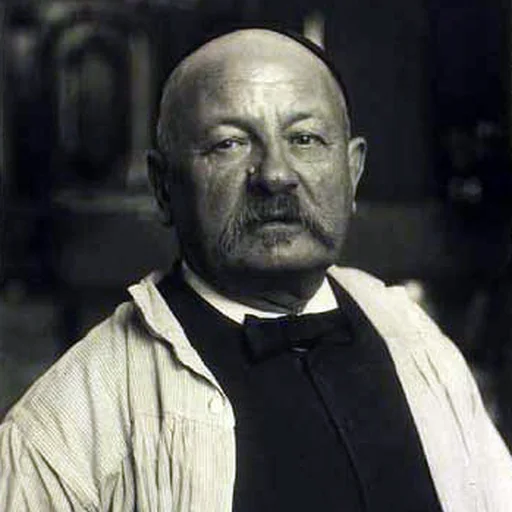
Peder Henrik Kristian Zahrtmann, known as Kristian Zahrtmann, (31 March 1843 – 22 June 1917) was a Danish painter.