Artwork
Η Διηδάμεια
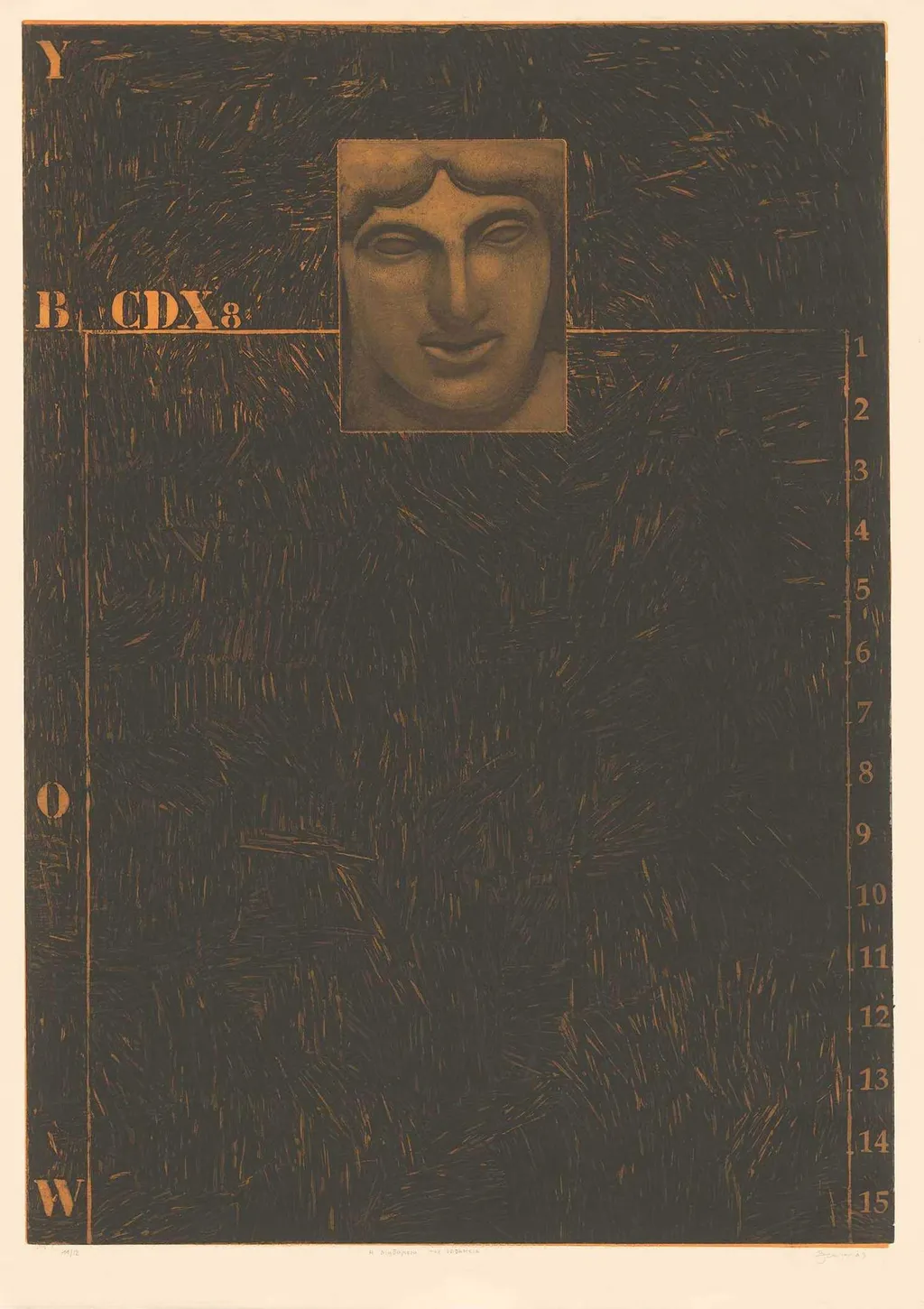
Η Διηδάμεια is a print by Velizar Krstić. It dates from 2003 and is held in the collection of the Metropolitan Organisation of Museums of Visual Arts of Thessaloniki – MOMus.
About this work
The print shows rough, blocky shapes in white and gray. A woman in the center stands firm. Around her, other figures twist and strain.
Krstić used an old story here. The scene comes from a Greek temple carving. He turned those ancient shapes into sharp, modern lines. The woman’s pose feels strong, almost like a statue.
Look up an artist who carved stone. Try Krstić, Velizar (1947-2020).
Overview
Velizar Krstić (1947–2020) produced a series of engraved compositions that reinterpreted classical Greek sculpture through a modernist lens.
Velizar Krstić (1947–2020) produced a series of engraved compositions that reinterpreted classical Greek sculpture through a modernist lens. His work 'Didameia' draws from the Centaur-Lapith battle depicted on the western pediment of the Temple of Zeus at Olympia, transforming ancient narrative into a structured, rhythmic graphic form. The piece merges classical mythology with contemporary visual language, emphasizing geometric clarity and symbolic weight over naturalism.
Subject & Meaning
The central figure, Didameia, embodies a static, monumental presence amid chaotic motion. Her upright posture contrasts with the twisting, strained forms surrounding her, evoking a sense of composure amid conflict. Krstić uses this arrangement to explore themes of order versus chaos, drawing from the mythological struggle between Lapiths and Centaurs as a metaphor for human civilization’s tension with primal forces.
Technique & Style
Krstić employed engraving to achieve sharp, angular forms with high contrast between white and gray tones. The composition mimics the red-figure technique of ancient Greek vases, using a dark background to isolate figures in lighter relief. Latin numerals and characters are integrated as temporal markers, anchoring the scene in a reconstructed chronology of early classical art while reinforcing its conceptual distance from antiquity.
History & Provenance
Created in the late 20th century, 'Didameia' is part of Krstić’s broader engagement with classical sources during a period of renewed interest in mythological symbolism among Balkan artists. The work reflects his study of Greek pedimental sculpture and his desire to reconcile ancient aesthetics with modernist abstraction. It was produced as a limited print, circulating primarily in regional art circles and institutional collections in Southeastern Europe.
Context
Krstić worked within a post-Yugoslav cultural environment where historical memory and classical heritage were frequently revisited in visual art. His reinterpretation of the Olympia pediment aligns with broader regional efforts to reconnect with pre-modern identities, filtered through formal experimentation. The use of Latin script and numerals subtly critiques Western historiographical frameworks while asserting a localized engagement with antiquity.
Legacy
Krstić’s 'Didameia' remains a significant example of how 20th-century artists reimagined classical motifs without romanticizing them. His reduction of form to essential shapes and his emphasis on rhythm over narrative influenced a generation of printmakers in the Balkans. The work is held in several public collections, where it is studied for its synthesis of ancient iconography and modernist graphic discipline.
Artist & collection
Museum
Metropolitan Organisation of Museums of Visual Arts of Thessaloniki – MOMus
Continue through works from the same source collection.
 Untitled
 The Old Garibaldian
 Unknown subject (Let Him look up into the Heaven and laugh in the bright air)
 Untitled
 Untitled
 Untitled
 Untitled
 Venise sauvée (Venice Preserved)
 Départ pour le sabbat (Departure for the Sabbath)
 La vierge et l'enfant (The Virgin and Child)
 Study for a Border Design
 La vierge et l'enfant (The Virgin and Child)