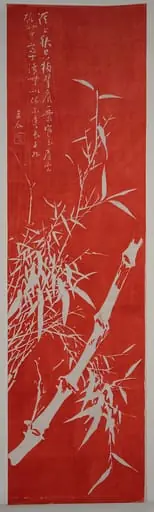
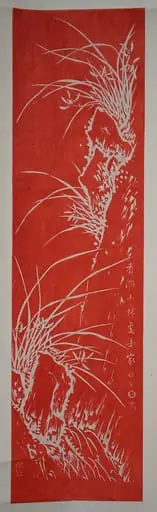
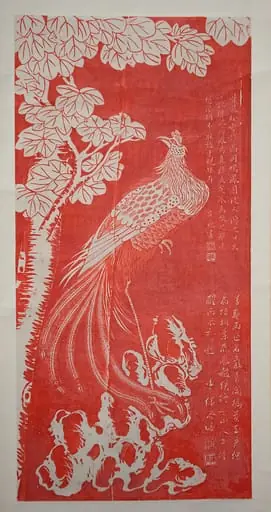
Artwork
Untitled
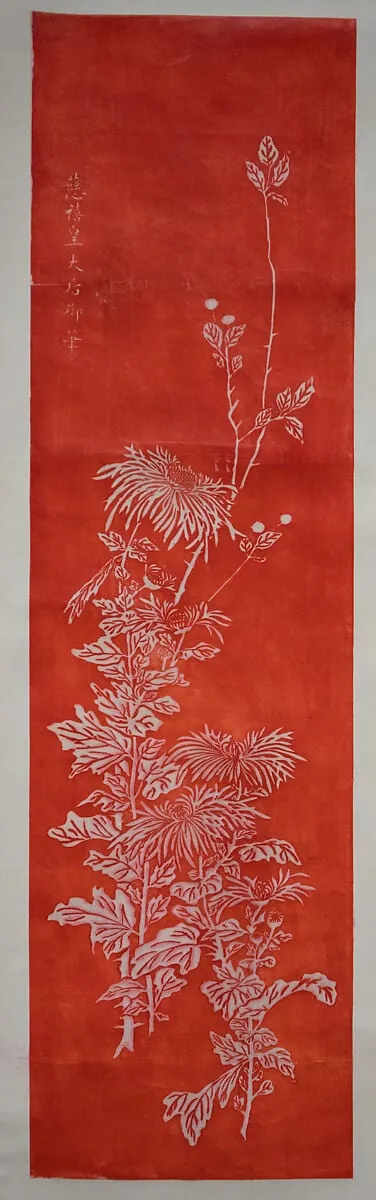
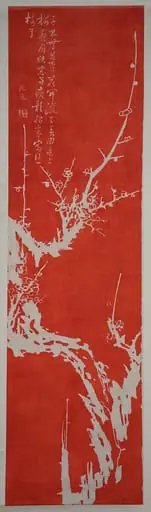
Untitled is an ink print by Kuang Xü|Empress Dowager Cixi. It dates from 1922 and is held in the collection of the Metropolitan Museum of Art. Created in 1922 by Kuang Xü, this hanging scroll is a polychrome woodblock print on paper.
About this work
Overview
The work employs traditional printing methods, with ink and color pressed into the paper to form a precise, linear composition.
Created in 1922 by Kuang Xü, this hanging scroll is a polychrome woodblock print on paper. It belongs to The Metropolitan Museum of Art’s collection of East Asian prints. The work employs traditional printing methods, with ink and color pressed into the paper to form a precise, linear composition. Its vertical format and monochromatic subject reflect conventions of Chinese ink painting adapted for reproductive printmaking.
Subject & Meaning
A single bare branch, adorned with white blossoms, small buds, and scattered berries, extends vertically against a solid red field. The absence of landscape or context focuses attention on the plant’s quiet vitality. In Chinese visual culture, such botanical motifs often symbolize resilience or seasonal change; here, the stark contrast may suggest solitude or endurance amid intensity.
Technique & Style
The image was produced using woodblock printing, with separate blocks carved for each color and inked in sequence. Lines are sharp and controlled, suggesting careful registration and skilled carving. The red background is uniformly flat, enhancing the delicate white forms. Subtle tonal variations in the branch are achieved through controlled ink density, not cross-hatching, emphasizing clarity over texture.
History & Provenance
The work was made in 1922 during a period of experimentation in Chinese printmaking, as artists blended traditional forms with modern aesthetics. It entered The Metropolitan Museum of Art’s collection through documented acquisition, though its earlier ownership history remains unrecorded. Its preservation as a hanging scroll indicates it was intended for display in domestic or scholarly settings.
Context
In early 20th-century China, woodblock printing was revitalized by artists seeking to reconcile classical aesthetics with contemporary expression. Kuang Xü’s work reflects this trend, using a format rooted in literati painting but produced through mechanical means. The bold red ground diverges from traditional ink-on-paper palettes, hinting at influences from modern design or Western color theory.
Legacy
This print represents a transitional moment in Chinese print culture, where handcrafted techniques served new artistic intentions. While not widely reproduced or publicly celebrated, it contributes to scholarly understanding of how traditional media were reinterpreted during a period of cultural change. Its presence in a major Western museum underscores its role in cross-cultural art exchange.
Artist & collection
Artist
Cixi started printing her own portraits in the 1920s when she was well past 70, cutting the woodblocks herself because the hired carvers kept softening her famously sharp gaze.