Artwork
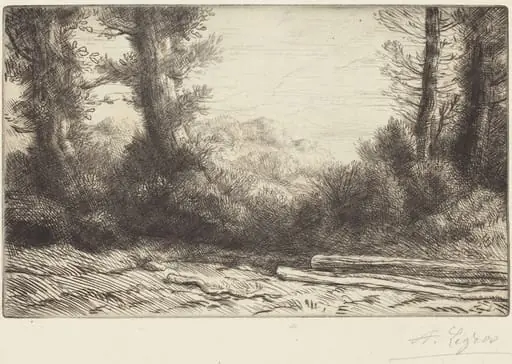
Edge of a Forest in Bourgogne (Un coin de foret en Bourgogne)
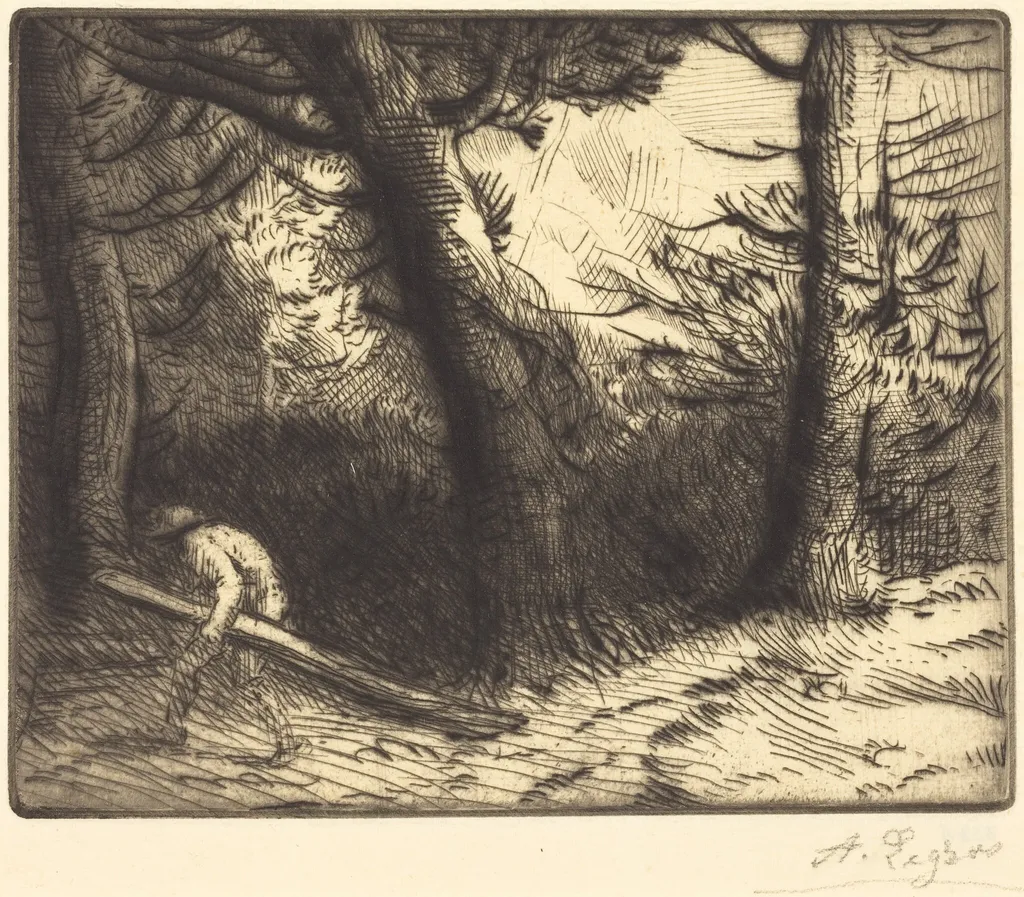
Edge of a Forest in Bourgogne (Un coin de foret en Bourgogne) is an ink print by the Romanticist artist Alphonse Legros. It dates from 1874 and is held in the collection of the National Gallery of Art.
About this work
Overview
Created in 1874, *Edge of a Forest in Bourgogne* is a print by Alphonse Legros, a French artist who moved to London in 1863.
Created in 1874, *Edge of a Forest in Bourgogne* is a print by Alphonse Legros, a French artist who moved to London in 1863. Executed in etching and drypoint, the work reflects his deep engagement with printmaking during the British etching revival. Unlike his paintings and sculptures, this piece emphasizes the tactile potential of the plate, capturing a quiet moment in a rural French landscape through inked lines and textured surfaces.
Subject & Meaning
The scene portrays the boundary of a dense forest in Burgundy, where thickets of trees and underbrush press inward, limiting the viewer’s access to light. A small, indistinct animal—possibly a rabbit—rests motionless in the lower left, adding a subtle sense of life amid the shadowed vegetation. The composition conveys stillness and isolation, suggesting an unmediated encounter with nature rather than an idealized pastoral vision.
Technique & Style
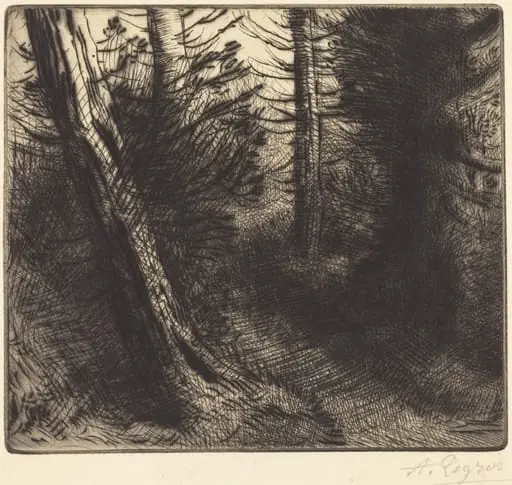
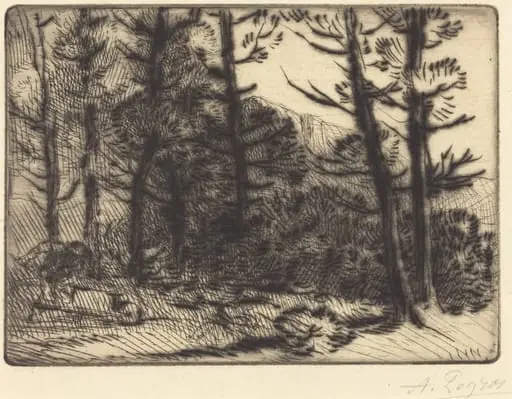
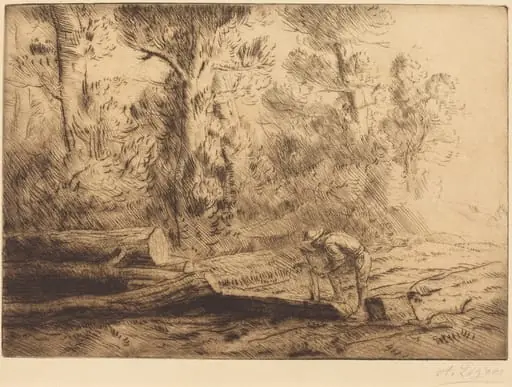
Legros employed drypoint to carve directly into a metal plate, creating raised burrs that hold ink and produce rich, fuzzy lines. Combined with etching, which allowed for finer, controlled marks, the result is a surface of contrasting textures: sharp contours alongside rough, granular shadows. The scratchy, uneven lines mimic the natural irregularity of woodland growth, emphasizing the physicality of the artist’s hand and the materiality of the medium.
History & Provenance
Made during Legros’s early years in England, the print reflects his ongoing connection to his French homeland while engaging with London’s growing interest in original prints. Though not widely exhibited at the time, it was part of a broader movement among artists to revive etching as a personal, expressive form rather than a reproductive technique. Its survival in collections today underscores its role in the transition of printmaking toward artistic autonomy.
Context
In the 1870s, British artists and collectors were rediscovering etching as a medium for individual expression, moving away from commercial reproduction. Legros, trained in Paris and active in London, bridged French realism with British revivalist ideals. His focus on unembellished natural scenes aligned with contemporary interests in direct observation, contrasting with the more dramatic or romantic landscapes popular in academic circles.
Legacy
Legros’s use of drypoint in this work influenced later generations of printmakers who valued the medium’s immediacy and expressive potential. While not widely reproduced, *Edge of a Forest in Bourgogne* remains a quiet example of how technical experimentation could convey atmospheric depth and emotional restraint. It stands as a testament to the quiet revolution in printmaking that prioritized the artist’s hand over mass production.
Own this work as a print
Artist & collection

Artist
Alphonse Legros (French pronunciation: ; 8 May 1837 – 8 December 1911) was a French, later British, painter, etcher, sculptor, and medallist.