Artwork
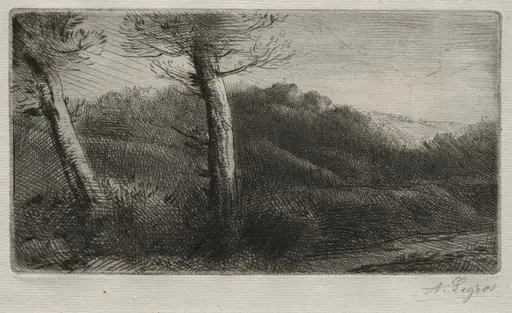
Edge of a Wood (Lisiere de bois)
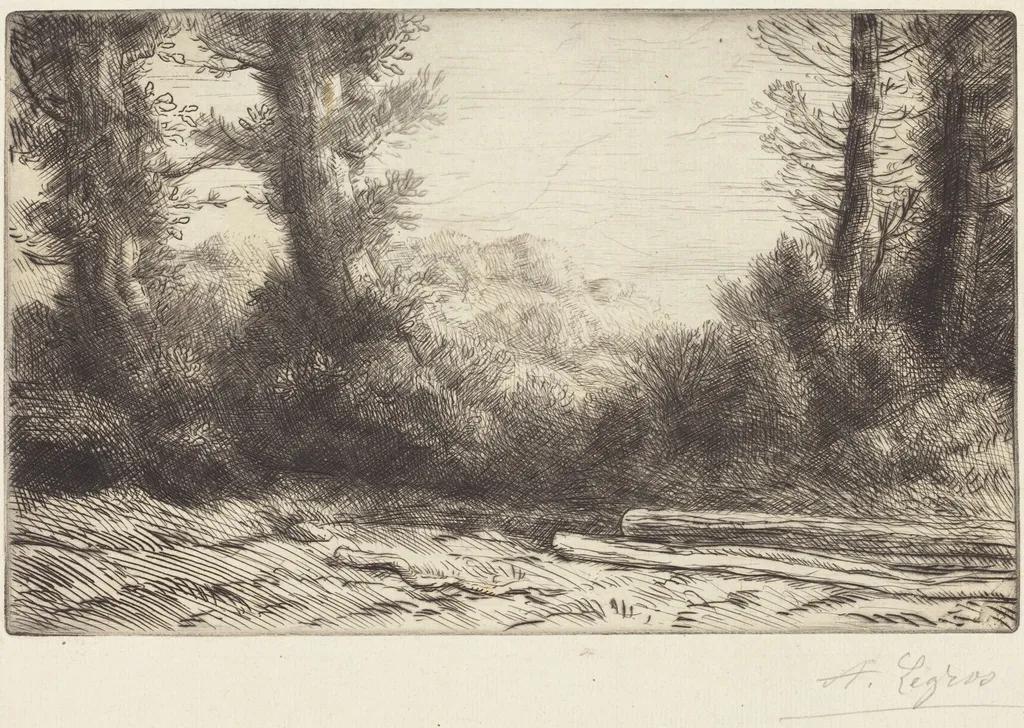
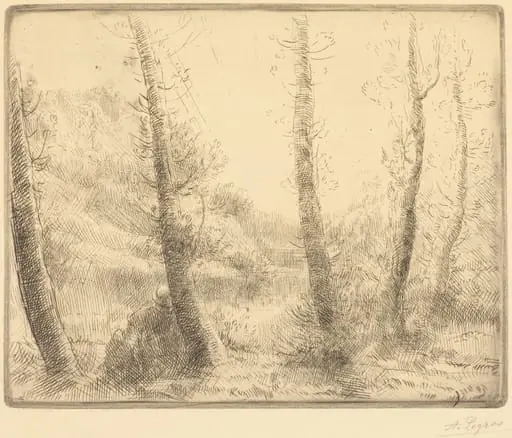
Edge of a Wood (Lisiere de bois) is an ink print by the Romanticist artist Alphonse Legros. It dates from 1874 and is held in the collection of the National Gallery of Art.
About this work
Overview
The work exemplifies his engagement with printmaking, a medium he helped revitalize in Britain through both his practice and instruction at the Slade School.
Created in 1874, *Edge of a Wood (Lisiere de bois)* is an etching and drypoint by Alphonse Legros, a French artist who moved to London in 1863 and became a British citizen. The work exemplifies his engagement with printmaking, a medium he helped revitalize in Britain through both his practice and instruction at the Slade School. Unlike polished academic works, this piece embraces a direct, tactile approach to image-making.
Subject & Meaning
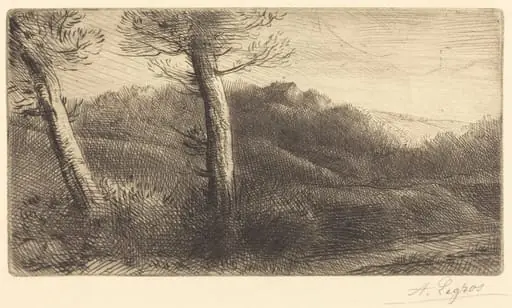
The scene captures the boundary between dense woodland and open ground, where shadow and light meet in subtle tension. Trees on the left loom heavily, their forms fragmented by dense mark-making, while the right side opens into a sunlit slope of scrub and earth. There is no human presence; the quietude of the natural transition suggests contemplation rather than narrative, emphasizing atmosphere over story.
Technique & Style
Legros employed drypoint to carve fine, burr-rich lines into the plate, creating deep, velvety blacks, and etching for softer, controlled tones. The bark and foliage are rendered through dense, hatched scratches rather than smooth contours, giving the trees a textured, almost tactile presence. The ground is suggested by irregular, agitated lines, evoking rough terrain without literal description. The overall effect is immediate, as if drawn in real time.
History & Provenance
Made during Legros’s early years in England, the print reflects his transition from French academic training to a more personal, experimental style influenced by British and Dutch print traditions. It was likely produced for private circulation or as part of his teaching portfolio. No public record of its early ownership exists, but it aligns with the growing interest in original prints among Victorian collectors and artists.
Context
In the 1870s, Britain saw a resurgence of interest in etching as an independent art form, moving away from reproductive prints. Legros, alongside figures like James McNeill Whistler, championed this revival by emphasizing the artist’s hand and the expressive potential of the medium. His focus on natural, unidealized landscapes aligned with broader European trends toward realism and direct observation.
Legacy
Legros’s work in printmaking, including *Edge of a Wood*, influenced a generation of British artists who valued the intimacy and spontaneity of etching and drypoint. His teaching at the Slade institutionalized these techniques, shifting emphasis from commercial reproduction to artistic expression. Though less widely known today, his contributions helped establish printmaking as a legitimate medium for serious artistic inquiry in Britain.
Own this work as a print
Artist & collection

Artist
Alphonse Legros (French pronunciation: ; 8 May 1837 – 8 December 1911) was a French, later British, painter, etcher, sculptor, and medallist.

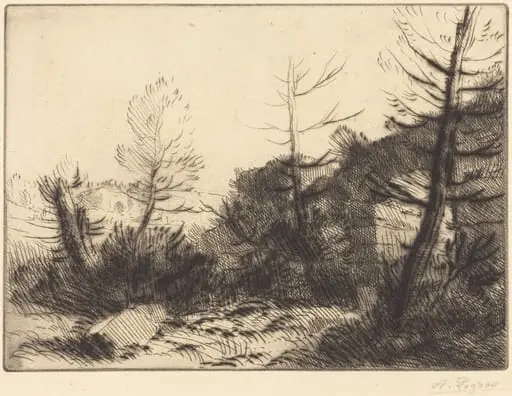 Roman Ruin (Ruine romaine)
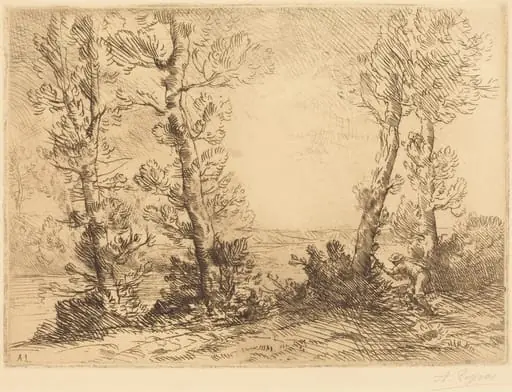 Salmon Fisher (Le pecheur du saumon)
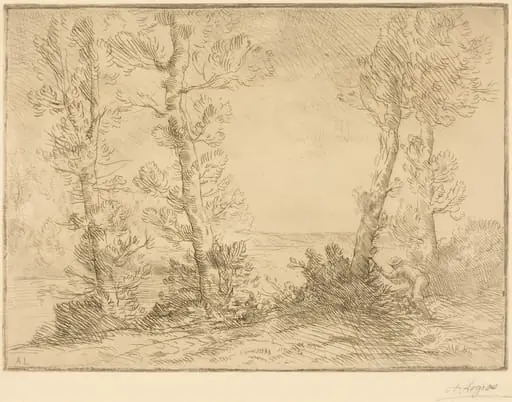 Salmon Fisher (Le pecheur du saumon)
 Sunset
 Sunset (Coucher du soleil)
 The House of the Well (La maison du puits)
 Landscape (Paysage)
 Small Lake (Le petit lac)
 Birch Trees: Water's Edge Seen in Morning Light (Les bouleaux: Bord de l'eau, effet du matin