Artwork
Farm with Large Tree (La ferme au grand arbre)
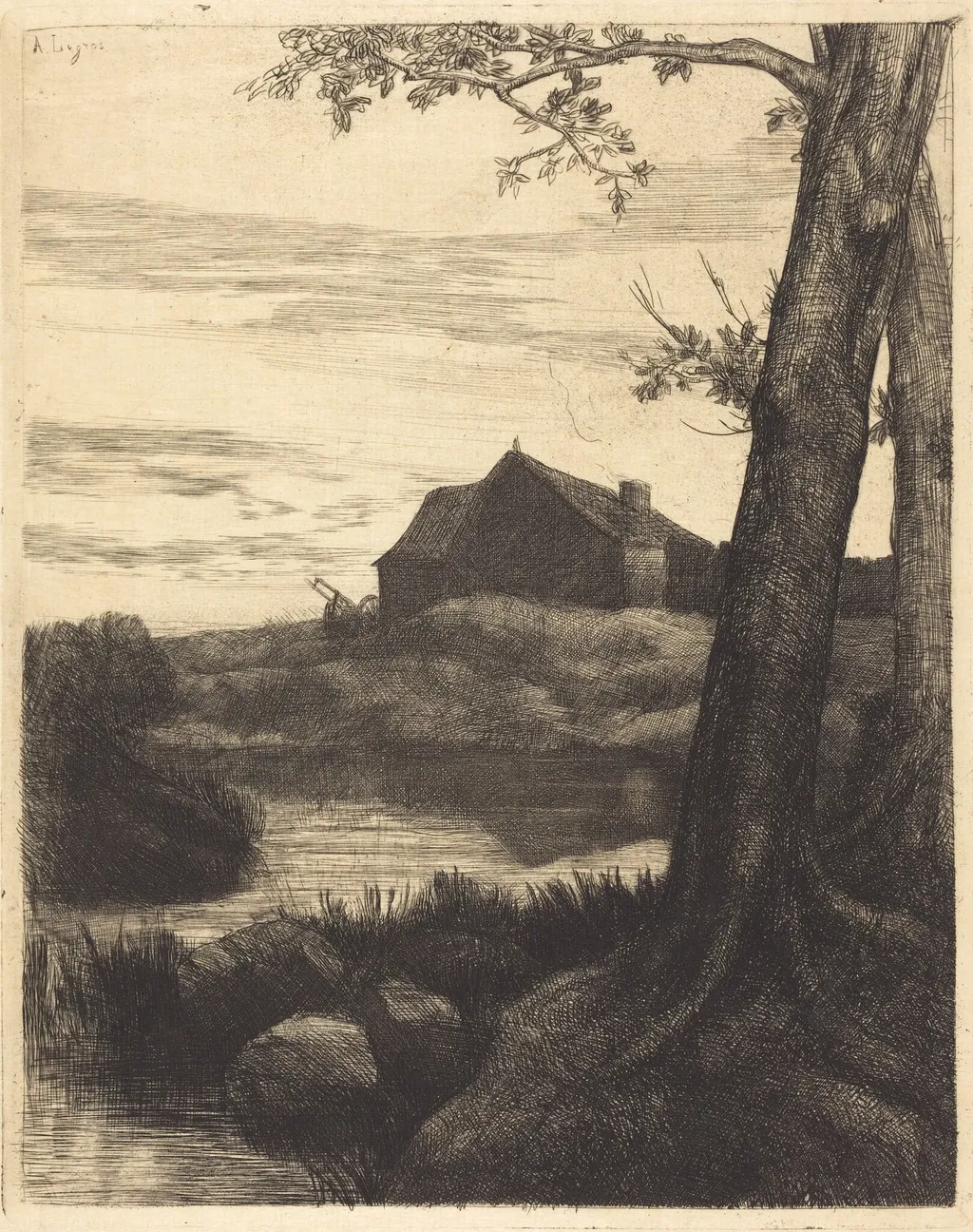
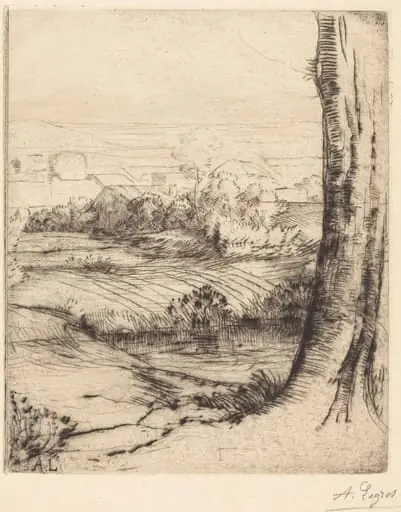
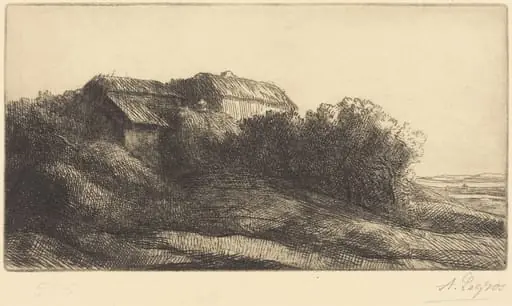
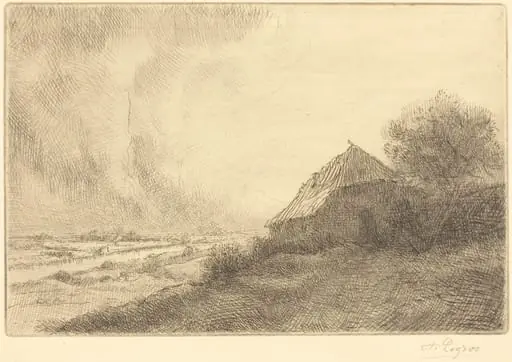
Farm with Large Tree (La ferme au grand arbre) is an ink print by the Romanticist artist Alphonse Legros. It dates from 1874 and is held in the collection of the National Gallery of Art.
About this work
Overview
Though born in France, Legros had settled in London by 1863 and became a British subject, where he influenced printmaking through teaching and practice.
Created in 1874 by Alphonse Legros, *Farm with Large Tree* is a multi-technique print combining etching, drypoint, and aquatint. Though born in France, Legros had settled in London by 1863 and became a British subject, where he influenced printmaking through teaching and practice. This work exemplifies his commitment to reviving etching as a serious artistic medium in Britain, moving beyond reproductive uses toward expressive, hand-crafted imagery.
Subject & Meaning
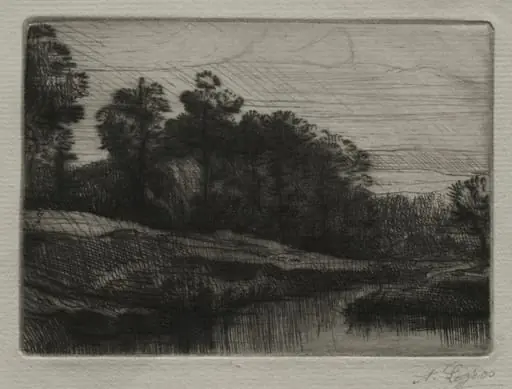
The scene depicts a modest rural farmhouse nestled on a gentle slope, anchored by a large, gnarled tree whose branches arch over the composition. The tree, both structural and symbolic, frames the dwelling without dominating it, suggesting harmony between human habitation and nature. Fences and scattered stones in the foreground guide the viewer’s gaze inward, reinforcing a quiet, contemplative mood rather than narrative drama.
Technique & Style
Legros employed fine, incised lines from etching and drypoint to render texture in bark, grass, and stone, while aquatint provided subtle tonal gradations. The sky is rendered as a uniform, soft wash, contrasting with the densely worked foreground. His meticulous use of cross-hatching and stippling creates a tactile realism, especially in the tree’s surface and the undulating field, where light and shadow are built through accumulated marks rather than broad strokes.
History & Provenance
The print was made during Legros’s early years in England, a period when he was deeply engaged in the British art scene as both practitioner and educator at the Slade School. While specific early ownership records are sparse, the work aligns with his broader output of landscape prints from the 1870s, which were circulated among collectors and students interested in the revival of original printmaking.
Context
In the 1870s, British printmaking was shifting from commercial reproduction toward personal expression. Legros, influenced by French Realism and the Barbizon School, brought a renewed emphasis on direct observation and handwork. His focus on rural subjects reflected broader cultural interest in agrarian life, even as industrialization transformed the countryside, offering a quiet counterpoint to urban modernity.
Legacy
Legros’s technical rigor and dedication to etching as an independent art form helped elevate its status in Victorian Britain. *Farm with Large Tree* stands as a representative example of his pedagogical and artistic ideals—emphasizing craftsmanship, tonal nuance, and the expressive potential of line and texture. His influence extended through generations of students who adopted his methods and values in printmaking.
Own this work as a print
Artist & collection

Artist
Alphonse Legros (French pronunciation: ; 8 May 1837 – 8 December 1911) was a French, later British, painter, etcher, sculptor, and medallist.