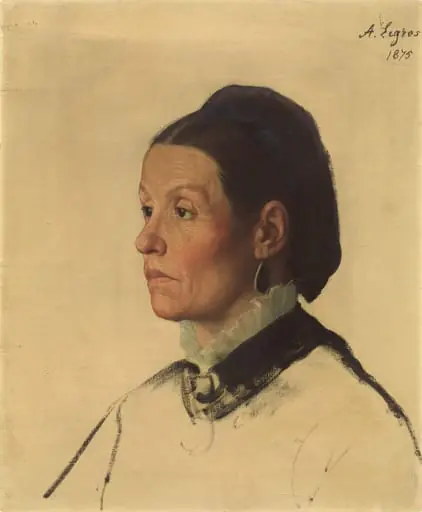
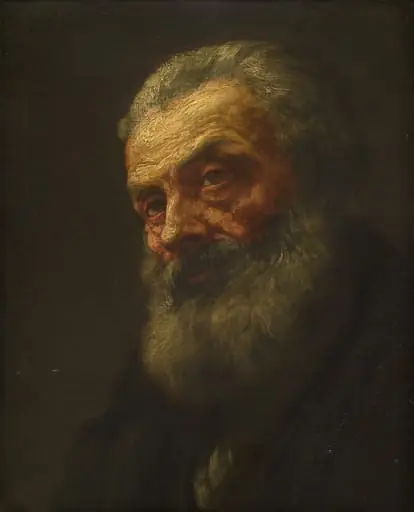
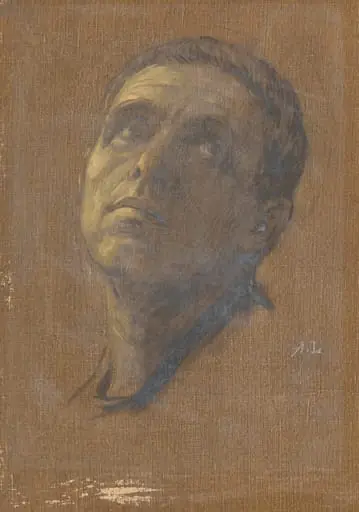
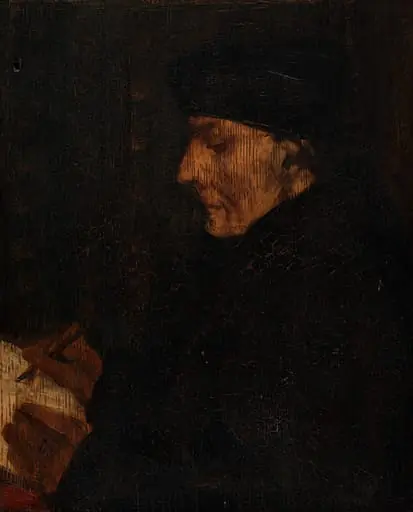
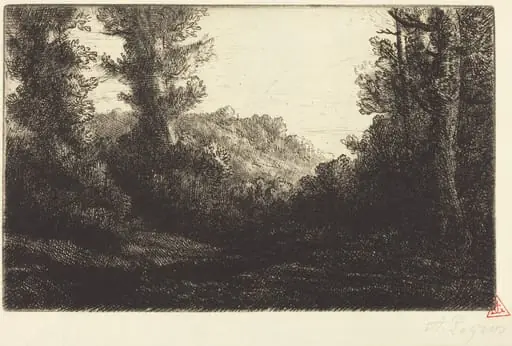
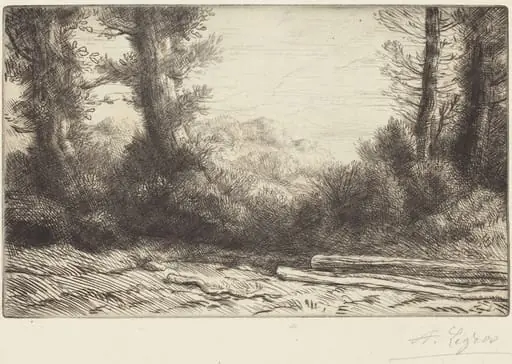
Artwork
In the Forest (Lisiere de foret)
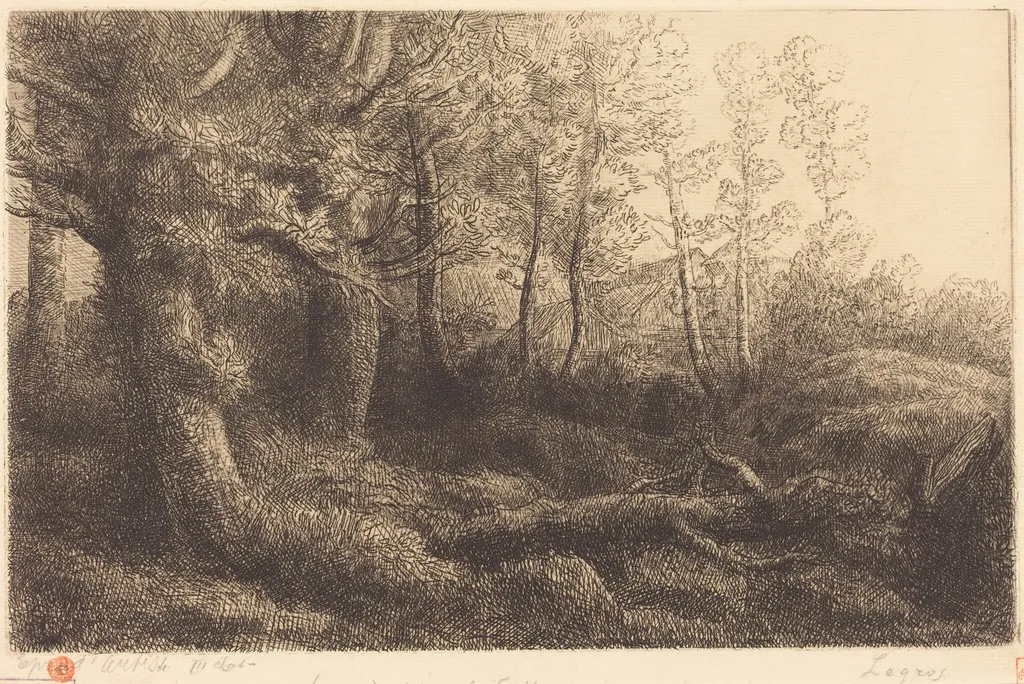
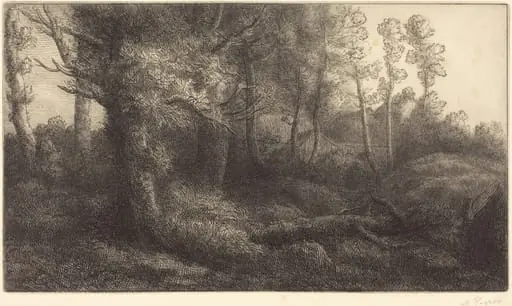
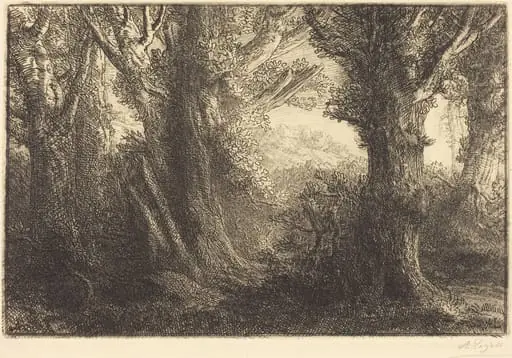
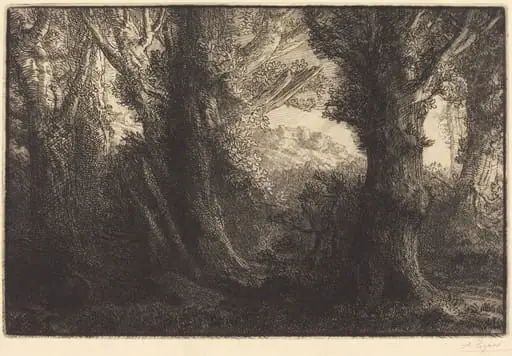
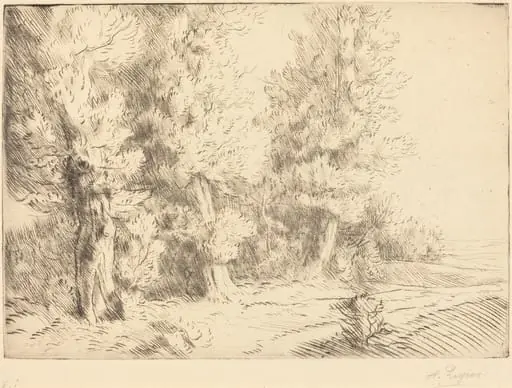
In the Forest (Lisiere de foret) is an ink print by the Romanticist artist Alphonse Legros. It dates from 1874 and is held in the collection of the National Gallery of Art.
About this work
Overview
The piece belongs to a series of nature-focused prints that emphasize raw, unidealized landscapes.
Created in 1874, *In the Forest (Lisière de forêt)* is an etching by Alphonse Legros, a French artist who relocated to London in 1863 and later became a British citizen. As part of his broader engagement with printmaking, this work reflects his commitment to reviving the technical and expressive potential of etching in 19th-century Britain. The piece belongs to a series of nature-focused prints that emphasize raw, unidealized landscapes.
Subject & Meaning
The scene portrays a dense, untamed woodland, devoid of human presence or narrative. Thick trunks and interwoven branches dominate the composition, while the forest floor is rendered with agitated, linear textures suggesting undergrowth. The play of light and shadow implies dappled sunlight filtering through the canopy, evoking a sense of quiet isolation and the untamed rhythms of nature rather than pastoral serenity.
Technique & Style
Legros employed fine, incised lines typical of etching, building tone and texture through dense, scratchy strokes rather than broad washes. The contrast between dark, heavily worked areas and lighter, sparser regions creates depth and atmospheric variation. His approach favors meticulous detail over idealized form, aligning with a realist sensibility that values the physicality of the natural world over romanticized depiction.
History & Provenance
The print was produced during Legros’s tenure at the Slade School of Fine Art, where he influenced a generation of British artists through his emphasis on direct observation and technical discipline in printmaking. While specific early ownership records are not widely documented, the work is recognized as part of his broader contribution to the revival of etching as a serious artistic medium in Victorian Britain.
Context
In the 1870s, British art saw a renewed interest in etching as a medium for personal expression, moving away from reproductive prints toward original works. Legros, trained in France and immersed in the Barbizon tradition, brought a continental emphasis on naturalism to London. His forest scenes, including this one, resonated with contemporary shifts toward valuing nature’s complexity over idealized landscapes.
Legacy
Legros’s etchings, including *In the Forest*, helped reestablish etching as a legitimate form of artistic inquiry in Britain. His technical rigor and focus on natural subjects influenced later printmakers and contributed to the broader Arts and Crafts movement’s appreciation for handcrafted imagery. The work remains a quiet but significant example of 19th-century printmaking’s capacity for atmospheric depth and emotional restraint.
Artist & collection

Artist
Alphonse Legros (French pronunciation: ; 8 May 1837 – 8 December 1911) was a French, later British, painter, etcher, sculptor, and medallist.