Artwork
Landscape (Paysage)
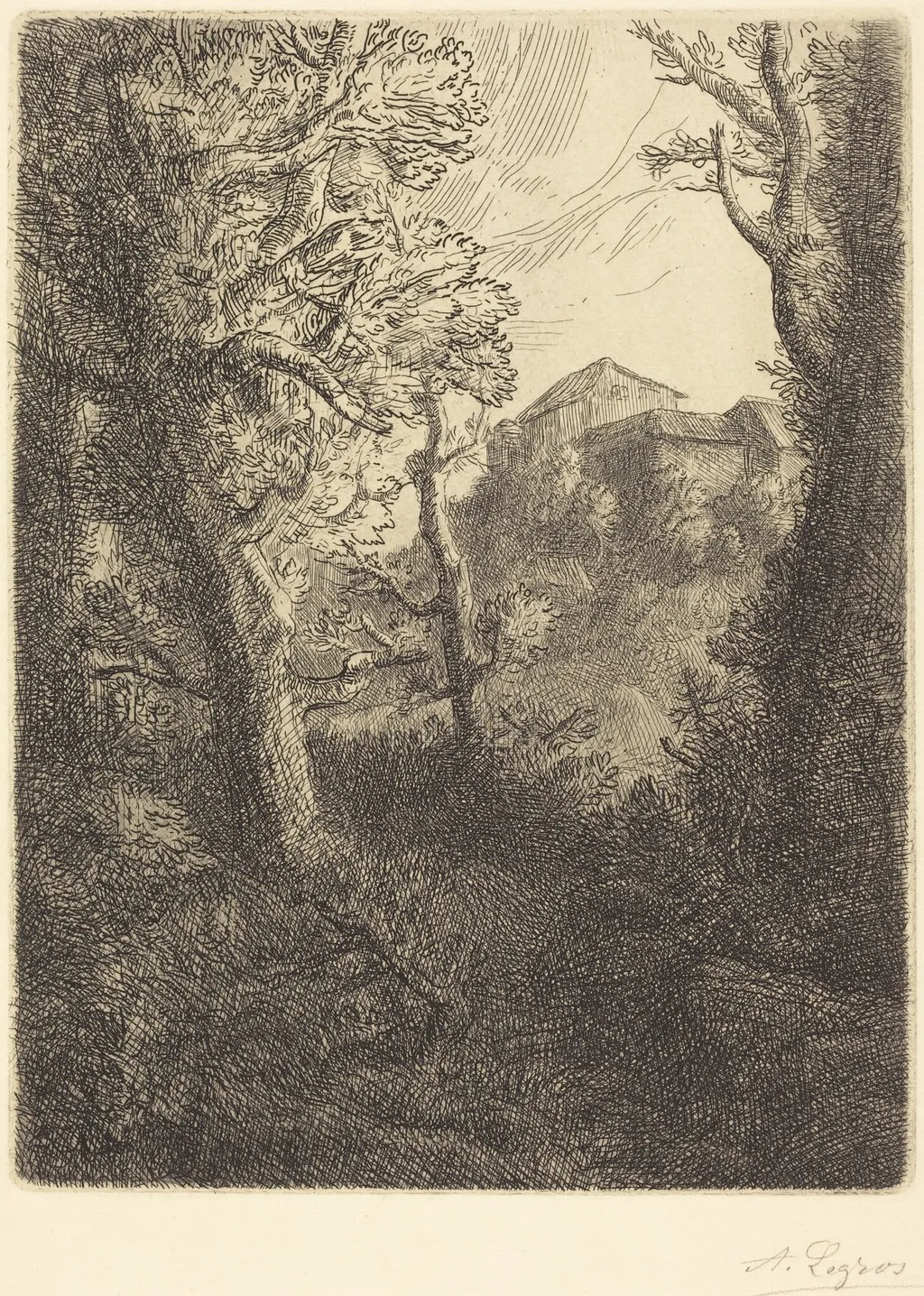
Landscape (Paysage) is an ink print by the Romanticist artist Alphonse Legros. It dates from 1874 and is held in the collection of the National Gallery of Art.
About this work
Overview
Created in 1874, *Landscape (Paysage)* is an etching by Alphonse Legros, a French artist who moved to London in 1863 and eventually became a British citizen.
Created in 1874, *Landscape (Paysage)* is an etching by Alphonse Legros, a French artist who moved to London in 1863 and eventually became a British citizen. The work belongs to a body of prints that helped reinvigorate the art of etching in Victorian Britain. Legros, active across multiple media, used this intimate format to explore natural scenes with quiet intensity, distinguishing his approach from more ornamental contemporary prints.
Subject & Meaning
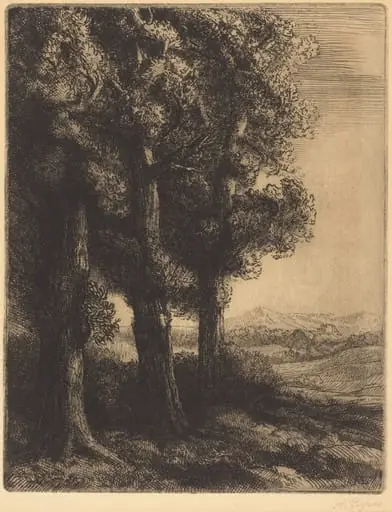
The scene presents a dense, shadowed forest pierced by a narrow path that dissolves into darkness. Behind the foliage, a solitary structure and a distant mountain emerge faintly, suggesting human presence amid wild terrain. The composition evokes solitude and the quiet persistence of nature, without narrative or symbolism. The subdued tone and obscured horizon invite contemplation rather than description, aligning with 19th-century Romantic sensibilities toward the sublime in nature.
Technique & Style
Legros employed fine, controlled etching lines to build texture and depth, using cross-hatching and varying line weight to suggest the thickness of foliage and the recession of space. The sky is rendered with minimal ink, allowing the paper’s tone to suggest atmospheric haze. The dark, tangled undergrowth contrasts with the faint outlines of distant forms, creating a sense of spatial ambiguity. This method reflects the revival of direct, expressive etching favored by artists seeking authenticity over mechanical reproduction.
History & Provenance
Executed during Legros’s early years in England, the print emerged from a period when he was actively teaching etching at the Slade School of Art. His technical rigor and emphasis on handcrafted printmaking influenced a generation of British artists. While the specific provenance of this impression is not documented, it aligns with the small, private circulation typical of artist-printed etchings of the time, often shared among collectors and students rather than widely published.
Context
In the 1870s, etching experienced a resurgence in Britain as artists rejected mass-produced illustrations in favor of original, hand-made prints. Legros, trained in France and immersed in the Barbizon tradition, brought continental sensibilities to London’s art scene. His landscapes, like this one, echoed the moody, naturalistic studies of French realists but were adapted to British aesthetic preferences for subtlety and restraint in printmaking.
Legacy
Legros’s etchings, including *Landscape (Paysage)*, contributed to the legitimization of etching as a serious artistic medium in Britain. His pedagogical influence at the Slade helped establish printmaking as a core discipline in art education. Though less celebrated today than his contemporaries, his quiet, technically precise works remain exemplars of the medium’s capacity for atmospheric depth and emotional understatement.
Artist & collection

Artist
Alphonse Legros (French pronunciation: ; 8 May 1837 – 8 December 1911) was a French, later British, painter, etcher, sculptor, and medallist.

 Corner of a Wood (Coin d'un bois)
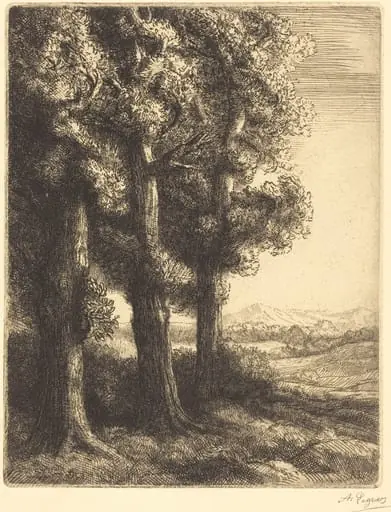 Corner of a Wood (Coin d'un bois)
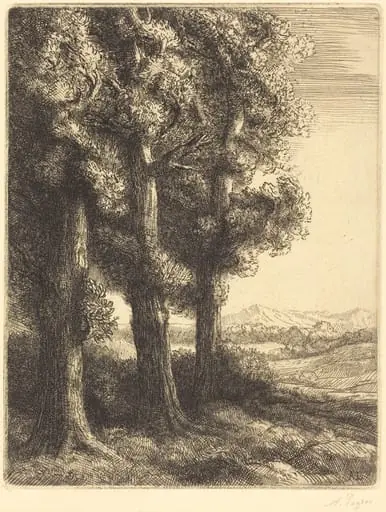 Corner of a Wood (Coin d'un bois)
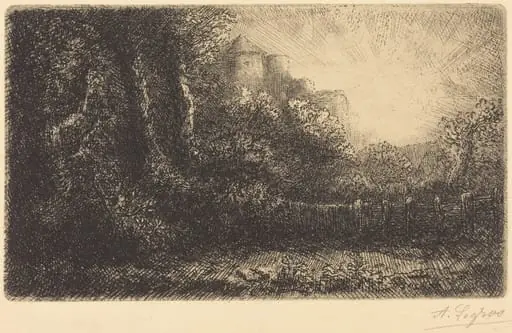 View of a Chateau (Chateau de Poillet)
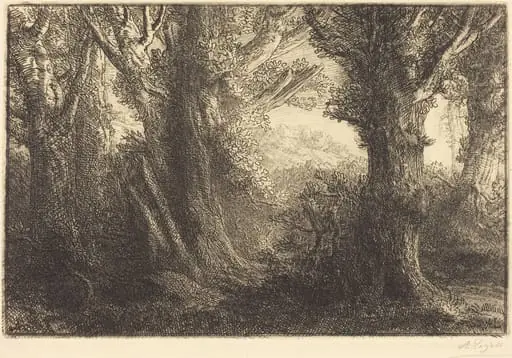 In the Forest of Conteville (Dans la foret de Conteville)
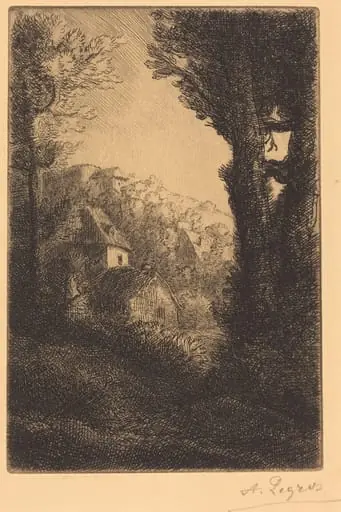 Farm on a Hillside in Sunlight (La ferme du coteau; Effet de soleil sur le coteau)
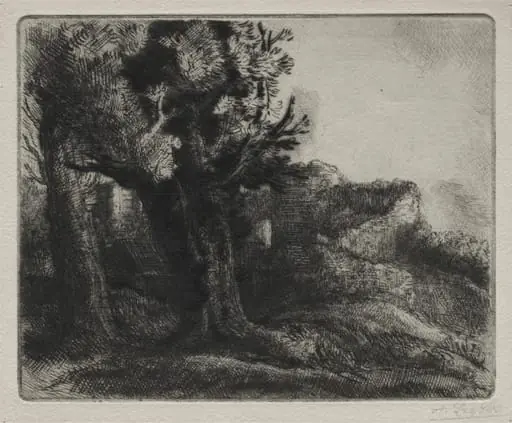 In the Ruins
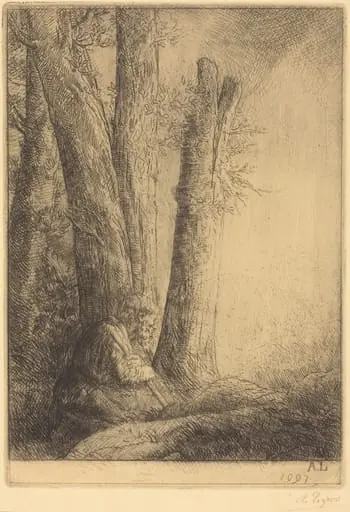 Study for the Prodigal Son (Etude pour L'enfant prodigue)
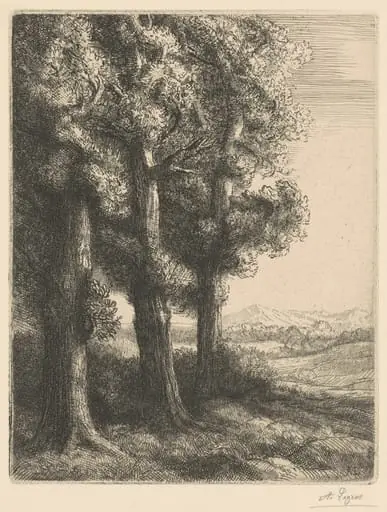 Corner of a Wood (Coin d'un Bois)