Artwork
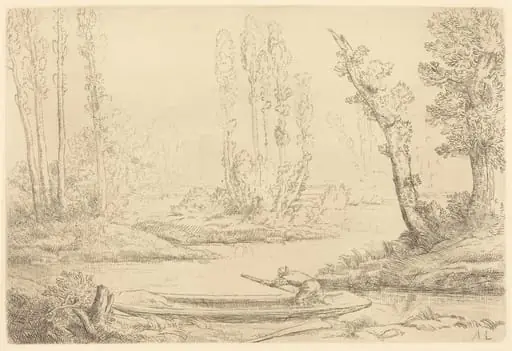
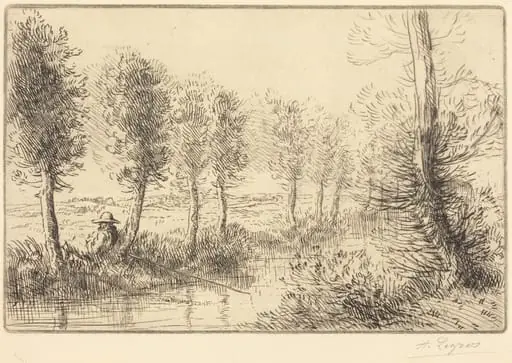
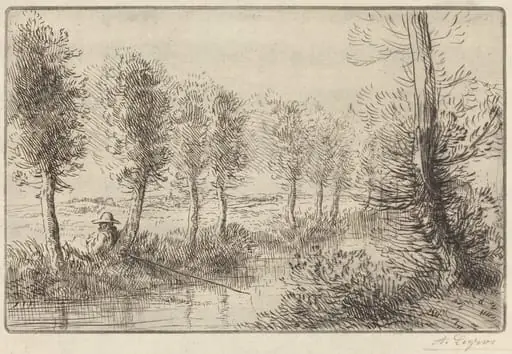
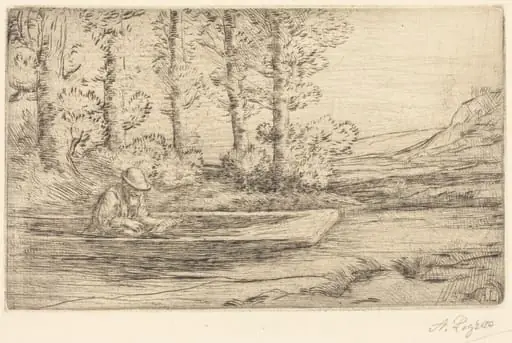
Morning along the River (La matin sur la riviere)
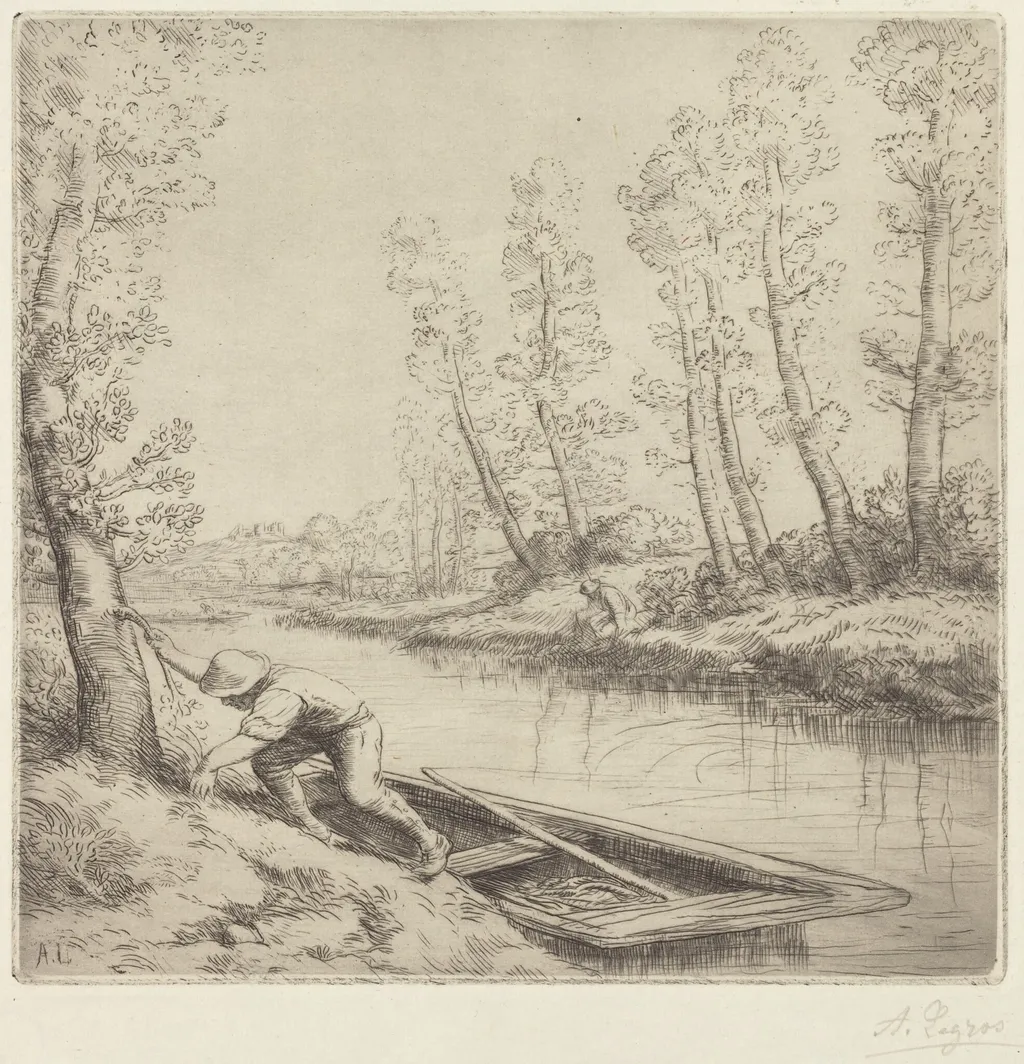
Morning along the River (La matin sur la riviere) is an ink print by the Romanticist artist Alphonse Legros. It dates from 1874 and is held in the collection of the National Gallery of Art.
About this work
Overview
The work belongs to a period when Legros was deeply engaged in printmaking and instrumental in revitalizing the medium in Britain.
Created in 1874, *Morning along the River* is an etching and drypoint by Alphonse Legros, a French artist who settled in London in 1863 and later became a British citizen. The work belongs to a period when Legros was deeply engaged in printmaking and instrumental in revitalizing the medium in Britain. Its quiet composition reflects his interest in everyday rural life and the subtle effects of early light.
Subject & Meaning
The scene captures a solitary figure seated on a riverbank at dawn, fishing with quiet focus. Tall trees arch over the water, their branches framing the stillness. Distant hills and faint outlines of buildings suggest a modest rural settlement. The absence of narrative tension and the subdued activity imply contemplation, aligning the image with themes of solitude and the rhythm of natural cycles.
Technique & Style
Legros employed etching and drypoint to build delicate tonal gradations, using fine, varied lines to suggest texture in grass, water, and foliage. The drypoint’s burr adds soft, velvety shadows, while the etched lines define structure with precision. The overall effect is sketchlike—intimate and unpolished—emphasizing immediacy over finish, characteristic of Legros’s approach to capturing transient moments.
History & Provenance
The print was made during Legros’s early years in England, when he was teaching at the Slade School of Fine Art and influencing a generation of British printmakers. Though its early ownership is undocumented, it was likely circulated among artists and collectors interested in the revival of etching. Its survival reflects its status as a working study rather than a commercial product.
Context
In the 1870s, British art saw renewed interest in etching as a serious medium, moving beyond reproduction toward original expression. Legros, trained in France but active in London, bridged continental realism with British sensibilities. His focus on quiet, unidealized landscapes aligned with broader European trends rejecting grand narrative in favor of observed, intimate moments.
Legacy
Legros’s prints, including this one, helped reestablish etching as a legitimate artistic medium in Britain. His emphasis on direct observation and technical precision influenced students and contemporaries. While less celebrated than his paintings, his graphic works remain important for understanding the evolution of 19th-century printmaking and the quiet aesthetic he championed.
Artist & collection

Artist
Alphonse Legros (French pronunciation: ; 8 May 1837 – 8 December 1911) was a French, later British, painter, etcher, sculptor, and medallist.