Artwork
View of a Chateau (Chateau des Revenants)
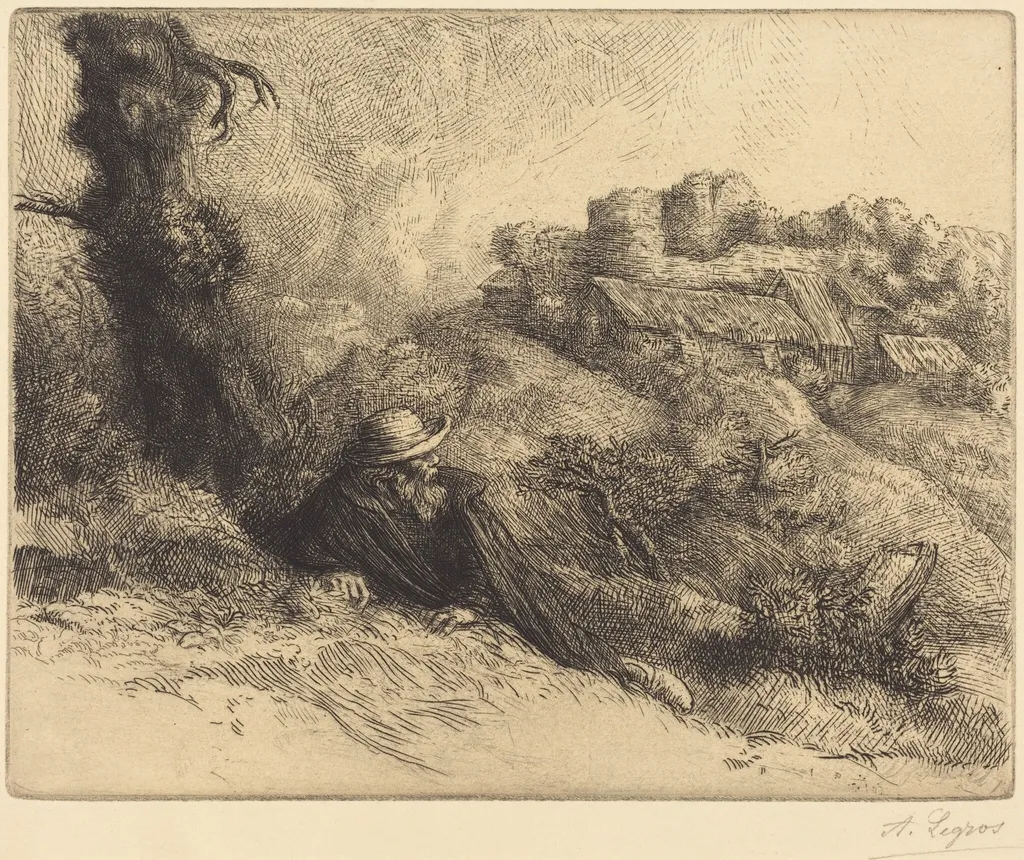
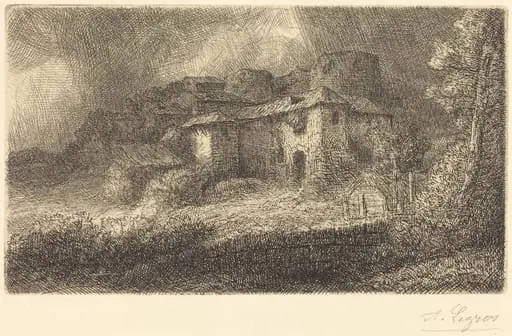
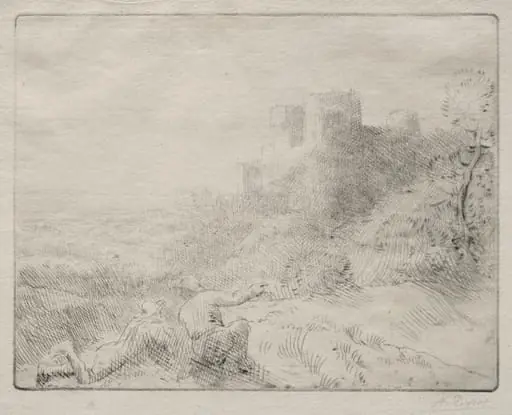
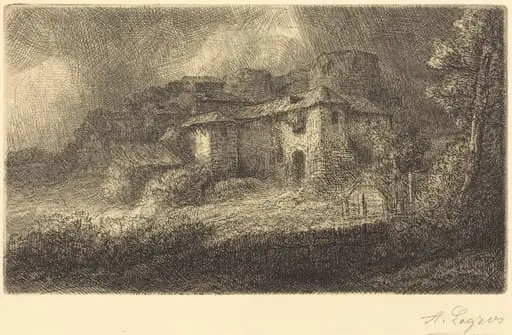
View of a Chateau (Chateau des Revenants) is an ink print by the Romanticist artist Alphonse Legros. It dates from 1874 and is held in the collection of the National Gallery of Art.
About this work
Overview
The work belongs to a period when Legros was actively reviving interest in etching as a serious artistic medium.
Created in 1874, *View of a Chateau (Chateau des Revenants)* is an etching by Alphonse Legros, a French artist who moved to London in 1863 and became influential in British printmaking. The work belongs to a period when Legros was actively reviving interest in etching as a serious artistic medium. Unlike oil painting, this piece relies on the precision and tonal range achievable through incised lines on metal, reflecting his technical mastery and commitment to the craft.
Subject & Meaning
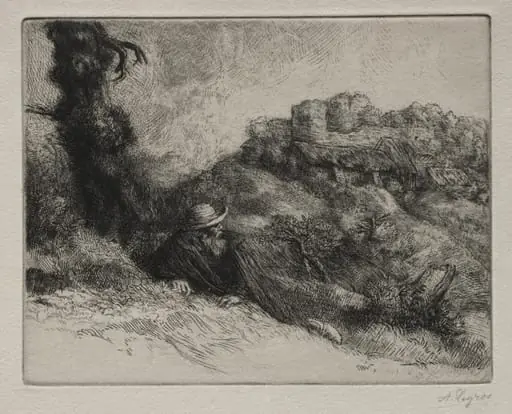
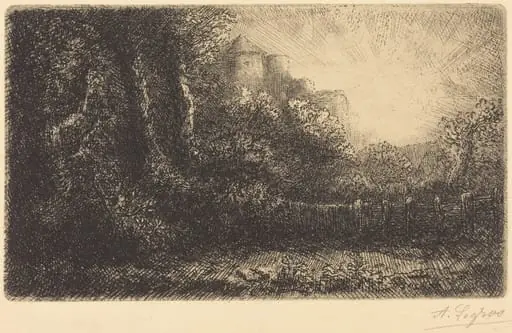
The scene presents a distant chateau nestled among dense trees, its silhouette softened by atmospheric perspective. In the foreground, a solitary figure sits with his back turned, clad in dark clothing and a broad-brimmed hat. The figure’s anonymity and stillness invite contemplation rather than narrative, reinforcing a mood of quiet solitude. The chateau, unnamed in the title beyond its poetic reference, evokes memory and decay rather than grandeur.
Technique & Style
Legros employed fine, controlled etching lines to build gradations of light and shadow, avoiding bold contrasts in favor of muted, earthy tones. The texture of the foliage and the crumbling stonework of the chateau emerge through layered hatching and drypoint scratching. The absence of bright color enhances the somber tone, while the etched surface captures the subtle interplay of air, foliage, and stone, lending the scene a tactile stillness.
History & Provenance
The work was produced during Legros’s early years in Britain, following his appointment at the Slade School of Art. It reflects his engagement with both French Romantic traditions and the British revival of etching, championed by artists like Francis Seymour Haden. Though the exact early ownership is undocumented, the print circulated among collectors and institutions interested in the renewed appreciation for handcrafted printmaking in the late 19th century.
Context
In the 1870s, etching experienced a resurgence in Britain as artists rejected mass-produced illustrations in favor of hand-made, expressive prints. Legros, trained in Paris but active in London, bridged continental and British aesthetics. His focus on landscape and solitary figures aligned with broader European trends in melancholic realism, contrasting with the rising popularity of Impressionism and industrial subject matter.
Legacy
Legros’s etchings, including this one, helped establish printmaking as a legitimate fine art form in Britain. His emphasis on tonal nuance and emotional restraint influenced a generation of British etchers. Though less widely known today, his work remains a touchstone in studies of 19th-century print revival, valued for its quiet intensity and technical discipline rather than spectacle.
Own this work as a print
Artist & collection

Artist
Alphonse Legros (French pronunciation: ; 8 May 1837 – 8 December 1911) was a French, later British, painter, etcher, sculptor, and medallist.