Artwork
Annunciation
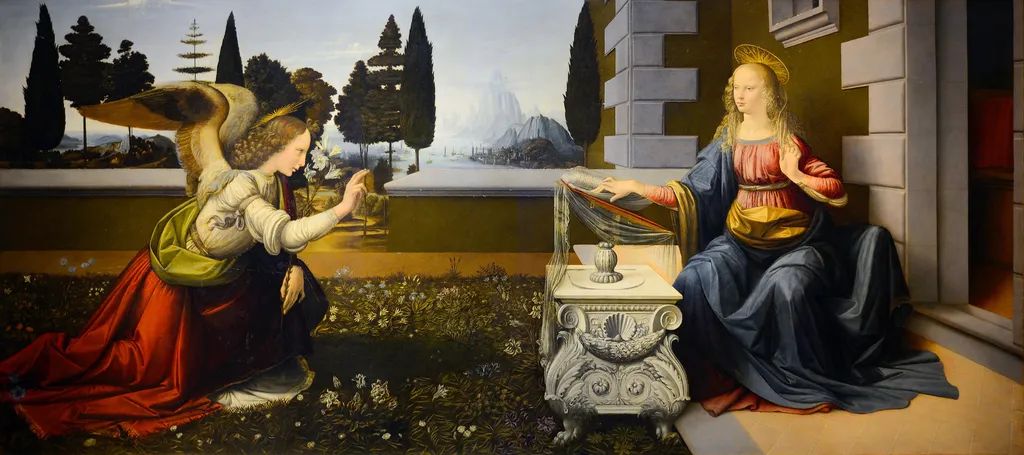
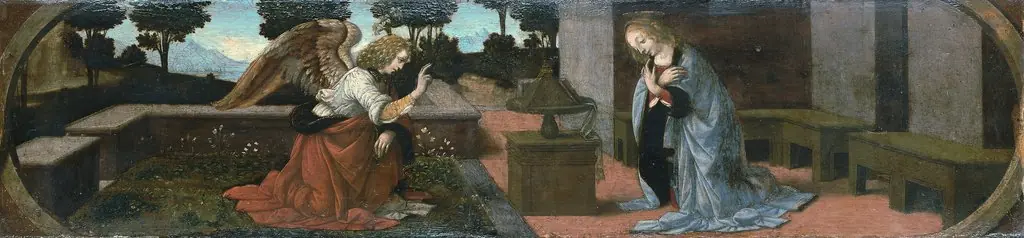
Annunciation is an oil painting by the High Renaissance artist Leonardo da Vinci. It dates from 1472 and is held in the collection of the Uffizi Gallery.
About this work
Overview
Leonardo da Vinci’s Annunciation, executed between roughly 1472 and 1476, is an early oil and tempera work on a sizable poplar panel. Created during his apprenticeship in Andrea del Verrocchio’s Florentine workshop, the painting presents a domestic interior illuminated by daylight, opening onto a garden landscape. It has been part of the Uffizi Gallery’s collection in Florence since 1867.
Subject & Meaning
The composition portrays the biblical moment when the Angel Gabriel announces to the Virgin Mary that she will bear the Son of God. In Leonardo’s version, the angel is shown kneeling, book in hand, while Mary sits serenely on an ornate chair, reading. The inclusion of a garden visible through a window underscores themes of fertility and divine promise common in 15th‑century Florentine art.
Technique & Style
The angel’s wings are rendered as delicate, draped fabric rather than feathery appendages, emphasizing a graceful, almost ethereal quality.
Leonardo combined oil and tempera, allowing subtle gradations of light across the figures. The angel’s wings are rendered as delicate, draped fabric rather than feathery appendages, emphasizing a graceful, almost ethereal quality. The luminous reds and greens of the garments respond to the bright interior light, while the background landscape is rendered with atmospheric perspective, anticipating the artist’s later chiaroscuro experiments.
History & Provenance
Completed while Leonardo was still a studio assistant, the Annunciation represents his earliest surviving major work. After remaining in Florence, the panel entered the Uffizi’s holdings in 1867, where it has remained on public display. Its attribution to Leonardo has been consistent, though scholars have noted compositional irregularities that suggest the artist’s developing skill at the time.
Context
In 15th‑century Florence, the Annunciation was a favored subject for devotional paintings, and Leonardo’s rendition reflects contemporary interest in integrating sacred narrative with domestic realism. Though some critics have pointed to compositional imbalances, the work remains a frequently cited example of early Renaissance experimentation with light, space, and emotional nuance, influencing later treatments of the same theme.
Artist & collection

![Ginevra de' Benci [obverse], by Leonardo da Vinci](https://artifactworldgallery.com/img/leonardo-da-vinci--ginevra-de-benci-obverse--afb6ec3a3e65f392-w320.webp)
![Wreath of Laurel, Palm, and Juniper with a Scroll inscribed Virtutem Forma Decorat [reverse], by Leonardo da Vinci](https://artifactworldgallery.com/img/leonardo-da-vinci--wreath-of-laurel-palm-and-juniper-with-a-scroll-inscribed-vi--4cdfe8467ad2438a-w320.webp)