Artwork
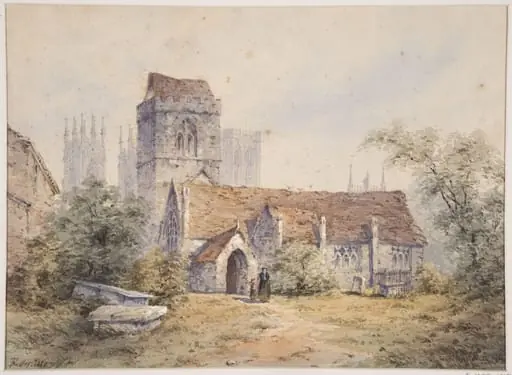
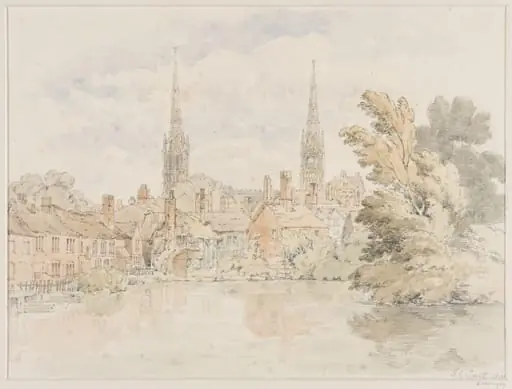
Dr Gooden's House and south view of Lichfield Cathedral
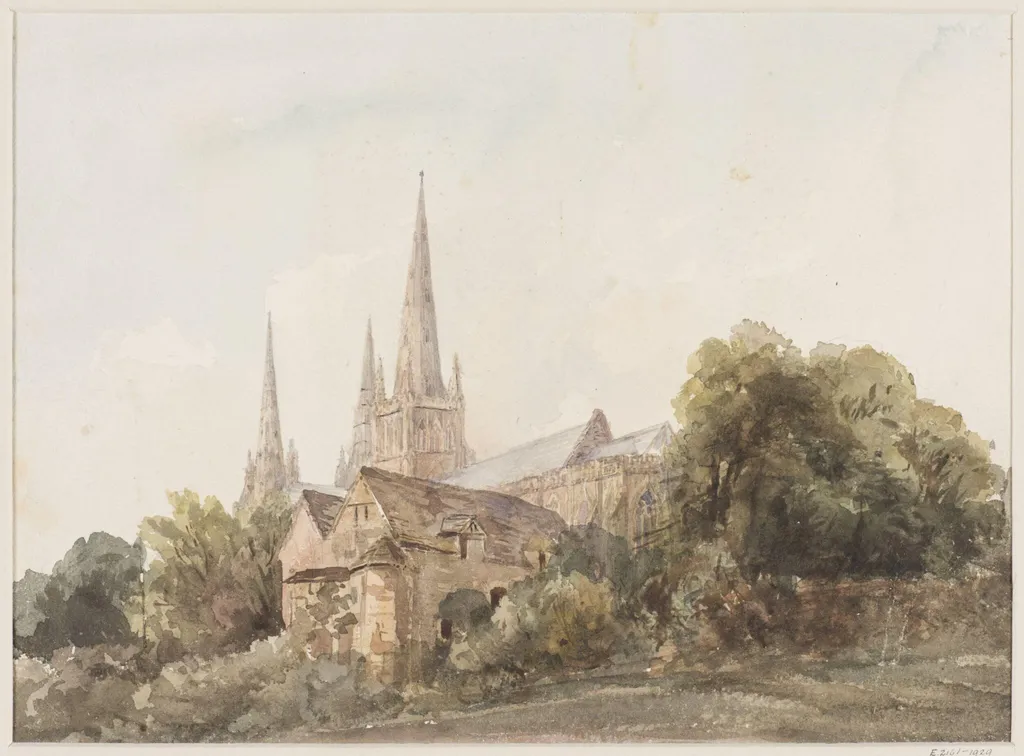
Dr Gooden's House and south view of Lichfield Cathedral is a drawing by the Romanticist artist Henry Harris Lines. It dates from 1818 and is held in the collection of the Victoria and Albert Museum.
About this work
Overview
The composition emphasizes verticality and spatial depth, with the cathedral’s twin spires dominating the horizon.
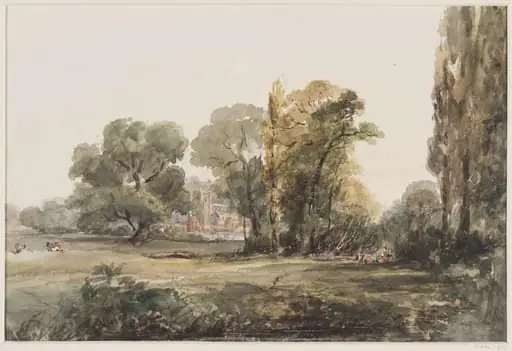
This pencil and watercolor drawing captures a quiet corner of Lichfield, England, framing a modest stone dwelling with a thatched roof in the foreground and the southern facade of the cathedral rising behind it. The composition emphasizes verticality and spatial depth, with the cathedral’s twin spires dominating the horizon. Subtle tonal shifts and restrained color create a contemplative mood, balancing architectural precision with loose, atmospheric brushwork in the surrounding foliage.
Subject & Meaning
The juxtaposition of a humble domestic structure and the monumental cathedral suggests a meditation on the coexistence of everyday life and sacred tradition. The house, grounded and unadorned, contrasts with the cathedral’s vertical ambition, hinting at layered histories—private and public, temporal and eternal. The absence of figures reinforces a sense of stillness, inviting reflection on time’s passage and the endurance of place.
Technique & Style
The artist employs delicate pencil lines to define the house and cathedral, lending them structural clarity, while the trees and sky are rendered with fluid, diluted washes that blur edges and suggest movement. Muted earth tones—soft ochres, greys, and olive greens—dominate, with faint highlights on the church’s windows introducing a subtle luminosity. This interplay of controlled draftsmanship and expressive watercolor reflects a sensitivity to light and texture over dramatic effect.
History & Provenance
The drawing is attributed to an early 19th-century artist, likely connected to the Lichfield region, though the creator remains unidentified. It was probably made as a personal record or study, given its intimate scale and observational focus. No documented exhibition or ownership history exists prior to its inclusion in regional collections, suggesting it was preserved locally rather than widely circulated.
Context
Created during the Romantic era, the work aligns with contemporary interests in vernacular architecture and the emotional resonance of landscape. While not overtly dramatic, its quiet emphasis on light, scale, and solitude reflects Romantic sensibilities—valuing introspection and the spiritual weight of place. It stands apart from grand historical narratives, instead honoring the quiet dignity of ordinary scenes.
Legacy
The drawing contributes to a modest but persistent tradition of regional topographical art in England, where artists documented local landmarks with personal rather than official intent. Though not widely reproduced, it remains a valuable record of Lichfield’s architectural fabric in the early 1800s, offering insight into how ordinary spaces were perceived and preserved through art.
Own this work as a print
Artist & collection
Artist
Henry Lines made quiet, fine drawings of English places in the 1800s. His pencil lines trace churches half-hidden by trees, old mills beside streams, and manor gates on rolling hills. Tap into Stowe: a church in the…