Artwork
Sketches in Belgium and Germany, First Series, Porch of Frauenkirch, Nuremberg
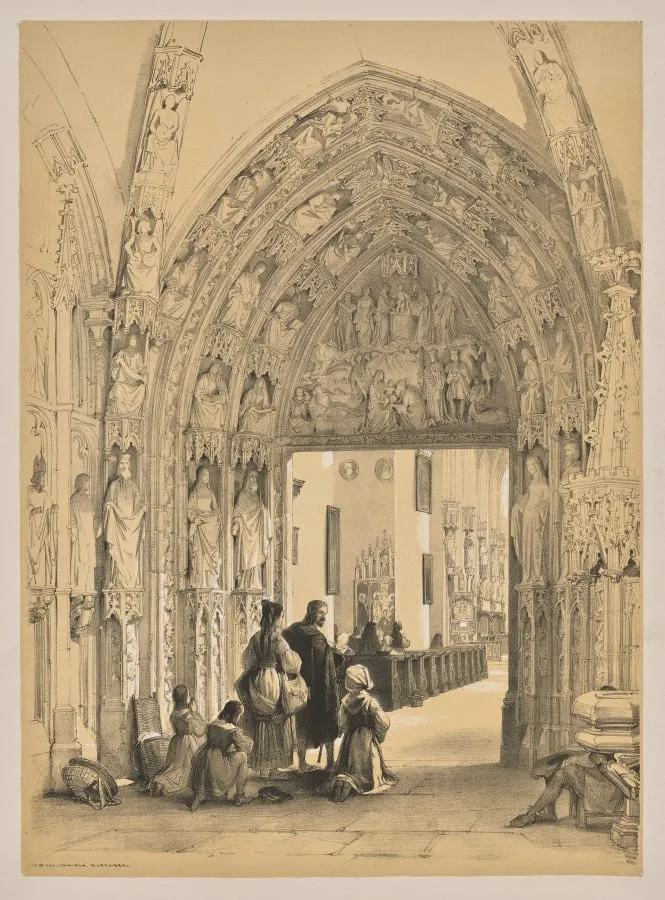
Sketches in Belgium and Germany, First Series, Porch of Frauenkirch, Nuremberg is a print by the Romanticist artist Louis Haghe. It dates from 1845 and is held in the collection of the Cleveland Museum of Art.
About this work
Overview
Created in 1845 by Louis Haghe, this lithograph is part of a series documenting architectural sites in Belgium and Germany.
Created in 1845 by Louis Haghe, this lithograph is part of a series documenting architectural sites in Belgium and Germany. Haghe, originally from Belgium and later based in England, was known for his precise topographical prints. The work captures the entrance porch of the Frauenkirche in Nuremberg, emphasizing its ornate stonework. Produced through lithography, the print reflects Haghe’s technical skill and his focus on architectural accuracy, aligning with mid-19th-century interest in documenting historic structures.
Subject & Meaning
The image centers on the sculpted portal of the Frauenkirche, where rows of carved saints, biblical scenes, and decorative motifs fill the arches and columns. A few figures stand quietly in the doorway, their small scale contrasting with the overwhelming richness of the stonework. The composition suggests reverence for the building’s religious and artistic heritage, presenting the architecture not merely as a structure but as a layered narrative space shaped by centuries of devotion and craftsmanship.
Technique & Style
Haghe employed lithography to render fine linear detail and subtle tonal gradations, capturing the depth of carved stone through careful shading. The interplay of light and shadow, entering through the open portal, enhances the three-dimensionality of the figures. The precision of the carving—each face, drapery fold, and floral element—is rendered with meticulous attention, reflecting both the artist’s training in watercolor and his mastery of lithographic processes developed during his time at Day & Haghe.
History & Provenance
The print was produced as part of Haghe’s First Series of Sketches, published in 1845, during a period of growing European interest in medieval architecture. It entered the collection of The Cleveland Museum of Art through documented acquisition, likely as part of a broader effort to preserve and display European graphic arts. Haghe’s prints were widely circulated among collectors and institutions, contributing to the dissemination of architectural documentation in the pre-photographic era.
Context
In the 1840s, artists and antiquarians across Europe were systematically recording medieval buildings threatened by industrialization and neglect. Haghe’s work aligns with this movement, echoing the scholarly pursuits of the Gothic Revival. His focus on Nuremberg’s Frauenkirche reflects a broader fascination with Germanic ecclesiastical art, which was being reevaluated as culturally significant rather than merely outdated. The print serves as both artistic record and cultural artifact of this historical moment.
Legacy
Haghe’s lithographs, including this one, remain valuable references for architectural historians studying late medieval German sculpture. His technique influenced later topographical printmakers and helped establish lithography as a legitimate medium for documentary art. While not widely exhibited today, the work endures in institutional collections as a quiet testament to the precision and dedication of 19th-century visual documentation.
Artist & collection
Artist
Louis Haghe (17 March 1806 – 9 March 1885) was a lithographer and watercolourist from the Netherlands and then the United Kingdom.

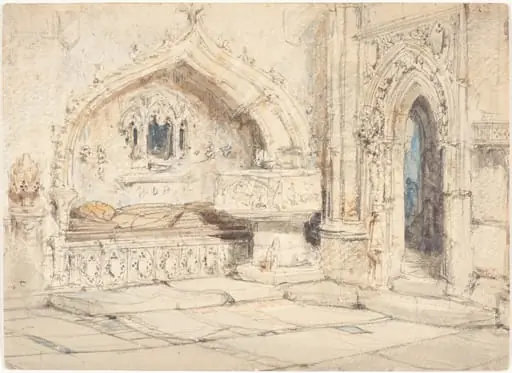 Interior of a Church with a Wall Tomb and Medieval Font
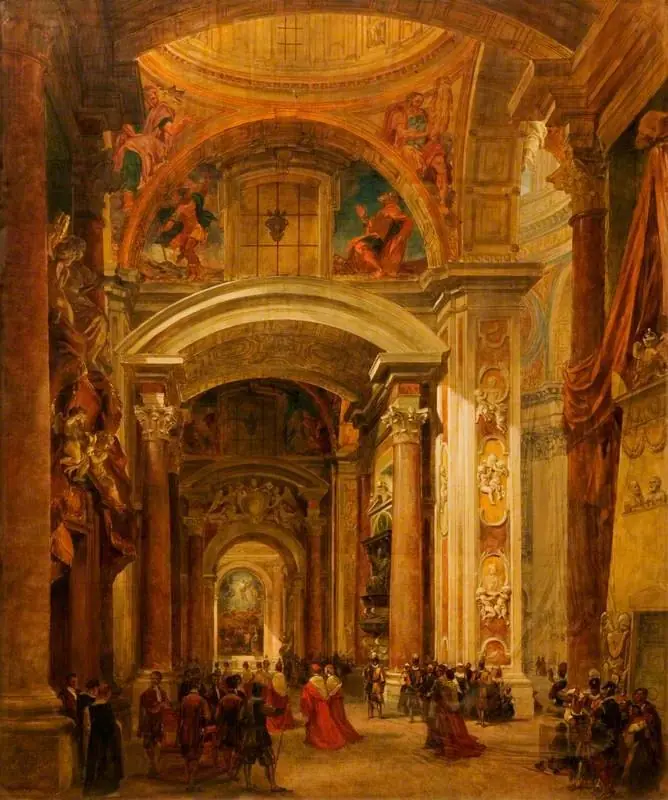 Interior of St Peter's, Rome
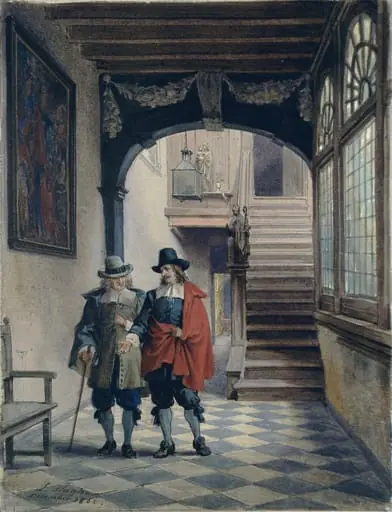 The Corridor, Brewer's Hall, Antwerp
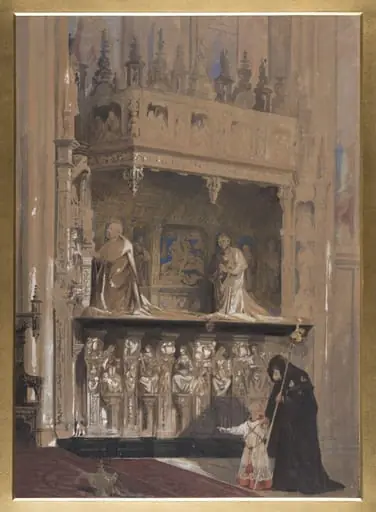 Monument of the Cardinald D'Amboise in Rouen Cathedral
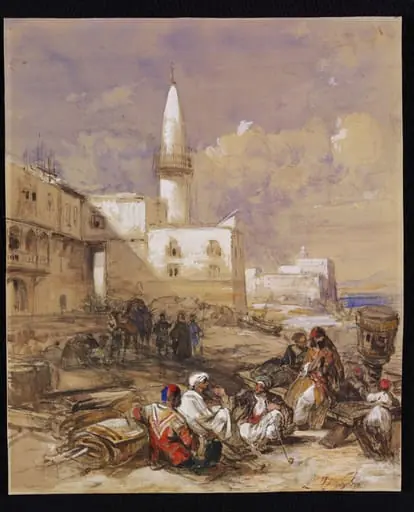 The Quay at Suez
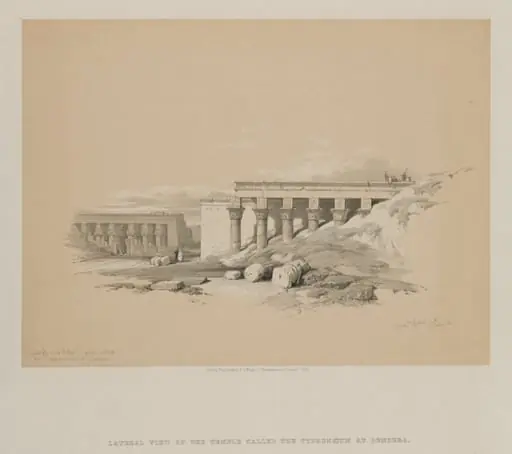 Egypt and Nubia, Volume II: Lateral View of the Temple called The Typhonoeum at Dendera
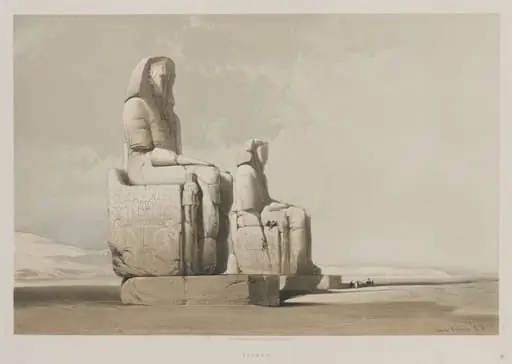 Egypt and Nubia, Volume I: Thebes
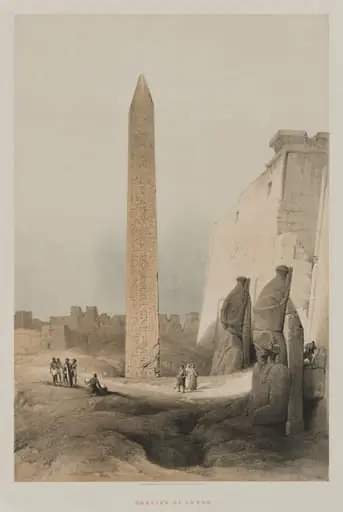 Egypt and Nubia, Volume I: Luxor
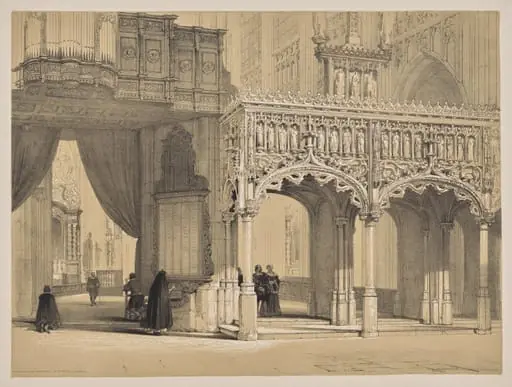 Sketches in Belgium and Germany, First Series, Screen in the Cathedral of St. Peter, Louvain
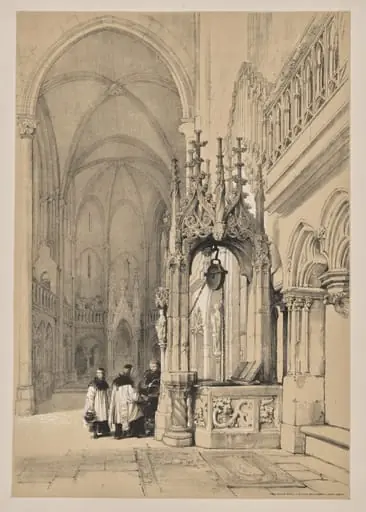 Sketches in Belgium and Germany, First Series, The Holy Well in the Cathedral of Ratisbon
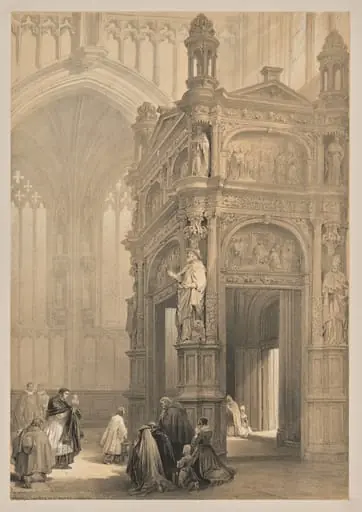 Sketches in Belgium and Germany, Second Series: No. 20 - Portail, Church of St. Peter, Louvain
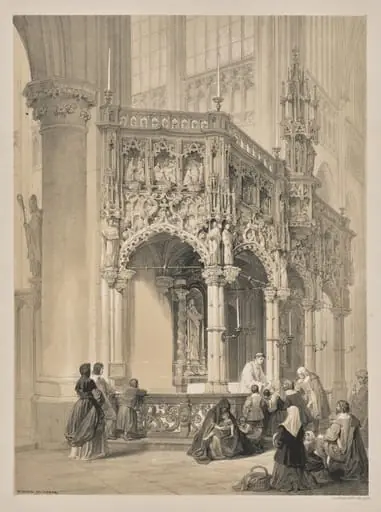 Sketches in Belgium and Germany, Second Series: No. 17 - Screens at Lierre
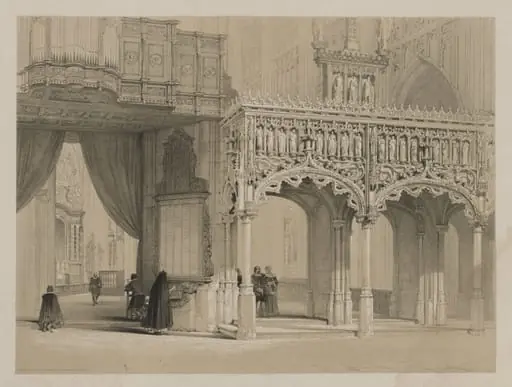 Sketches in Belgium and Germany, Volume I: Screen in the Cathedral of St. Peter, Louvain
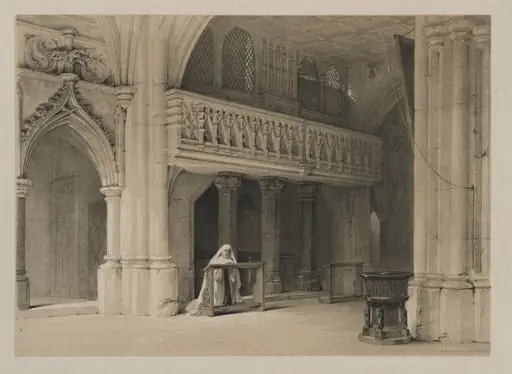 Sketches in Belgium and Germany, Volume I: Nönnberg Convent, Salzburg
 Sketches in Belgium and Germany, Second Series: No. 1 - Title Page - St. Jacques, Liege
 Facisimilies of Sketches made in Flanders and Germany: Thein Church, Prague
 Sketches in Belgium and Germany, First Series, Tomb of Maximilian 1st, Innsbruck