Artwork
The Kiss of Judas
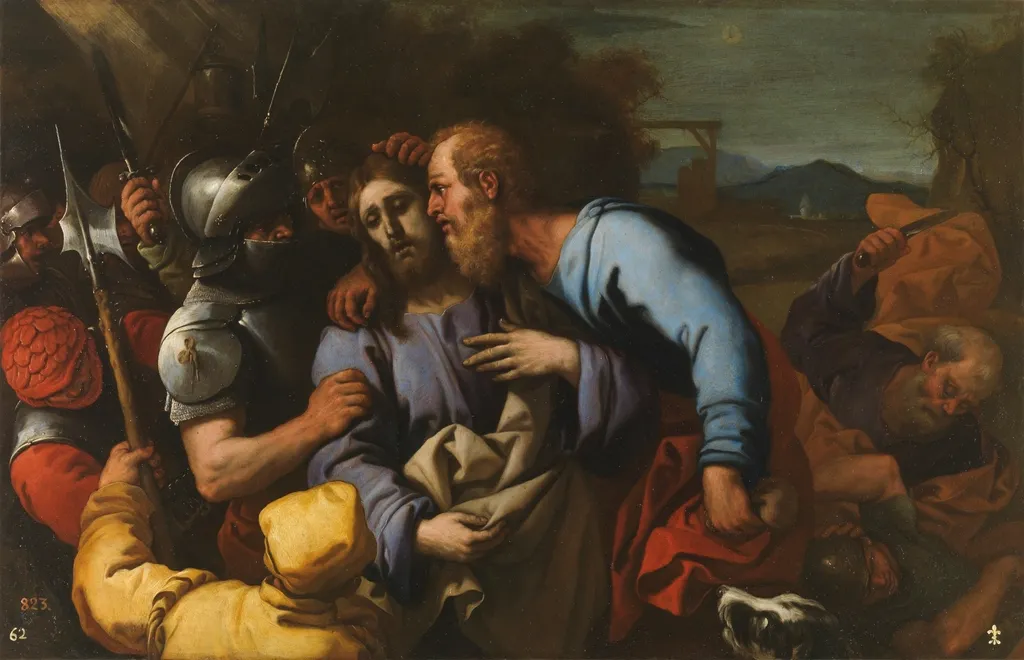
The Kiss of Judas is an oil painting by the Early Baroque Italian artist Luca Giordano. It dates from 1655 and is held in the collection of the Museo del Prado.
About this work
Overview
Created in 1655 by the Neapolitan painter Luca Giordano, The Kiss of Judas is executed on a copper support and now belongs to the collection of the Museo del Prado. The work captures the moment of betrayal in the Garden of Gethsemane, focusing on the intimate yet treacherous kiss that signals Jesus’ arrest.
Subject & Meaning
The central figures are a man in a blue robe, identified as Jesus, and a man in a red robe, representing Judas Iscariot, whose kiss seals the apostle’s betrayal. Adjacent to them stand a soldier in armor with a spear and a shadowy figure suggested to hold a knife, emphasizing the imminent violence of the scene.
Technique & Style
Giordano employs the luminous qualities of copper to achieve a rich, deep chiaroscuro, allowing stark contrasts between illuminated faces and a tenebrous background. The painter’s handling of light creates a three‑dimensional effect, while the vivid reds and blues of the garments draw the eye to the narrative focal point.
History & Provenance
The painting entered the Prado’s holdings during the 19th‑century reorganization of the Spanish royal collections, where it has remained on public display. Its copper medium, less common than canvas at the time, reflects a period when the artist experimented with durable supports for detailed figural work.
Context
The composition belongs to the Baroque tradition of dramatizing biblical episodes, echoing the Counter‑Reformation’s emphasis on emotional engagement. Giordano’s depiction aligns with contemporary depictions of the Passion, yet his use of a compact copper surface offers a distinctive, intimate scale compared with larger altar pieces.
Own this work as a print
Artist & collection

Artist
Luca Giordano was an Italian late-Baroque painter and printmaker in etching. Giordano was one of the most celebrated artists of the Neapolitan Baroque, whose vast output included altarpieces, mythological paintings and…