Artwork
Saint Anthony Abbot
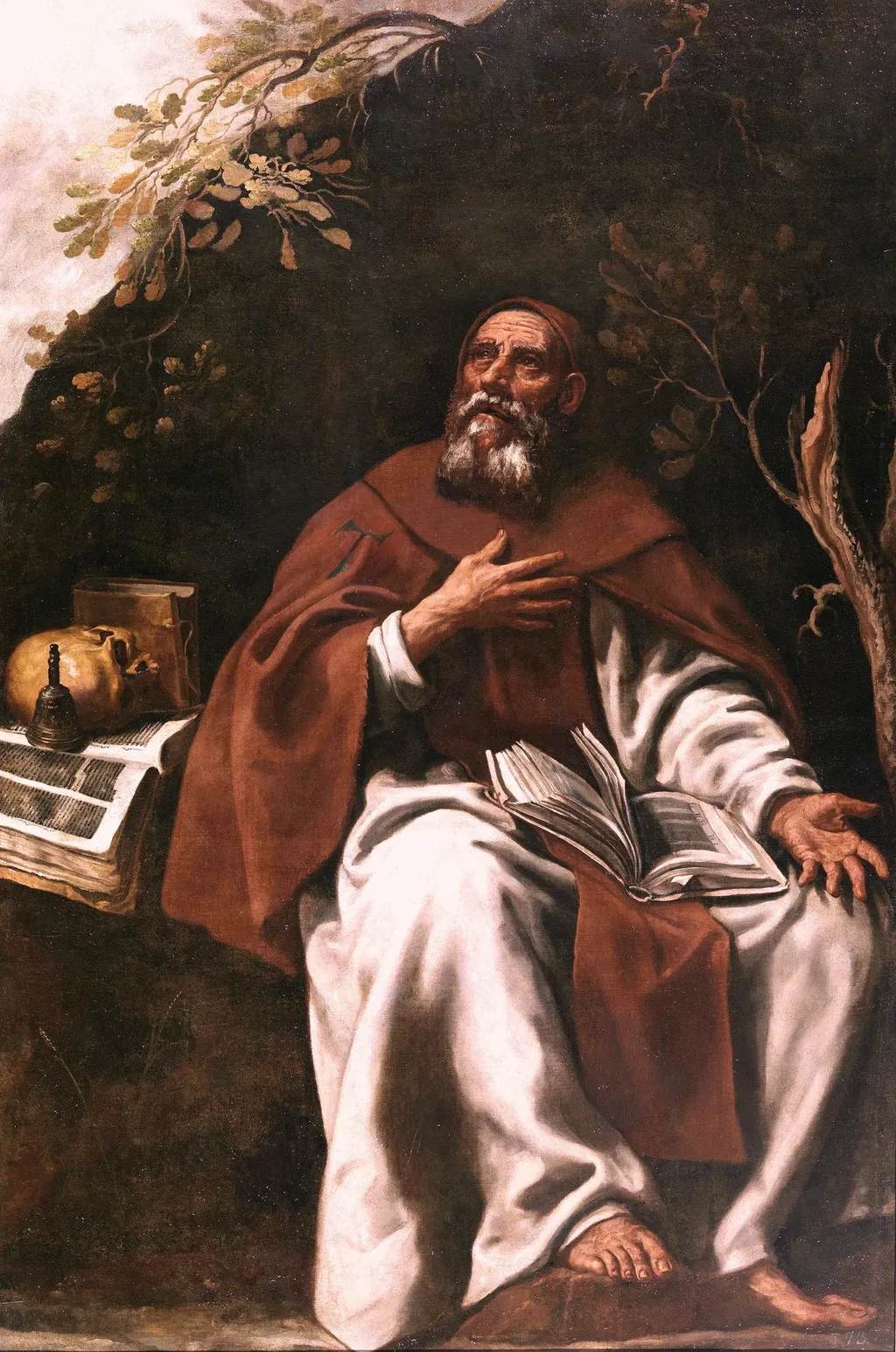
Saint Anthony Abbot is an oil painting by the Early Baroque Italian artist Luis Tristán. It dates from 1601 and is held in the collection of the Museo del Prado.
About this work
Overview
Luis Tristán’s *Saint Anthony Abbot* (1601) is an oil painting that exemplifies the early Baroque style emerging in Italy. Executed in Toledo, the work portrays the Egyptian hermit Anthony the Great, a figure venerated for his ascetic life, and is part of the Prado Museum’s collection.
Subject & Meaning
The composition centers on an elderly monk with a flowing white beard and disheveled hair, seated outdoors beneath a tree. He holds an open book, a symbol of his spiritual learning, while a second volume, a small brass bell, and a wooden cup rest nearby, alluding to the hermit’s austere routine and devotional practices.
Technique & Style
Tristán employs pronounced chiaroscuro, using deep shadows against a dark backdrop to render the saint’s face and hands with a sculptural quality. The contrast between the brown robe, the white undergarment, and the illuminated skin creates a vivid three‑dimensional effect characteristic of early Baroque naturalism.
History & Provenance
Created while Tristán was still rooted in the Mannerist tradition, the painting predates the full impact of Caravaggio’s naturalistic approach on Spanish art. It later entered the collection of the Museo del Prado, where it remains on public display.
Context
Tristán worked primarily in Toledo during a period of stylistic transition, when Spanish painters began to absorb Italian Baroque influences. *Saint Anthony Abbot* reflects this shift, blending Mannerist elegance with emerging Baroque realism, and illustrates the broader religious iconography prevalent in early 17th‑century Spain.
Own this work as a print
Artist & collection
Artist
Luis Tristán de Escamilla, also known as Luis de Escamilla or Luis Rodríguez Tristán (c.1585, Toledo - 1624, Toledo), was a Spanish painter in the mannerist style.