Artwork
The Crucifixion
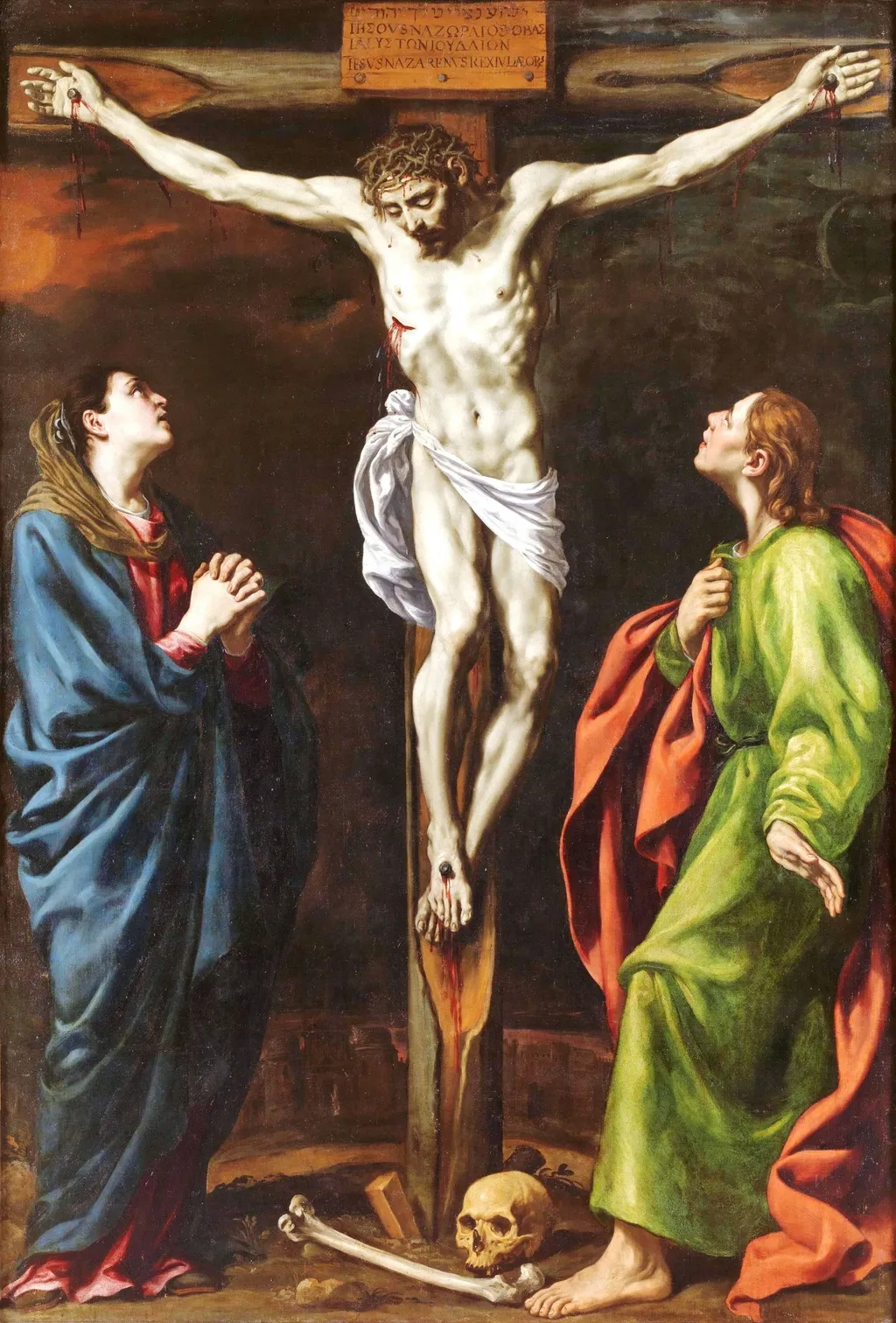
The Crucifixion is an oil painting by the Early Baroque Italian artist Luis Tristán. It dates from 1613 and is held in the collection of the Museo del Prado.
About this work
Overview
Luis Tristán’s *The Crucifixion* (1613) is an oil on canvas that presents the biblical episode of Christ’s death on the cross. Central to the composition is the nailed figure of Jesus, flanked by two mournful witnesses—identified as John the Evangelist and the Virgin Mary—set against a stark, shadowed landscape.
Subject & Meaning
The work captures the moment of Christ’s crucifixion, emphasizing his physical suffering through the pale flesh, crown of thorns, and the wound at his side. The accompanying figures express contrasting emotions: the Virgin’s clasped hands convey sorrow, while John’s upward gaze suggests concern and devotion, underscoring themes of sacrifice and redemption.
Technique & Style
Tristán employs a dramatic chiaroscuro, juxtaposing deep shadows with illuminated forms to heighten the scene’s intensity. The composition reflects early Baroque influences while retaining Mannerist elongation inherited from his mentor El Greco, evident in the elongated limbs and heightened emotional expression.
History & Provenance
Born in Toledo around 1585, Tristán trained under El Greco before developing his own style. *The Crucifixion* entered the Museo del Prado’s collection, where it remains on display, offering insight into the transitional period between Spanish Mannerism and the emerging Baroque aesthetic.
Own this work as a print
Artist & collection
Artist
Luis Tristán de Escamilla, also known as Luis de Escamilla or Luis Rodríguez Tristán (c.1585, Toledo - 1624, Toledo), was a Spanish painter in the mannerist style.