Artwork
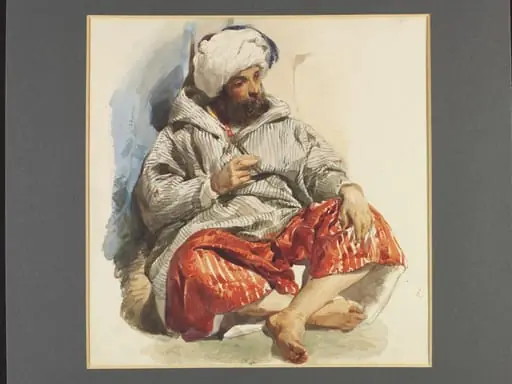
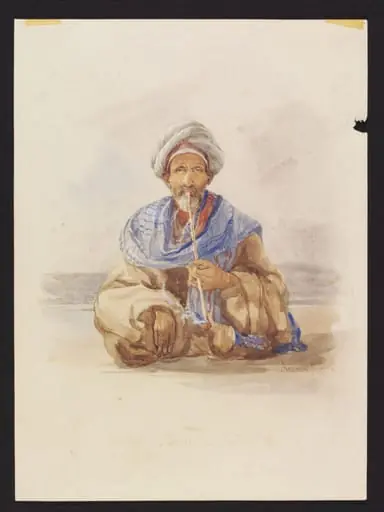
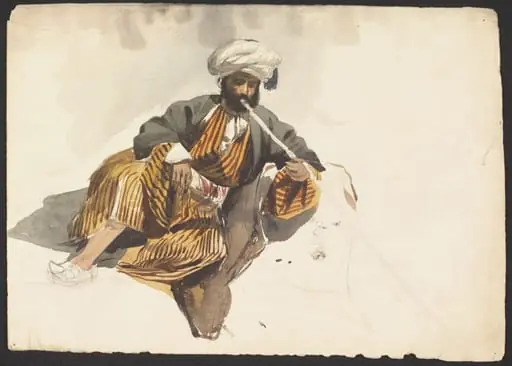
Blind Egyptian with a Madrab [Teasel]
![Blind Egyptian with a Madrab [Teasel], by Egron Sillif Lundgren, watercolor, 1862](https://artifactworldgallery.com/img/egron-sillif-lundgren--blind-egyptian-with-a-madrab-teasel--05374d5103b0d694-w1024.webp)
Blind Egyptian with a Madrab [Teasel] is a watercolor work on paper by the Impressionist artist Egron Sillif Lundgren. It dates from 1862 and is held in the collection of the Victoria and Albert Museum.
About this work
This watercolor shows a blind Egyptian man sitting alone. He holds a madrab, used to clean wool before spinning. Egron Lundgren painted it around 1862.
Other men chat nearby, making the blind man’s quiet focus stand out. Lundgren traveled often, including trips to Egypt in 1861-62. He used these experiences in many later watercolors.
Look up the Victoria and Albert Museum.
Overview
Painted around 1862, this watercolour by Swedish artist Egron Lundgren depicts a blind Egyptian man seated with a madrab, a tool used to prepare fibres for spinning. Executed in delicate washes, the work captures a quiet moment of labor amid a bustling environment. Lundgren created it following his travels in Egypt, drawing on firsthand observation rather than romanticized stereotypes.
Subject & Meaning
The central figure, blind and absorbed in his task, embodies quiet resilience. Around him, other men engage in conversation, their animated presence underscoring his solitude. The contrast between communal noise and individual stillness suggests a meditation on perception, labor, and isolation—without overt sentimentality or moralizing.
Technique & Style
Lundgren employed transparent watercolour washes to render texture and light with subtlety. The man’s clothing and the madrab are defined by soft, controlled strokes, while the background figures are rendered with looser, suggestive brushwork. This technique directs focus to the central figure while preserving atmospheric depth and spatial ambiguity.
History & Provenance
Lundgren painted this during or shortly after his 1861–62 journey to Egypt, a trip that deeply influenced his later work.
Lundgren painted this during or shortly after his 1861–62 journey to Egypt, a trip that deeply influenced his later work. He exhibited frequently at London’s Old Water-Colour Society between 1862 and 1875, where this piece likely appeared. The painting entered the Victoria and Albert Museum’s collection through documented acquisition, reflecting its recognition within British artistic circles of the period.
Context
Lundgren was part of a generation of European artists who traveled to North Africa and the Middle East, documenting local life with increasing attention to detail. Unlike many contemporaries, he avoided exoticizing his subjects. His focus on ordinary laborers, rendered with dignity, aligns with broader 19th-century shifts toward ethnographic realism in visual culture.
Legacy
Though not widely known today, Lundgren’s watercolours contributed to a more grounded representation of Eastern societies in Victorian Britain. This work, among others, helped shift public perception from theatrical orientalism toward quieter, human-centered depictions of daily life in the regions he visited.
Own this work as a print
Artist & collection
Artist
Egron Lundgren painted everyday life in Egypt during the 1860s, using soft watercolours.