Artwork
Sosie
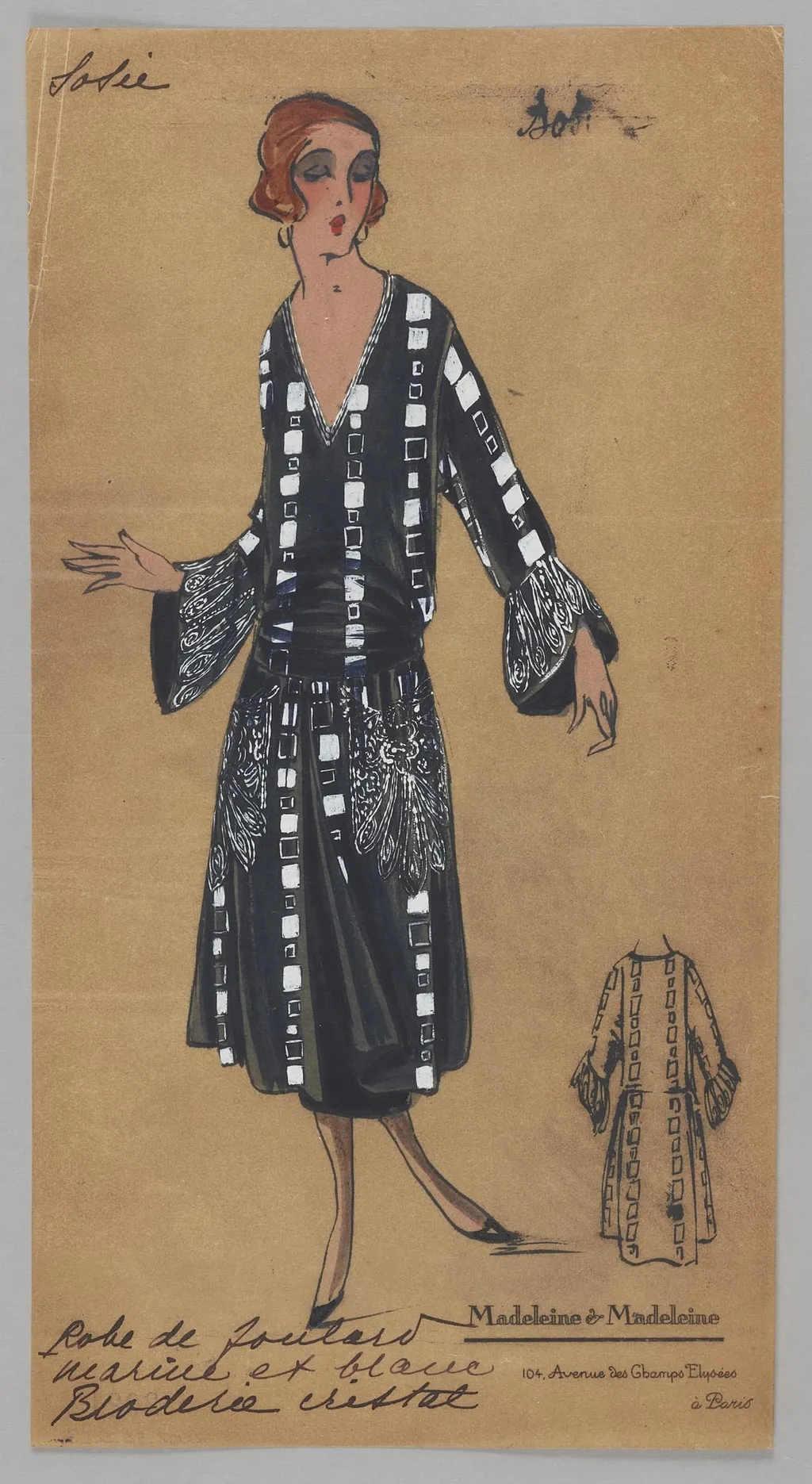
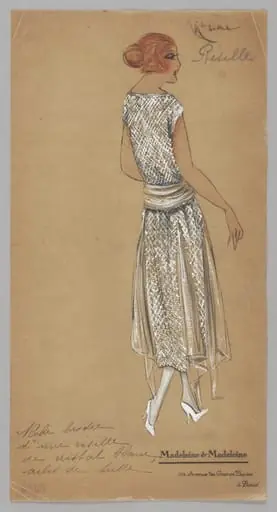
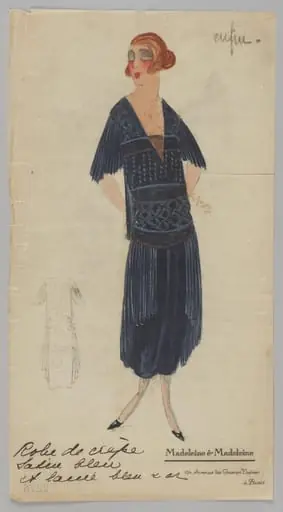
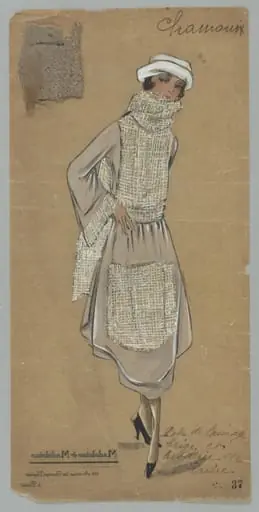
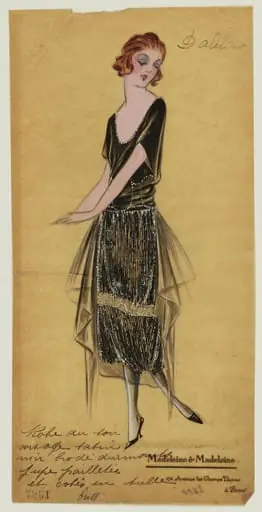
Sosie is a drawing by Madeleine & Madeleine. It dates from 1924 and is held in the collection of the Palais Galliera - Musée de la Mode de la Ville de Paris.
About this work
Overview
Created in 1924 by the design collective Madeleine & Madeleine, this work depicts a woman in a tailored black dress adorned with crystal embroidery.
Created in 1924 by the design collective Madeleine & Madeleine, this work depicts a woman in a tailored black dress adorned with crystal embroidery. Though labeled as a marine painting, the imagery is figurative and fashion-focused. The piece is held in the collection of the Museum of Ethnography, suggesting its significance as a cultural artifact of interwar design rather than a traditional landscape.
Subject & Meaning
The central figure, named 'Sosie,' wears a sleek black dress with a deep V-neck and long sleeves, styled with a short bob and headband—characteristic of 1920s modernity. Her outstretched arms suggest movement or gesture, possibly evoking performance or ritual. The title’s reference to crystal embroidery implies a fusion of elegance and craftsmanship, positioning the dress as both garment and symbolic object.
Technique & Style
The dress is rendered with precise geometric white patterns, interpreted as tiny stitched crystals. A secondary sketch on the right reveals the back detailing, emphasizing the embroidery’s structural role. The drawing’s clean lines and minimal shading reflect Art Deco sensibilities, prioritizing form and ornamentation over naturalism. The use of line and repetition suggests a designer’s study rather than a finished painting.
History & Provenance
The work entered the Museum of Ethnography’s collection as part of a broader effort to document early 20th-century fashion as cultural expression. Its attribution to Madeleine & Madeleine, a collaborative design studio active in Paris during the 1920s, aligns with their known focus on textile innovation. No earlier exhibition records are documented, but its preservation indicates early institutional recognition of fashion as art.
Context
Produced during a period when Parisian designers redefined women’s silhouettes, the piece reflects the era’s shift toward streamlined, androgynous forms. Crystal embroidery, once reserved for haute couture, was increasingly used to elevate everyday wear. The inclusion of technical sketches alongside the main figure reveals a design process rooted in both aesthetics and craftsmanship, mirroring broader trends in applied arts.
Legacy
This work contributes to the historical record of fashion as a medium of artistic expression, bridging textile design and visual art. Its preservation in an ethnographic museum underscores a growing scholarly interest in material culture during the interwar years. While not widely reproduced, it remains a reference point for studies on early modernist embroidery and gendered aesthetics in design.
Artist & collection
Artist
These artists left a small but striking set of 1924 drawings and designs that mix fashion and line.
Museum
Palais Galliera - Musée de la Mode de la Ville de Paris
Continue through works from the same source collection.
![Sans le v[illisible], by Madeleine & Madeleine](https://artifactworldgallery.com/img/madeleine-madeleine--sans-le-v-illisible--8212b979ada6b65a-w320.webp)