Artwork
At the Prado (Au Prado)
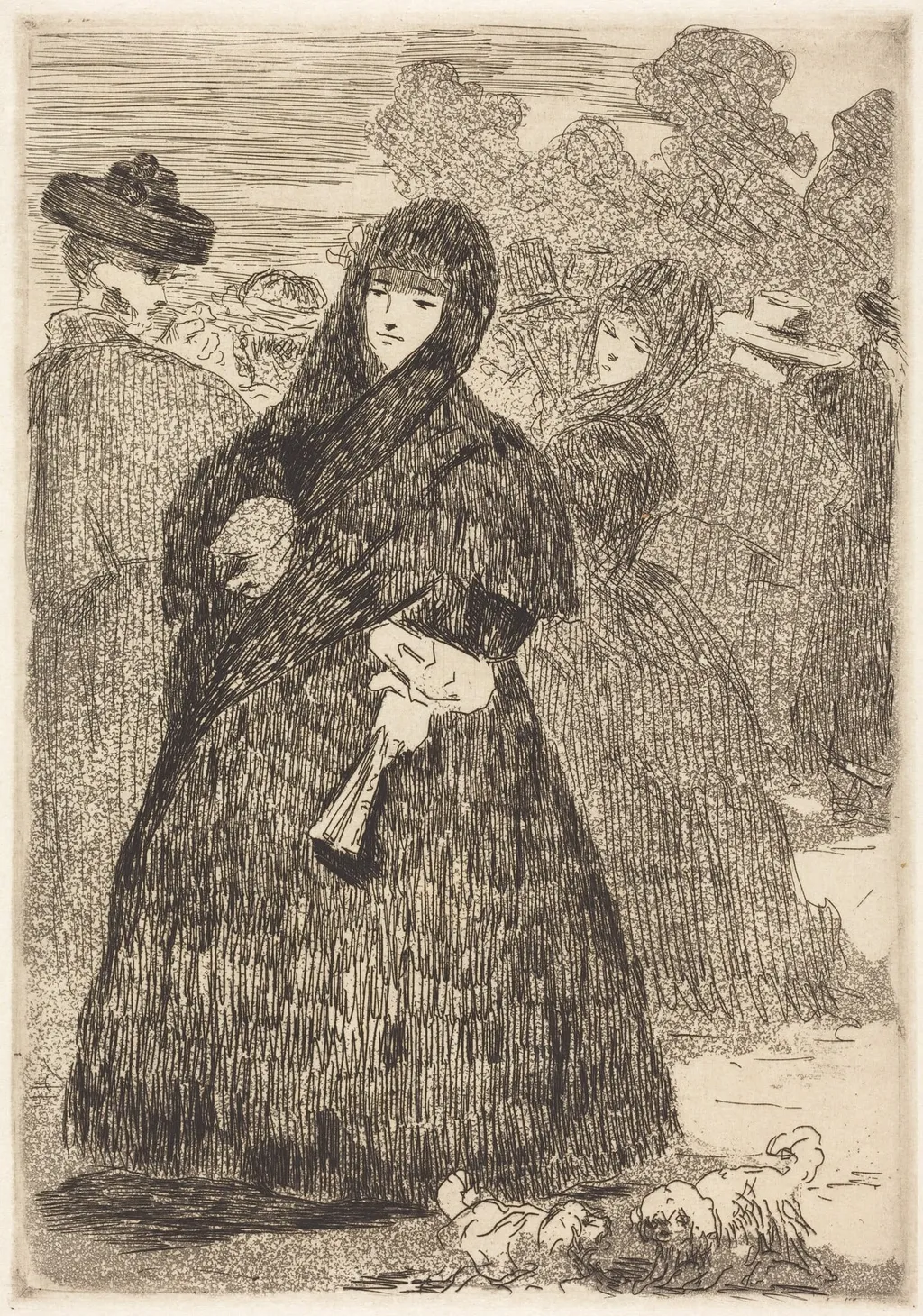
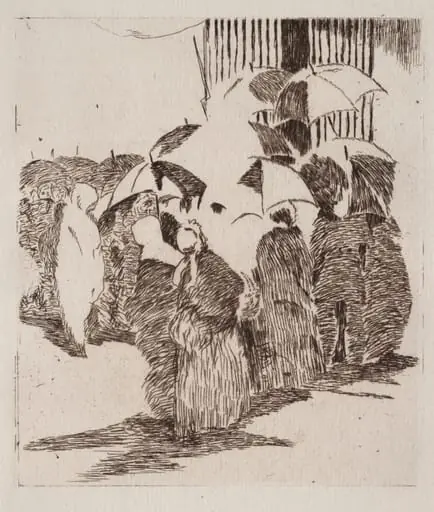
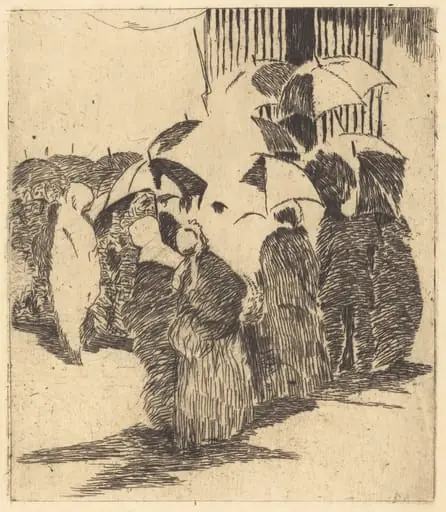
At the Prado (Au Prado) is an ink print by the Impressionist artist Edouard Manet. It dates from 1866 and is held in the collection of the National Gallery of Art.
About this work
Overview
Created in 1866, At the Prado (Au Prado) is a print by the French painter‑printmaker Edouard Manet. Executed as an etching combined with aquatint, the work measures roughly a typical sheet size for the period and presents a single figure set against an indistinct park landscape. The composition captures a fleeting moment, characteristic of Manet’s interest in contemporary urban scenes.
Subject & Meaning
The image centers on a woman dressed in a long, flowing gown, her hand holding a fan and her expression solemn. She wears a modest headscarf, suggesting a respectable social status. Behind her, vague silhouettes of other figures and trees dissolve into a soft background, evoking the atmosphere of a public garden where individuals mingle yet remain anonymous.
Technique & Style
Manet employed a combination of traditional etching and aquatint to achieve both crisp linear detail and broad tonal washes. The lines are rendered with a loose, sketch‑like quality that conveys movement, particularly in the swirling folds of the dress. Aquatint areas create a muted, atmospheric haze in the distance, blurring the crowd and foliage into an impression of depth.
History & Provenance
The print was produced during a prolific phase of Manet’s printmaking, when he explored modern life through reproducible media. While the original plate’s whereabouts are not documented, surviving impressions have appeared in several 19th‑century collections and are now held by major institutions, reflecting the work’s continued relevance to studies of Manet’s graphic oeuvre.
Context
Manet’s interest in leisure spaces such as parks aligns with broader mid‑19th‑century artistic trends that documented the rise of public recreation in Paris. By focusing on a solitary figure amid a bustling yet indistinct crowd, the work comments on the tension between individual presence and collective anonymity in the rapidly modernizing city.
Artist & collection

Artist
Édouard Manet didn’t have much time to make his mark—he died at 51—but he used every year.