Artwork
The Barricade (La barricade)
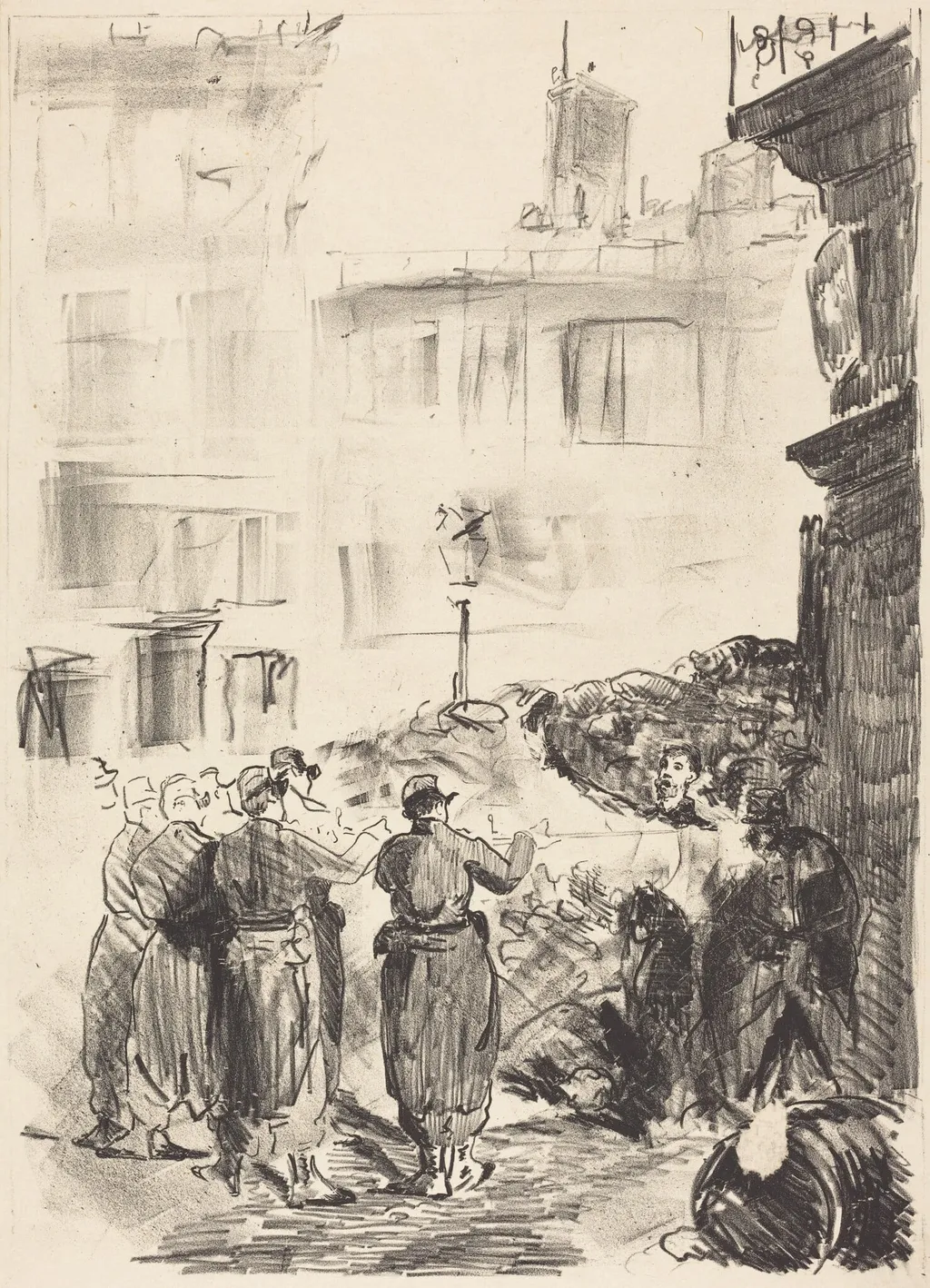
The Barricade (La barricade) is a crayon print by the Impressionist artist Edouard Manet. It dates from 1871 and is held in the collection of the Rosenwald Collection.
About this work
Look close: two soldiers aim at a fallen man whose coat glows white against dark cobblestones.
Manet’s lithograph shows a firing squad in front of a rough barricade.
This print was made fast, almost on the spot, after the bloody Paris week in May 1871.
The artist left scratch marks in the ink so the scene looks raw and urgent.
Look close: two soldiers aim at a fallen man whose coat glows white against dark cobblestones.
It’s not grand history painting—just a quick record of a brutal day.
The marks around the guns and bodies feel like shouts, not smooth lines.
Try the same scratchy style next in lithography.
Overview
Created in May 1871, The Barricade is a lithographic print by Édouard Manet, executed rapidly in the aftermath of the Paris Commune’s suppression. Made on chine collé with scraped ink, the work captures a moment of violence with minimal detail and heightened urgency. Unlike traditional historical compositions, it avoids grandeur, presenting instead a raw, immediate record of execution beneath a makeshift barrier.
Subject & Meaning
The scene shows a firing squad confronting a fallen figure, his white coat stark against dark stones. Two soldiers, barely defined, aim toward the body, while the barricade behind them suggests urban combat. There is no heroism or narrative resolution—only the quiet finality of state violence. The absence of context or emotion turns the image into a witness’s note, not a memorial.
Technique & Style
Manet employed crayon lithography with deliberate scraping to erase and rework the surface, creating jagged, urgent lines. The ink was partially removed to suggest motion and chaos, particularly around the guns and bodies. The chine collé support added texture, reinforcing the work’s tactile immediacy. The style rejects polish, favoring a sketch-like intensity that mirrors the haste of its making.
History & Provenance
Produced shortly after the Bloody Week in May 1871, the print was likely made from direct observation or eyewitness accounts. Only a few proofs exist, none widely distributed at the time. Manet did not exhibit it publicly, possibly due to its politically sensitive subject. Its survival as a rare impression underscores its role as a personal, uncommissioned response to trauma.
Context
The Paris Commune’s violent end saw hundreds executed by government forces in the streets. Manet, though not a revolutionary, was deeply affected by the bloodshed. His print stands apart from official imagery, refusing to glorify either side. It reflects a civilian’s view of repression—unvarnished, unmediated, and quietly defiant in its silence.
Legacy
The Barricade influenced later artists seeking to depict political violence without rhetoric. Its informal technique and emotional restraint prefigured modern reportage in print. Though little known in Manet’s lifetime, it is now recognized as a pivotal work in the shift from historical narrative to documentary immediacy in 19th-century printmaking.
Own this work as a print
Artist & collection

Artist
Édouard Manet didn’t have much time to make his mark—he died at 51—but he used every year.