Artwork
Peisaj marin
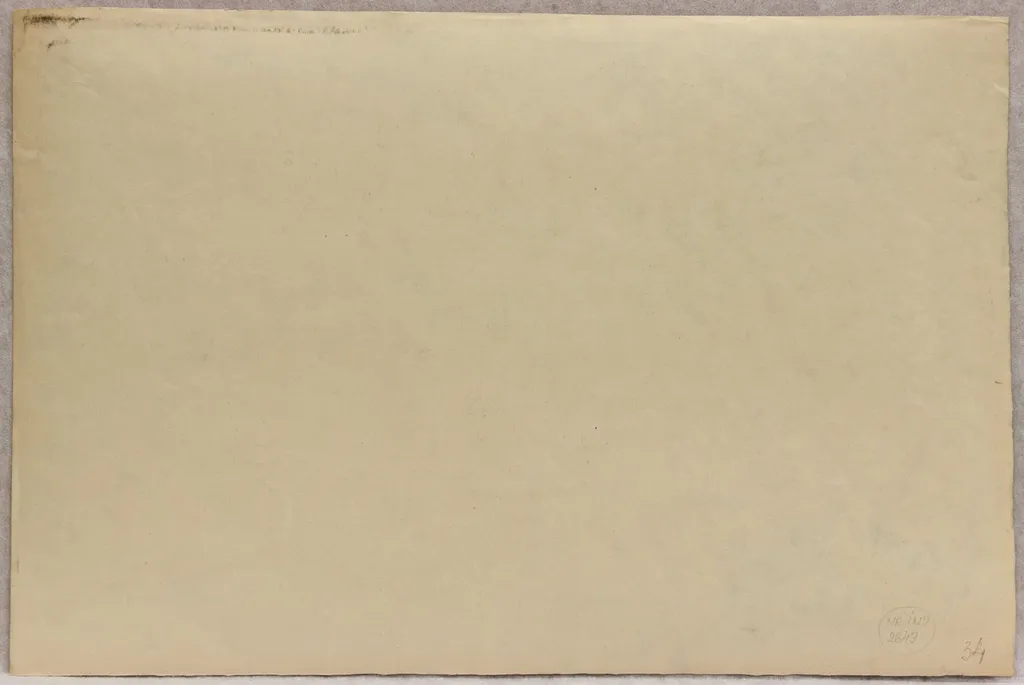
Peisaj marin is a print by Rodica Maniu. It dates from 1950 and is held in the collection of the Gavrila Simion Eco-Museum Research Institute Tulcea.
About this work
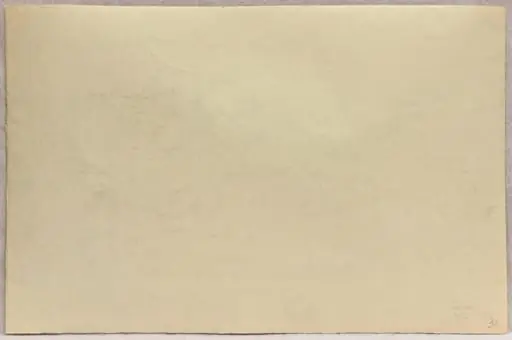
The paper has a smooth texture and appears to be slightly aged, with a few faint marks and creases visible.
The image shows a plain, off-white sheet of paper with a subtle yellowish tint. The paper has a smooth texture and appears to be slightly aged, with a few faint marks and creases visible.
In the bottom-right corner, a small, handwritten note reads "34" in pencil. The note is accompanied by a faint, circular stamp with the text "METRO 2619" inside it. The stamp is partially obscured by the note.
This artwork is held at the Museum of Ethnography.
Overview
Peisaj marin is a modest sheet of paper, dated around 1950, created by Romanian artist Rodica Maniu. It is part of the collection at the Museum of Ethnography. The surface bears minimal intervention: no painted forms or drawn figures, only the quiet presence of aged paper, subtly discolored and marked by time. A small pencil notation and a faint stamp in the lower right suggest cataloging practices rather than artistic embellishment.
Subject & Meaning
The work’s title, meaning 'marine landscape,' offers no visual correspondence. There are no seas, waves, or coastal elements depicted. Instead, the piece invites reflection on absence and suggestion—perhaps a conceptual gesture toward the unseen or the unrepresentable. Its minimalism may reflect an experimental approach to landscape as an idea rather than an image, aligning with postwar artistic inquiries into materiality and perception.
Technique & Style
Maniu employed no traditional artistic media—no ink, pigment, or brushwork. The work consists solely of a sheet of paper, its natural texture and aging process forming the visual content. The faint pencil mark and stamp are administrative, not compositional. The style resists conventional aesthetics, emphasizing the object’s physical state over intentional design, aligning with early conceptual or proto-Fluxus sensibilities.
History & Provenance
The piece entered the Museum of Ethnography’s collection in the mid-20th century, likely as part of a broader effort to document Romanian artistic practices beyond formal painting. The stamp 'METRO 2619' and the pencil number '34' indicate it was cataloged under a system used by the museum or a related institution. Its survival as a standalone object suggests it was preserved not for its imagery, but for its material or contextual significance.
Context
Created in postwar Romania, Peisaj marin emerges during a period of cultural constraint and artistic experimentation. While official art promoted socialist realism, some artists explored abstraction, materiality, and conceptual gestures in private or unofficial contexts. This work may reflect such quiet resistance—using the mundane as a medium to question the boundaries of art and documentation under a regime that prioritized narrative over nuance.
Legacy
Peisaj marin remains an understated artifact, rarely exhibited or discussed. Its value lies in its silence—offering a counterpoint to dominant narratives of artistic production. It has influenced later interpretations of Romanian modernism that prioritize ephemeral, non-object-based practices. As a relic of marginal experimentation, it contributes to a broader understanding of how art persisted in constrained environments through subtlety rather than spectacle.
Artist & collection
Museum
Gavrila Simion Eco-Museum Research Institute Tulcea
Continue through works from the same source collection.
 Port la Dunăre
 Țărancă pe drum
 S4 - Peisaj la Sulina (Ochi de apă cu bărci și case)
 S 14 - Omagiul meu Sulinei (Mal de Dunăre cu trandafir și bărci)
 În portul Tulcea
 Ma 1 - Peisaj la Măcin (Case, garduri și pomi)
 Peisaj câmpenesc cu gârlă
 Barcaze la fluviu
 S 9 - Peisaj la Sulina
 S5 - Peisaj la Sulina (Stradă cu pomi și casă)
 S 35 - Peisaj la Sulina (Maluri de Dunăre la răsărit)