Artwork
The Cassollette: Women Supporting an Urn
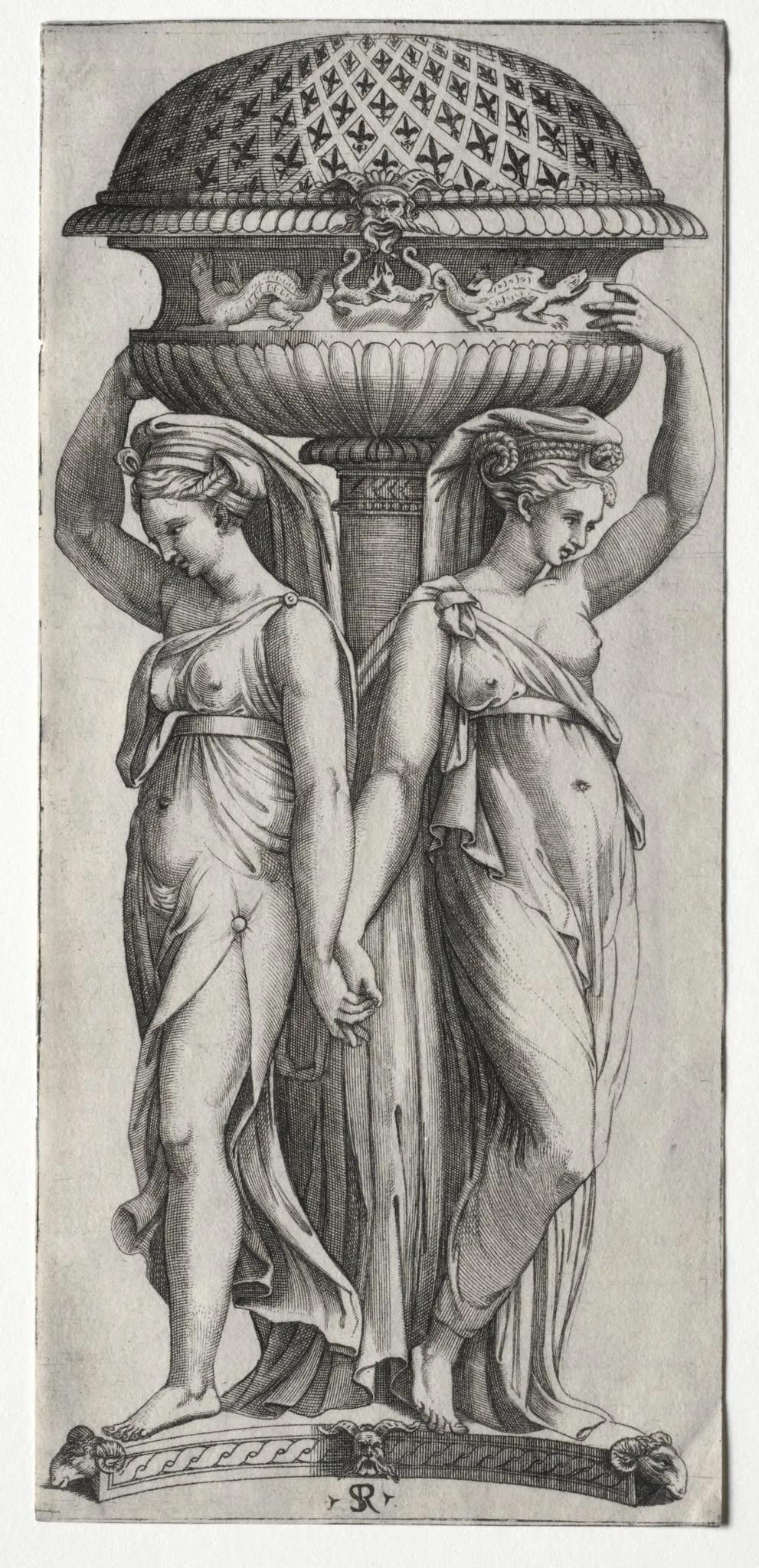
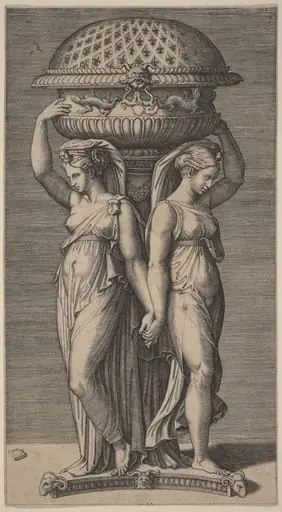
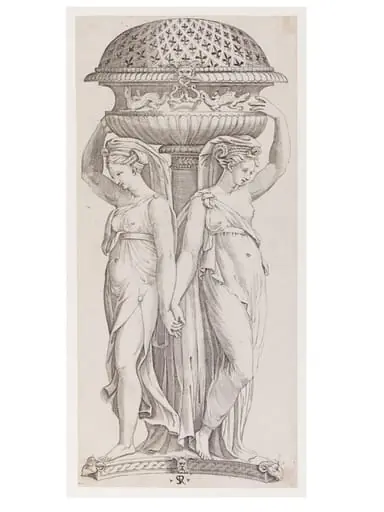
The Cassollette: Women Supporting an Urn is a print by the Renaissance artist Marco Dente. It dates from 1524 and is held in the collection of the Cleveland Museum of Art. This print depicts a pair of draped female figures, modeled after classical caryatids, each supporting an elaborate incense burner.
About this work
You can learn more about this style by looking at the work of artist: Marco Dente (Italian, c.
You see two draped female figures holding an ornamental incense burner.
They are decorated with lily-shaped fleurs-de-lis and salamanders.
The design was influenced by Greek architecture and created for a royal client.
The incense burner was designed by Raphael, a famous artist.
This design was made for King François I of France.
The salamanders on the vessel refer to the king.
You can learn more about this style by looking at the work of artist: Marco Dente (Italian, c. 1486–1527)
Overview
This print depicts a pair of draped female figures, modeled after classical caryatids, each supporting an elaborate incense burner. The vessel is adorned with lily‑shaped fleurs‑de‑lis on its lid and a series of salamanders along its sides, linking the composition to French royal symbolism.
Subject & Meaning
The caryatids function as architectural supports, echoing ancient Greek temple design, while the decorative elements on the burner reference the personal emblems of King François I. The fleurs‑de‑lis signify the French monarchy, and the salamanders—an animal the king adopted as his badge—suggest resilience, recalling the legend that salamanders can endure fire.
Technique & Style
Executed as a print, the image reproduces a design originally conceived by the Italian master Raphael around 1515–1520. The work translates Raphael’s drawing into a graphic format that could be circulated, allowing the royal aesthetic to reach a broader audience through the reproducible medium.
History & Provenance
The original incense burner design was commissioned by François I, who ruled France from 1515 to 1547, and was intended as a luxurious court object. The print served to disseminate the design, reinforcing the king’s taste for classical motifs and reinforcing his cultural prestige across Europe.
Context
During the early sixteenth century, French courts embraced the revival of classical architecture, integrating elements such as caryatids into decorative arts. Prints played a crucial role in spreading these ideas, especially when they bore royal insignia, thereby shaping contemporary decorative trends.
Artist & collection

Artist
Marco Dente da Ravenna (1493–1527), usually just called Marco Dente, was an Italian engraver born in Ravenna in the latter part of the 15th Century.