Artwork
Entellus and Dares
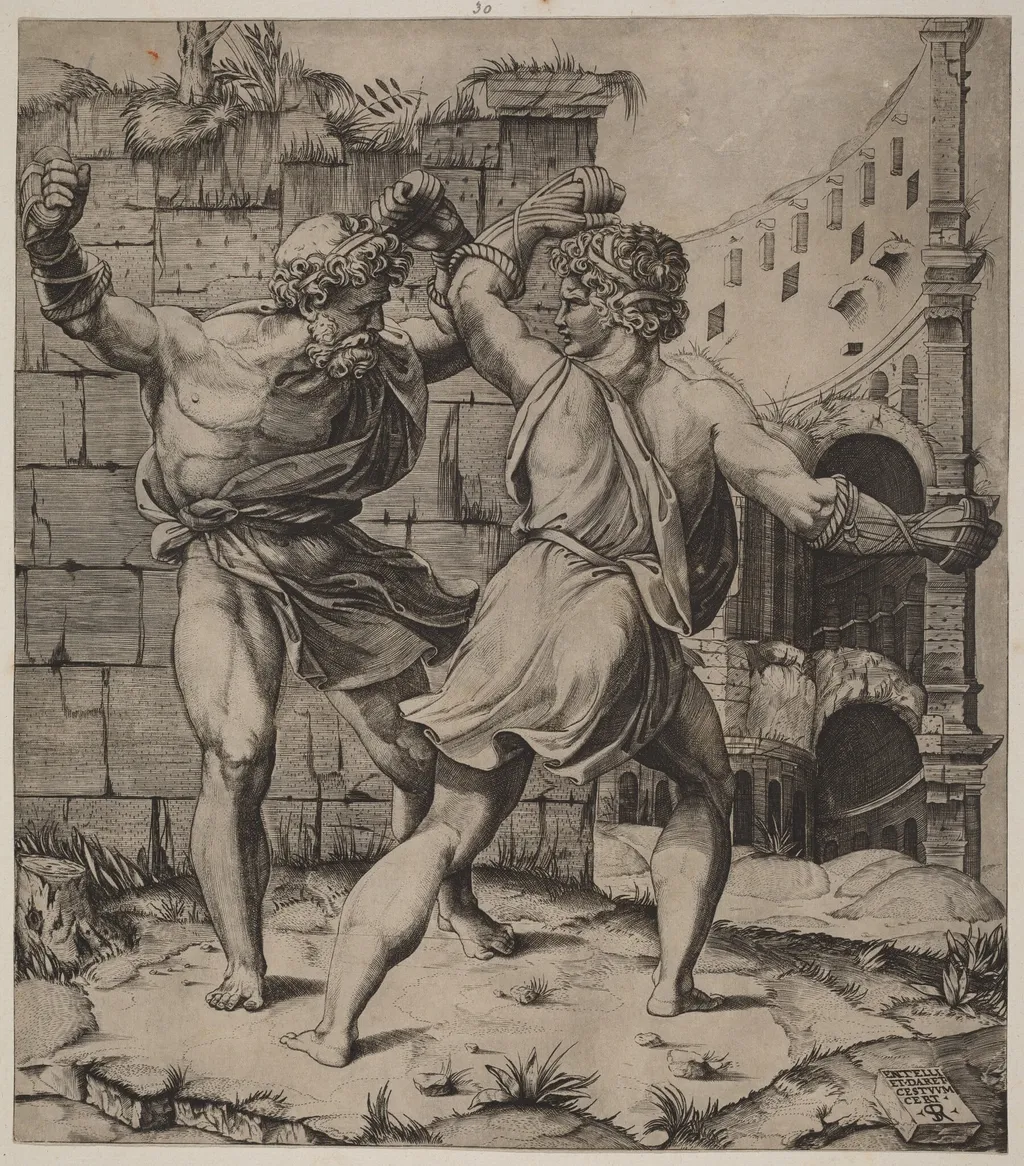
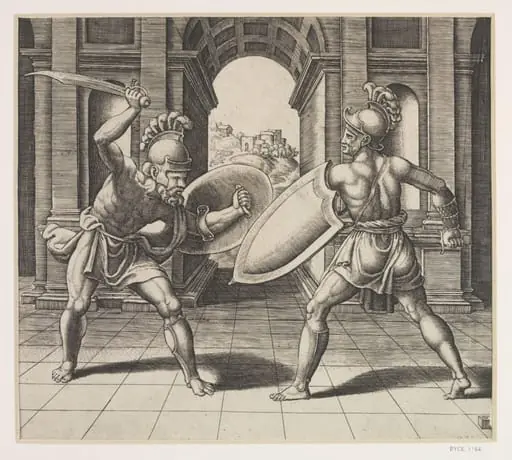
Entellus and Dares is an ink print by the Renaissance artist Marco Dente. It dates from 1524 and is held in the collection of the National Gallery of Art.
About this work
Overview
Executed on laid paper, it belongs to a body of work produced by artists who translated painted or sculpted compositions into printed form.
Marco Dente’s 1524 engraving *Entellus and Dares* is a reproductive print made in Rome during the early 16th century. Executed on laid paper, it belongs to a body of work produced by artists who translated painted or sculpted compositions into printed form. Dente, trained in Ravenna and active in Rome, specialized in reproducing classical themes for circulation among collectors and scholars, aligning with the practices of Marcantonio Raimondi’s workshop.
Subject & Meaning
The scene illustrates a contest between Entellus, a Sicilian warrior, and Dares, a Trojan boxer, as recounted in Virgil’s *Aeneid*. Their struggle, part of funeral games held for Anchises, symbolizes the clash of strength and fate. Dente captures the moment of physical tension, emphasizing the narrative’s classical roots without embellishment, reflecting Renaissance interest in reviving ancient literary motifs through visual art.
Technique & Style
Dente employed fine, controlled lines to model form and texture, characteristic of engraving on copper. The figures’ muscular anatomy and drapery are rendered with dense cross-hatching and parallel strokes, creating depth and volume. Facial expressions and fabric folds are meticulously defined, demonstrating the precision required to translate three-dimensional sculpture into two-dimensional print, a hallmark of Roman reproductive printmaking at the time.
History & Provenance
Created around 1524, the print was made during Dente’s most productive years in Rome, before his death in 1527 during the Sack of the city. As a reproductive engraver, he rarely originated compositions but adapted works by others, often following designs attributed to Raphael or his circle. Few of Dente’s prints survive in large numbers, and this one is among the more documented examples of his output.
Context
Dente worked within a network of printmakers who reproduced high art for broader audiences, a practice fueled by Renaissance humanism and the demand for classical imagery. His prints served as educational tools and status objects, circulating among intellectuals and patrons. The choice of a scene from the *Aeneid* reflects the period’s reverence for Virgil and the integration of mythological narratives into visual culture.
Legacy
Though Dente’s name faded after his early death, his prints contributed to the dissemination of classical themes across Europe. His technical discipline influenced later engravers, and his work remains a record of how Renaissance artists interpreted antiquity. *Entellus and Dares* exemplifies the role of reproductive prints in preserving and transmitting visual culture before the age of mechanical reproduction.
Artist & collection

Artist
Marco Dente da Ravenna (1493–1527), usually just called Marco Dente, was an Italian engraver born in Ravenna in the latter part of the 15th Century.

![The Medici Wrestlers, side view, turned to left [plate 36], by François Perrier](https://artifactworldgallery.com/img/francois-perrier--the-medici-wrestlers-side-view-turned-to-left-plate-36--c50b05437f8744ca-w320.webp)